Explainable XGBoost Prediction of Academic Impostor Phenomenon from Perfectionistic Concerns, Fear of Failure, and Self-Doubt
Keywords:
Academic impostor phenomenon, XGBoost, explainable artificial intelligence, SHAP, perfectionistic concerns, fear of failure, self-doubtAbstract
Objective: This study aimed to predict academic impostor phenomenon among Hungarian university students using an explainable XGBoost model based on perfectionistic concerns, fear of failure, and self-doubt.
Methods and Materials: This quantitative, cross-sectional predictive study was conducted among 468 university students enrolled in higher education institutions in Hungary. Data were collected using standardized self-report instruments measuring academic impostor phenomenon, perfectionistic concerns, fear of failure, and self-doubt. After preliminary data screening, descriptive statistics, reliability analysis, and Pearson correlation analysis were performed. The main predictive analysis was conducted using XGBoost regression, with academic impostor phenomenon entered as the continuous outcome variable and perfectionistic concerns, fear of failure, and self-doubt entered as predictors. Model performance was evaluated using root mean square error, mean absolute error, and coefficient of determination. SHAP analysis was applied to interpret the relative contribution of each predictor to the final model.
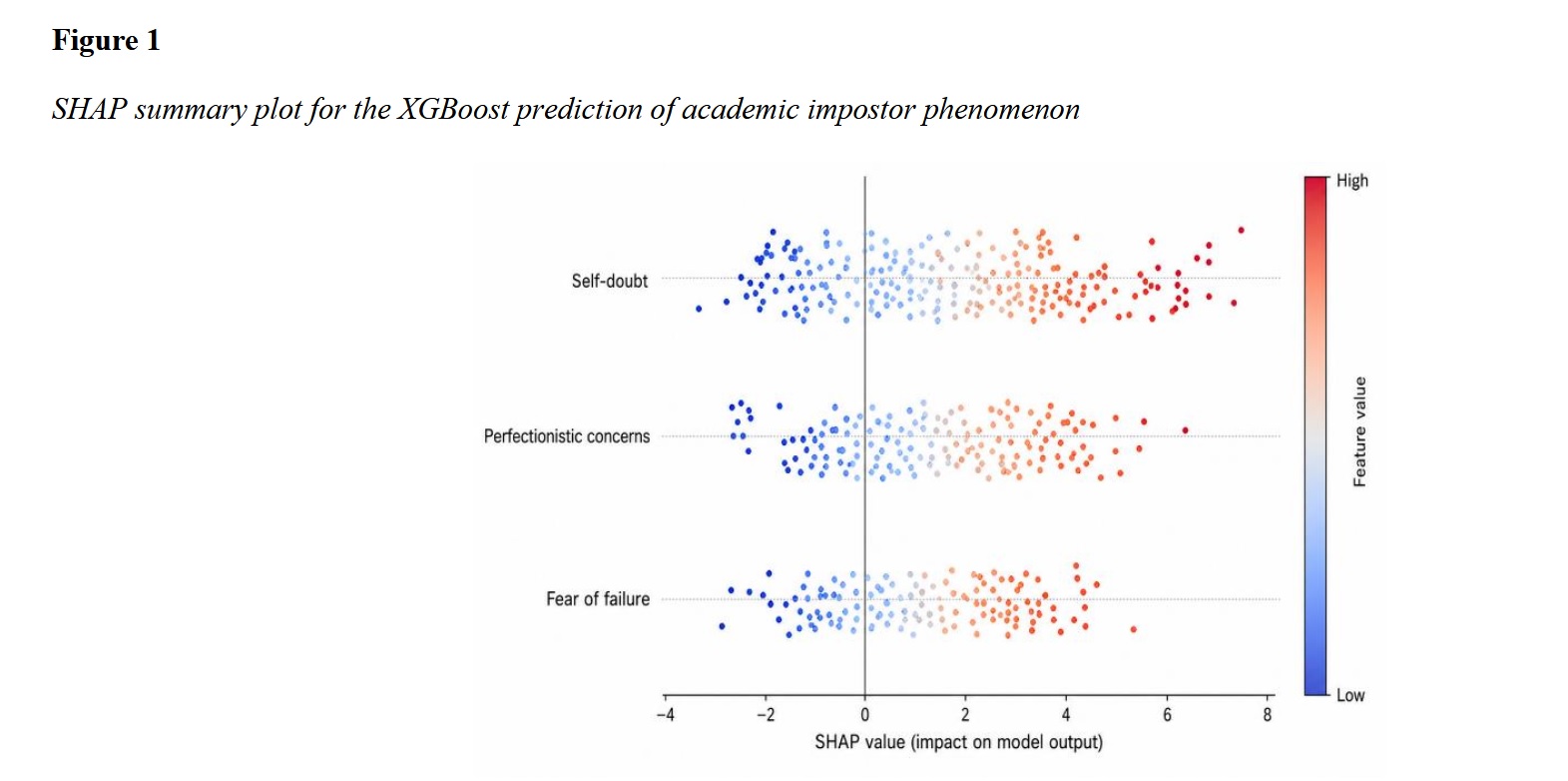
Findings: The correlation results showed significant positive associations between academic impostor phenomenon and self-doubt, r = .66, p < .001, perfectionistic concerns, r = .58, p < .001, and fear of failure, r = .54, p < .001. The XGBoost model demonstrated the strongest predictive performance compared with the baseline model, multiple linear regression, and random forest regression. The final XGBoost model obtained RMSE = 8.86, MAE = 6.91, and R² = .63, indicating that the model explained 63% of the variance in academic impostor phenomenon. SHAP-based interpretation showed that self-doubt was the most influential predictor, followed by perfectionistic concerns and fear of failure.
Conclusion: The findings indicate that academic impostor phenomenon can be predicted with considerable accuracy using an explainable XGBoost model. Self-doubt was the strongest predictor, suggesting that persistent uncertainty about academic competence is central to impostor-related experiences. Perfectionistic concerns and fear of failure also made meaningful predictive contributions, highlighting the importance of maladaptive achievement evaluation in students’ psychological vulnerability.
Downloads
References
AbuDujain, N. M., Almebki, R. A., Alghonaim, R. M., Aldkhyyal, M., Alshehri, N., Alomar, S., AlMujil, A. S., Almutairi, J. S., Altulihee, M. A., & Almigbal, T. H. (2025). The Relation Between Imposter Phenomenon and Self-Critical, Narcissistic, and Rigid Perfectionism: An Observational Study From a Women’s Medical College in Saudi Arabia. Healthcare, 13(24), 3311. https://doi.org/10.3390/healthcare13243311
Alderton, D. K., Boyd, L. D., Adams, J. L., & Vineyard, J. (2024). Associations Between Stress, Perfectionism, and Imposter Phenomenon Among Dental Hygiene Students. Journal of Dental Education, 88(12), 1616-1624. https://doi.org/10.1002/jdd.13669
Barari, N., Singh, T., Thakur, N., & Nayak, S. (2024). Imposter Syndrome: - A Threat to Mental Health. Eatp. https://doi.org/10.53555/kuey.v30i6.5400
Boghdady, M. E., & Ewalds‐Kvist, B. M. (2025). Surgeon’s Imposter Syndrome: A Systematic Review. Langenbeck S Archives of Surgery, 410(1). https://doi.org/10.1007/s00423-024-03582-8
Choi, J., & Lee, Y. E. (2025). Exploring the Impostor Phenomenon Among Korean Daycare Directors: A Grounded Theory Approach. Behavioral Sciences, 15(5), 565. https://doi.org/10.3390/bs15050565
Chua, S. M., Thummachai, M. E., Chew, Q. H., & Sim, K. (2025). Impostor Syndrome, Associated Factors and Impact on Well-Being Across Medical Undergraduates and Postgraduate Medical Professionals: A Scoping Review. BMJ open, 15(7), e097858. https://doi.org/10.1136/bmjopen-2024-097858
Easley, E., & Guske, S. (2022). Analysis of the Extent to Which Advanced Placement Students Experience the Imposter Phenomenon. Journal of Student Research, 11(4). https://doi.org/10.47611/jsrhs.v11i4.3657
Fleischhauer, M., Wossidlo, J., Michael, L., & Enge, S. (2021). The Impostor Phenomenon: Toward a Better Understanding of the Nomological Network and Gender Differences. Frontiers in psychology, 12. https://doi.org/10.3389/fpsyg.2021.764030
Flett, G. L., & Hewitt, P. L. (2022). Perfectionism and Problems in Learning, Performance, and Achievement. 173-199. https://doi.org/10.1037/0000289-009
Garba, R., Coleman, C., & Kelley, T. (2024). The Impostor Phenomenon and Mental Health. 61-79. https://doi.org/10.1037/0000397-004
Gaudreau, P., Schellenberg, B. J. I., Gareau, A., Kljajić, K., & Manoni-Millar, S. (2023). Because Excellencism Is More Than Good Enough: On the Need to Distinguish the Pursuit of Excellence From the Pursuit of Perfection. https://doi.org/10.31234/osf.io/tg3jr
Gilbert, A. (2024). Impostor Syndrome Among Ecuadorian Women in the Labour Market. Journal of Business and Entrepreneurial Studie, 9(4), 13-26. https://doi.org/10.37956/jbes.v9i4.377
Jang, M. S., Choi, D. J., & Jang, S. J. (2025). Factors Affecting Perfectionistic Self‐Presentation Among ICU Nurses, Focusing on Pride and Impostor Phenomenon. Nursing and Health Sciences, 27(4). https://doi.org/10.1111/nhs.70260
Jayne, A., Stoa, R., & Dik, B. J. (2025). Transcendent or Fraudulent: Investigating the Relationships Among Imposter Phenomenon, Perfectionism, and Calling. Journal of Career Development, 53(1), 81-101. https://doi.org/10.1177/08948453251396139
Joseph, B., Tseng, E. S., Zielinski, M. D., Ramirez, C. L., Lynde, J., Galey, K. M., Bhogadi, S. K., El‐Qawaqzeh, K., & Hosseinpour, H. (2023). Feeling Like an Imposter: Are Surgeons Holding Themselves Back? Trauma Surgery & Acute Care Open, 8(1), e001021. https://doi.org/10.1136/tsaco-2022-001021
Kananifar, N., & Garcia, D. (2026). Imposter Syndrome as Mediator and Moderator Between Personality and Mental Health in Malaysian Students. Scientific reports, 16(1). https://doi.org/10.1038/s41598-026-46843-w
Kanatova, R. (2023). Women Leaders: Overcoming Impostor Syndrome in Higher Education in Kazakhstan. Journal of Higher Education Theory and Practice, 23(14). https://doi.org/10.33423/jhetp.v23i14.6382
Khalil, A. I., Alharbi, R., Qtame, H. A., Bena, R. A., & Khan, M. A. (2024). Investigating the Association Between Resilience and Impostor Syndrome in Undergraduate Nursing and Medical Students: A Cross-Sectional Study. Journal of Medicine and Life, 17(9), 868-879. https://doi.org/10.25122/jml-2024-0160
Koshy, H. A., Wilson, P. P., Abraham, K. R., Sebastian, S. T., Jacob, F. G., Nair, N. B., & John, J. M. (2022). Imposter Phenomenon, Perfectionism and Fear of Failure Among Emerging Adults. International Journal of Research Publication and Reviews, 03(12), 2763-2766. https://doi.org/10.55248/gengpi.2022.31293
Kowalczyk-Kroenke, A. (2024). Does Success Really Hurt? Impostor Syndrome Among Managers of Polish Enterprises – Results of a – Preliminary Qualitative Study. Journal of Intercultural Management, 16(1), 76-98. https://doi.org/10.2478/joim-2024-0003
Liu, S., Wei, M., & Russell, D. W. (2023). Effects of a Brief Self-Compassion Intervention for College Students With Impostor Phenomenon. Journal of counseling psychology, 70(6), 711-724. https://doi.org/10.1037/cou0000703
McKay, J., Williams, K., & Stewart, J. (2023). You Just Want a Break From the Hatred of Failure: The Lived Experience of Being a Student Physiotherapist Perfectionist and Considerations for Educators. https://doi.org/10.21203/rs.3.rs-2952524/v1
Ménard, A. D., & Chittle, L. (2023). The Impostor Phenomenon in Post‐secondary Students: A Review of the Literature. Review of Education, 11(2). https://doi.org/10.1002/rev3.3399
Mohammed, A. A., & Al-Omar, A. A. (2025). Imposter Syndrome in Dentistry: Prevalence, Contributing Factors, and Educational Implications: A Narrative Review. Cureus. https://doi.org/10.7759/cureus.100384
Nashwa Ahmed Hussein Abdel, K. (2022). Correlation Between Perfectionism and Imposter Syndrome Among Nursing Educators at Zagazig University. Egyptian Journal of Health Care, 13(1), 1810-1824. https://doi.org/10.21608/ejhc.2022.246428
Pannhausen, S., Klug, K., & Rohrmann, S. (2020). Never Good Enough: The Relation Between the Impostor Phenomenon and Multidimensional Perfectionism. Current Psychology, 41(2), 888-901. https://doi.org/10.1007/s12144-020-00613-7
Sheveleva, M. S., Permyakova, T. M., & Kornienko, D. S. (2023). Perfectionism, the Impostor Phenomenon, Self-Esteem, and Personality Traits Among Russian College Students. Psychology in Russia State of Art, 16(3), 132-148. https://doi.org/10.11621/pir.2023.0310
Snyder, K. E., Bartley, M. I., & Fowler, A. (2024). Context-Dependent Social Comparison and Imposter Phenomenon: An Experimental Vignette Approach. Gifted Child Quarterly, 68(4), 264-278. https://doi.org/10.1177/00169862241265310
Tenhulzen, K. A., Claridge, A. M., Baker, K., & Carlson, K. (2023). There Is No “One Right Way”: Perfectionism, Imposterism, and Well-Being in Child Life Training and Practice. The Journal of Child Life Psychosocial Theory and Practice, 4(2). https://doi.org/10.55591/001c.88114
Thomas, M., & Bigatti, S. M. (2020). Perfectionism, Impostor Phenomenon, and Mental Health in Medicine: A Literature Review. International Journal of Medical Education, 11, 201-213. https://doi.org/10.5116/ijme.5f54.c8f8
Walker, D. L., & Saklofske, D. H. (2023). Development, Factor Structure, and Psychometric Validation of the Impostor Phenomenon Assessment: A Novel Assessment of Impostor Phenomenon. Assessment, 30(7), 2162-2183. https://doi.org/10.1177/10731911221141870
Wang, Y., & Li, W. (2023). The Impostor Phenomenon Among Doctoral Students: A Scoping Review. Frontiers in psychology, 14. https://doi.org/10.3389/fpsyg.2023.1233434
Wrench, A., Padilla, M., O’Malley, C., & Levy, A. (2024). Impostor Phenomenon: Prevalence Among 1st Year Medical Students and Strategies for Mitigation. Heliyon, 10(8), e29478. https://doi.org/10.1016/j.heliyon.2024.e29478
Young, V. (2024). An Evolving Analysis of Impostor Syndrome From 1983 to the Present: Implications for Clinicians and Researchers. 285-307. https://doi.org/10.1037/0000397-014
Zülfiqar, N., & Abbasi, T. A. A. (2024). Mediating Role of Test Anxiety in Association Between Imposter Phenomenon and Perfectionism Among High-Achieving Students. Journal of Advanced Academics, 35(4), 698-717. https://doi.org/10.1177/1932202x241281782