Comparison of Ego Strength, Aggression, and Fear of Loss in Three Groups with Anxiety Symptoms, Depression Symptoms, and Normal Individuals
DOI:
https://doi.org/10.61838/kman.jarac.3081Keywords:
Ego Strength, Aggression, Fear of Loss, DepressionAbstract
Objective: This study was conducted with the aim of comparing ego strength, aggression, and fear of loss among three groups: individuals with anxiety symptoms, individuals with depression symptoms, and normal individuals.
Methods and Materials: The research design was a causal-comparative method. The statistical population of this study included all women aged 20-40 years who referred to counseling centers in the province of Qom. The sample consisted of 105 women aged 20-40 years who referred to counseling centers in the province of Qom and were selected using convenience sampling. The instruments used in this study included the Beck Depression Inventory (second edition), the Beck Anxiety Inventory, the Ego Strength Psychological Questionnaire by Markstrom et al., the Fear of Loss Questionnaire by Przybylski, and the Buss-Perry Aggression Questionnaire. To analyze the findings, both univariate and multivariate analysis of variance (ANOVA) were used, and data analysis was conducted using SPSS.26 software.
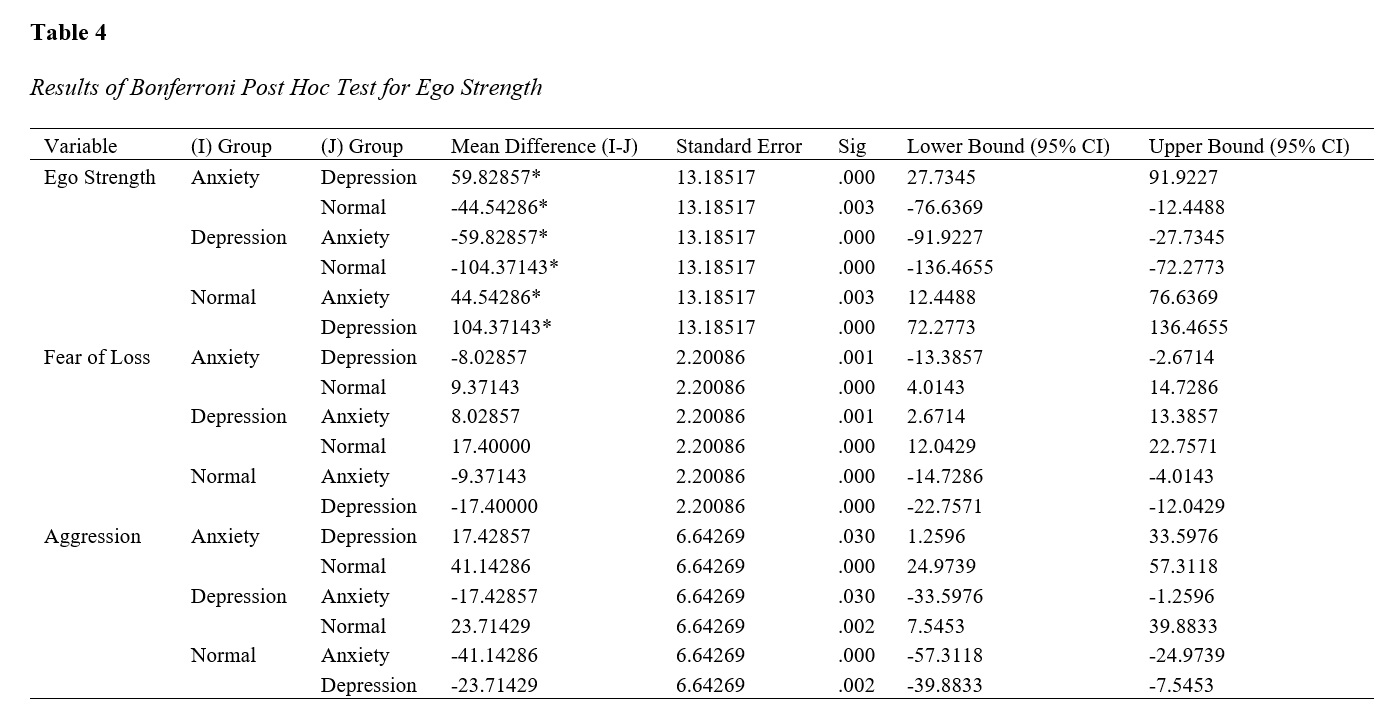
Findings: The results showed that the normal group had higher ego strength compared to the groups with depression and anxiety symptoms. The group with depression symptoms exhibited a higher fear of loss compared to the anxiety symptoms group and the normal group, and aggression was higher in the anxiety symptoms group compared to the depression symptoms group and the normal group (p < .01).
Conclusion: The study concludes that ego strength, aggression, and fear of loss significantly differ among individuals with anxiety symptoms, depression symptoms, and normal individuals. Higher ego strength was observed in the normal group, while the depression group exhibited greater fear of loss, and aggression was most pronounced in the anxiety group.
Downloads
References
Adavi, A., Fathi Marghmaleki, R., Madmoli, Y., & Madmoli, M. (2017). The Effectiveness of Group Cognitive-Behavioral Stress Management Interventions on Aggression in Women with Hypertension. https://core.ac.uk/download/pdf/143844865.pdf
Aldahadha Al-Khawaldeh, B., & Mohammed Al-Khawalde, M. A. (2023). The Predictive Power of Ego Identity with Situational Regret Among the Divorced Women in Tafila Governorate. Refereed Journal of Northern Europe Academy for Studies & Research (Denmark), 21. https://ebsco-openurl.publicaciones.saludcastillayleon.es/results?sid=ebsco:ocu:record&bquery=DE+%22DIVORCED%20women%22
Bahmani Nia, M., & Sohrabi Shegefti, N. (2024). Comparison of Ego Strength, Defense Mechanisms, and Object Relations in Individuals with Depression and Healthy Individuals. Clinical Psychology and Personality, 22(1), 126-145. https://cpap.shahed.ac.ir/article_4316.html?lang=en
Cheng, C. Y., & Wee, S. X. (2023). Kiasu (fear of losing out): An indigenous psychological construct in Singapore and its impact. International Perspectives in Psychology: Research, Practice, Consultation, 12(2), 65. https://doi.org/10.1027/2157-3891/a000066
Cunningham, S., Hudson, C. C., & Harkness, K. (2021). Social media and depression symptoms: a meta-analysis. Research on Child and Adolescent Psychopathology, 49(2), 241-253. https://doi.org/10.1007/s10802-020-00715-7
Daly, M., Sutin, A. R., & Robinson, E. (2021). Depression reported by US adults in 2017-2018 and March and April 2020. Journal of affective disorders, 278, 131-135. https://doi.org/10.1016/j.jad.2020.09.065
Falla, D., Dueñas-Casado, C., & Ortega-Ruiz, R. (2023). Unjustified aggression in early childhood education: A systematic, narrative and conceptual review of the current scientific literature. Aggression and Violent Behavior. https://doi.org/10.1016/j.avb.2023.101857
Hafer, A. (2020). The Power of Sight: A Reexamination of Guercino and Poussin's Et in Arcadia Ego Paintings In Light of Early Modern Vision Theory https://etd.library.emory.edu/concern/etds/1c18dg89c
Harsanyi, S., Kupcova, I., Danisovic, L., & Klein, M. (2022). Selected biomarkers of depression: what are the effects of cytokines and inflammation? International Journal of Molecular Sciences, 24(1), 578. https://doi.org/10.3390/ijms24010578
Hull, L., Levy, L., Lai, M. C., Petrides, K. V., Baron-Cohen, S., Allison, C., & Mandy, W. (2021). Is social camouflaging associated with anxiety and depression in autistic adults? Molecular Autism, 12, 1-13. https://doi.org/10.1186/s13229-021-00421-1
Karami Boldaghi, R., & Daryazadeh, s. (2018). Predicting the elderly couple's decision-making styles based on adult attachment styles in Qeshm City [Research]. Journal of Caspian Health and Aging, 3(2), 14-23. https://doi.org/10.22088/cjhaa.3.2.14
Kelly, J. R., Borre, Y., O'Brien, C., Patterson, E., El Aidy, S., Deane, J., & Hoban, A. E. (2016). Transferring the blues: depression-associated gut microbiota induces neurobehavioural changes in the rat. Journal of psychiatric research, 82, 109-118. https://doi.org/10.1016/j.jpsychires.2016.07.019
Kinrade, C., Hart, W., & Lambert, J. T. (2022). Mental toughness, rather than self-esteem, moderates effects of grandiose narcissism on aggression under conditions of ego-threat. Personality and individual differences, 189, 111518. https://doi.org/10.1016/j.paid.2022.111518
Kjærvik, S. L., & Bushman, B. J. (2021). The link between narcissism and aggression: A meta-analytic review. Psychological bulletin, 147(5), 477. https://doi.org/10.1037/bul0000323
Madresi, S., & Shomali Askuei, A. (2023). Comparison of Ego Strength and Psychological Capital in Spouses of Recovered Addicts and Spouses of Non-Addicts. Advances in Behavioral Sciences, 8(56), 98-109. https://ijndibs.com/article-1-810-fa.html
Malhotra, A., Kumari, S., & Koderma, J. A. (2023). Comparative Study of Ego Strength and Anxiety between Government and Private School Students of Ranchi Town. https://www.scribd.com/document/660824437/A-Comparative-Study-of-Ego-Strength-and-Anxiety-between-Government-and-Private-School-Students-of-Ranchi-Town
Moncrieff, J., Cooper, R. E., Stockmann, T., Amendola, S., Hengartner, M. P., & Horowitz, M. A. (2023). The serotonin theory of depression: a systematic umbrella review of the evidence. Molecular Psychiatry, 28(8), 3243-3256. https://doi.org/10.1038/s41380-022-01661-0
Nikosafat, Z., & Qarebaghi, F. (2020). The Mediating and Moderating Role of Ego Strength in the Relationship Between Object Relations and Identity States Among Students. Clinical Psychology and Personality (Daneshvar Raftar), 18(2), 109-118. https://www.sid.ir/paper/1044139/en
Radomsky, A. S. (2022). The fear of losing control. Journal of Behavior Therapy and Experimental Psychiatry, 77, 101768. https://doi.org/10.1016/j.jbtep.2022.101768
Ramazani, K., & Hadizadeh Kafash, R. (2016). Effectiveness of Hypnotherapy on Aggression in Students.
Rapee, R. M., Creswell, C., Kendall, P. C., Pine, D. S., & Waters, A. M. (2023). Anxiety disorders in children and adolescents: A summary and overview of the literature. Behaviour Research and Therapy. https://doi.org/10.1016/j.brat.2023.104376
Renaud-Charest, O., Lui, L. M., Eskander, S., Ceban, F., Ho, R., Di Vincenzo, J. D., & McIntyre, R. S. (2021). Onset and frequency of depression in post-COVID-19 syndrome: A systematic review. Journal of psychiatric research, 144, 129-137. https://doi.org/10.1016/j.jpsychires.2021.09.054
Sadafi, E., Monirpour, N., & Mirzahoseini, H. (2020). Explaining Structural Relationships of the Relationship between Objective Relationship Quality and Marital Instability Based on the Mediating Role of Ego Power. medical journal of mashhad university of medical sciences, 63(Special Psychology). https://mjms.mums.ac.ir/article_20771.html
Soheili-Pour, A., Rashtbari, A., Ahmadi, D., & Saed, O. (2023). Changes in Symptoms of Generalized Anxiety, Depression, Obsessive-Compulsive Disorder, Social Anxiety, and Generalized Anxiety Among Students During the COVID-19 Pandemic. Cognitive Psychology and Psychiatry, 10(1), 45-58. https://doi.org/10.32598/shenakht.10.1.45
Tam, K. P., Chan, H. W., & Clayton, S. (2023). Climate change anxiety in China, India, Japan, and the United States. Journal of Environmental Psychology, 87, 101991. https://doi.org/10.1016/j.jenvp.2023.101991
Tao, Y., Tang, Q., Zou, X., Wang, S., Ma, Z., Zhang, L., & Liu, X. (2023). Effects of attention to negative information on the bidirectional relationship between fear of missing out (FoMO), depression and smartphone addiction among secondary school students: Evidence from a two-wave moderation network analysis. Computers in human Behavior, 148, 107920. https://doi.org/10.1016/j.chb.2023.107920
Toprak, M., Boldrini, C., Passarella, A., & Conti, M. (2022). Harnessing the power of ego network layers for link prediction in online social networks. IEEE Transactions on Computational Social Systems, 10(1), 48-60. https://doi.org/10.1109/TCSS.2022.3155946
Wei, D., Osakada, T., Guo, Z., Yamaguchi, T., Varshneya, A., Yan, R., & Lin, D. (2023). A hypothalamic pathway that suppresses aggression toward superior opponents. Nature Neuroscience, 26(5), 774-787. https://doi.org/10.1038/s41593-023-01297-5
Wei, L., Yang, Y., Wu, J., Long, C., & Li, B. (2022). Trust management for Internet of Things: A comprehensive study. Ieee Internet of Things Journal, 9(10), 7664-7679. https://doi.org/10.1109/JIOT.2021.3139989
Wisse, B., Rus, D., Keller, A. C., & Sleebos, E. (2019). "Fear of losing power corrupts those who wield it": the combined effects of leader fear of losing power and competitive climate on leader self-serving behavior. European Journal of work and organizational psychology, 28(6), 742-755. https://doi.org/10.1080/1359432X.2019.1635584
Zanjanchi Niko, S., & Farahani, A. (2024). Comparison of Ego Strength and Defense Mechanisms in Patients with Borderline Personality Disorder and Healthy Individuals. Khomeini Shahr.
Downloads
Additional Files
Publication Timeline
- Submitted
- Revised
- Accepted
Issue
Section
License
Copyright (c) 2025 Zahra Razaghi (Author); Atefeh Hojjati (Corresponding Author)

This work is licensed under a Creative Commons Attribution-NonCommercial 4.0 International License.