Comparison of Dark Personality Traits, Self-Compassion, Mindfulness, and Ego Strength in Depressed and Obsessive-Compulsive Patients
DOI:
https://doi.org/10.61838/kman.jarac.7.2.6Keywords:
Depression, Mindfulness, Self-Compassion, Dark Personality Traits, Ego Strength, Obsessive-Compulsive DisorderAbstract
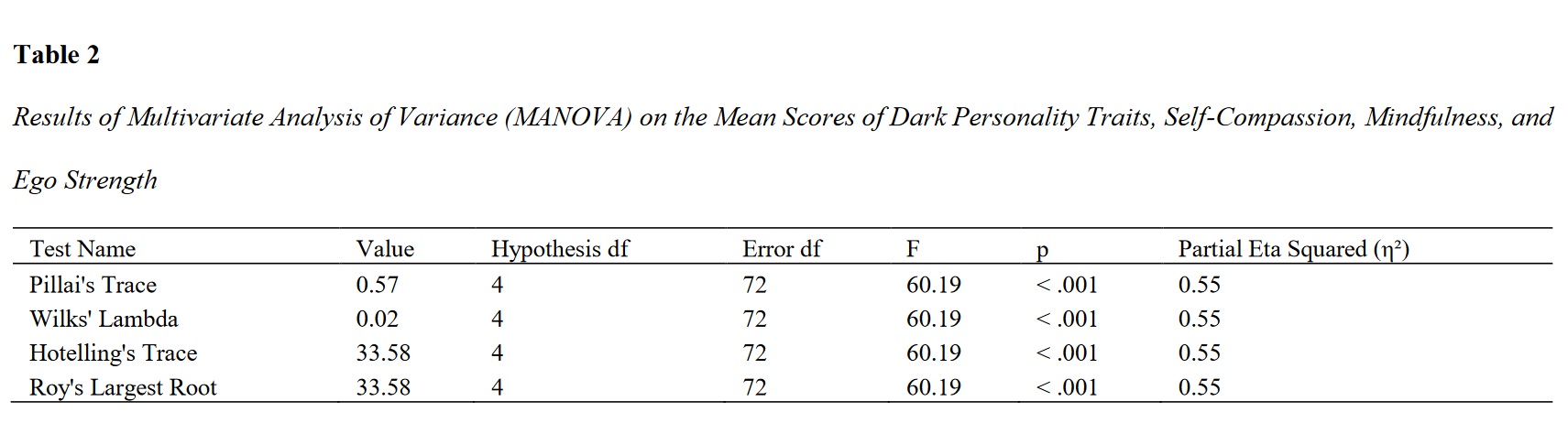
Objective: This study aimed to compare dark personality traits, self-compassion, mindfulness, and ego strength in patients with depression and obsessive-compulsive disorder.
Methods and Materials: The research design was a causal-comparative method. The statistical population of this study included all individuals with a confirmed psychiatric and clinical diagnosis of obsessive-compulsive disorder and major depressive disorder in the province of Qom. The sample consisted of 80 individuals with obsessive-compulsive disorder and depression, selected using purposive sampling. The instruments used in this study included the Beck Depression Inventory, the Revised Obsessive-Compulsive Questionnaire, the Dark Triad Personality Questionnaire, the Self-Compassion Scale, the Mindfulness Questionnaire, and the Psychological Ego Strength Questionnaire. To analyze the findings, univariate and multivariate analysis of variance tests were used, and data analysis was conducted using SPSS.22 software.
Findings: The findings indicated that the mean score of dark personality traits in the obsessive-compulsive group was higher than in the depression group. Additionally, self-compassion, mindfulness, and ego strength were higher in the obsessive-compulsive group compared to the depression group (p < 0.01).
Conclusion: The study reveals significant differences between individuals with obsessive-compulsive disorder and major depressive disorder in dark personality traits, self-compassion, mindfulness, and ego strength. These findings suggest that these psychological traits play a crucial role in the manifestation and severity of these disorders.
Downloads
References
Basharpour, S., & Estiri, S. (2024). Predicting Marriage Readiness Based on Identity, Intimacy, Desire for Marriage and Optimism Model. Journal of Family Research, 19(76), 553-566. https://www.magiran.com/paper/2696260
Borgholthaus, C. J., White, J. V., & Harms, P. D. (2023). CEO dark personality: A critical review, bibliometric analysis, and research agenda. Personality and individual differences, 201, 111951. https://doi.org/10.1016/j.paid.2022.111951
Britton, W. B., Lindahl, J. R., Cooper, D. J., Canby, N. K., & Palitsky, R. (2021). Defining and measuring meditation-related adverse effects in mindfulness-based programs. Clinical Psychological Science, 9(6), 1185-1204. https://doi.org/10.1177/2167702621996340
Chen, F., Zheng, D., Liu, J., Gong, Y., Guan, Z., & Lou, D. (2020). Depression and anxiety among adolescents during COVID-19: A cross-sectional study. Brain, behavior, and immunity, 88, 36. https://doi.org/10.1016/j.bbi.2020.05.061
Conversano, C., Ciacchini, R., Orrù, G., Di Giuseppe, M., Gemignani, A., & Poli, A. (2020). Mindfulness, compassion, and self-compassion among health care professionals: What's new? A systematic review. Frontiers in psychology, 11, 564573. https://doi.org/10.3389/fpsyg.2020.01683
Dodson, S. J., & Heng, Y. T. (2022). Self‐compassion in organizations: A review and future research agenda. Journal of Organizational Behavior, 43(2), 168-196. https://doi.org/10.1002/job.2556
Edinger, E. F. (2017). Ego and archetype. Shambhala Publications. https://www.shambhala.com/ego-and-archetype-3813.html?srsltid=AfmBOoq3nnEoQVqC0usk9PHRdswGjooU3LnOU8MrLo7jD1FVh5FGYQgm
Fried, E. I., Flake, J. K., & Robinaugh, D. J. (2022). Revisiting the theoretical and methodological foundations of depression measurement. Nature Reviews Psychology, 1(6), 358-368. https://doi.org/10.1038/s44159-022-00050-2
Fritz, M., Soravia, S. M., Dudeck, M., Malli, L., & Fakhoury, M. (2023). Neurobiology of aggression-review of recent findings and relationship with alcohol and trauma. Biology, 12(3), 469. https://doi.org/10.3390/biology12030469
Hartung, J., Bader, M., Moshagen, M., & Wilhelm, O. (2022). Age and gender differences in socially aversive ("dark") personality traits. European Journal of Personality, 36(1), 3-23. https://doi.org/10.1177/0890207020988435
Herrman, H., Patel, V., Kieling, C., Berk, M., Buchweitz, C., Cuijpers, P., & Wolpert, M. (2022). Time for united action on depression: a Lancet-World Psychiatric Association Commission. The lancet, 399(10328), 957-1022. https://doi.org/10.1016/S0140-6736(21)02141-3
Kapoor, P. S., Balaji, M. S., Maity, M., & Jain, N. K. (2021). Why consumers exaggerate in online reviews? Moral disengagement and dark personality traits. Journal of Retailing and Consumer Services, 60, 102496. https://doi.org/10.1016/j.jretconser.2021.102496
Liao, K. Y. H., Stead, G. B., & Liao, C. Y. (2021). A meta-analysis of the relation between self-compassion and self-efficacy. Mindfulness, 12, 1878-1891. https://doi.org/10.1007/s12671-021-01626-4
Loewenberg, P. J. (2014). Nixon, Hitler, and power: An ego psychological study. Routledge. https://doi.org/10.1080/07351698609533616
Mohamadinikoo, Z., & Tamannaeifar, M. (2024). Structural Model of psychological Well-being based on Basic Psychological Needs and Mindfulness With the Mediating role of Problematic internet Use in adolescents [Research]. Rooyesh-e-Ravanshenasi Journal(RRJ), 13(1), 19-28. http://frooyesh.ir/article-1-4840-en.html
Muris, P., & Otgaar, H. (2023). Self-esteem and self-compassion: A narrative review and meta-analysis on their links to psychological problems and well-being. Psychology research and behavior management, 2961-2975. https://doi.org/10.2147/PRBM.S402455
Neff, K., & Germer, C. (2022). The role of self‐compassion in psychotherapy. World Psychiatry, 21(1), 58. https://doi.org/10.1002/wps.20925
Neff, K. D. (2023). Self-compassion: Theory, method, research, and intervention. Annual review of psychology, 74, 193-218. https://doi.org/10.1146/annurev-psych-032420-031047
Neff, K. D., Knox, M. C., Long, P., & Gregory, K. (2020). Caring for others without losing yourself: An adaptation of the Mindful Self‐Compassion Program for Healthcare Communities. Journal of Clinical Psychology, 76(9), 1543-1562. https://doi.org/10.1002/jclp.23007
Omidi, A., Ahmadi, V., & valizadeh, r. (2024). Comparison of the effectiveness of emotion regulation training with cognitive therapy based on mindfulness on perceived stress and self-compassion in patients with irritable bowel syndrome. medical journal of mashhad university of medical sciences, 66(6). https://doi.org/10.22038/mjms.2023.70085.4163
Pavlović, T., & Franc, R. (2023). Antiheroes fueled by injustice: dark personality traits and perceived group relative deprivation in the prediction of violent extremism. Behavioral sciences of terrorism and political aggression, 15(3), 277-302. https://doi.org/10.1080/19434472.2021.1930100
Peixoto, Â., Gouveia, T., Sousa, P., Faria, R., & Almeida, P. R. (2023). Dark personality traits and tolerance towards unethical behaviors on entrepreneurship: A comparison between entrepreneurs and non-entrepreneurs. Journal of White Collar and Corporate Crime, 4(1), 5-13. https://doi.org/10.1177/2631309X211029877
Phillips, W. J., & Hine, D. W. (2021). Self-compassion, physical health, and health behaviour: A meta-analysis. Health Psychology Review, 15(1), 113-139. https://doi.org/10.1080/17437199.2019.1705872
Pihlajamäki, J., Lehikoinen, J., Partanen, J., Honkalampi, K., Kaasinen, V., & Kuikka, J. T. (2019). Cognitive behavior therapy for obsessive-compulsive disorder: The role of performance monitoring and error-related negativity. Journal of affective disorders, 246, 356-362.
Rasmussen, A. R., & Parnas, J. (2022). What is obsession? Differentiating obsessive-compulsive disorder and the schizophrenia spectrum. Schizophrenia Research, 243, 1-8. https://doi.org/10.1016/j.schres.2022.02.014
Ryan, R. M., Donald, J. N., & Bradshaw, E. L. (2021). Mindfulness and motivation: A process view using self-determination theory. Current Directions in Psychological Science, 30(4), 300-306. https://doi.org/10.1177/09637214211009511
Sadeghkhani, M., Emamipour, S., & Mirhashemi, M. (2023). The structural model of emotional divorce based on the dark triad traits of personality and conflict resolution styles with the mediation of marital dissatisfaction. Journal of Applied Family Therapy, 4(2), 444-471. https://doi.org/10.22034/aftj.2023.394409.2029
Salman Nasab, A., Yusefi, R., & Yagubi, H. (2024). Comparison of Personality Organization in People with Dark and Bright Personality Traits. Iranian Journal of Neurodevelopmental Disorders, 2(4), 28-35. https://doi.org/10.61838/kman.jndd.2.4.4
Sezer, I., Pizzagalli, D. A., & Sacchet, M. D. (2022). Resting-state fMRI functional connectivity and mindfulness in clinical and non-clinical contexts: A review and synthesis. Neuroscience & Biobehavioral Reviews, 135, 104583. https://doi.org/10.1016/j.neubiorev.2022.104583
Sharma, P. K., & Kumra, R. (2022). Relationship between mindfulness, depression, anxiety and stress: Mediating role of self-efficacy. Personality and individual differences, 186, 111363. https://doi.org/10.1016/j.paid.2021.111363
Sulosaari, V., Unal, E., & Cinar, F. I. (2022). The effectiveness of mindfulness-based interventions on the psychological well-being of nurses: A systematic review. Applied Nursing Research, 64, 151565. https://doi.org/10.1016/j.apnr.2022.151565
Szabó, Z. P., Simon, E., Czibor, A., Restás, P., & Bereczkei, T. (2021). The importance of dark personality traits in predicting workplace outcomes. Personality and individual differences, 183, 111112. https://doi.org/10.1016/j.paid.2021.111112
Tayebmanesh, L., & Saadati, N. (2023). Effectiveness of Integrating Quality of Life-Based Therapy and Phototherapy on Emotion Regulation, Depression, and Anxiety in Psychosomatic Patients. KMAN Counseling & Psychology Nexus, 1(2), 37-43. https://doi.org/10.61838/kman.psychnexus.1.2.7
Toprak, M., Boldrini, C., Passarella, A., & Conti, M. (2022). Harnessing the power of ego network layers for link prediction in online social networks. IEEE Transactions on Computational Social Systems, 10(1), 48-60. https://doi.org/10.1109/TCSS.2022.3155946
Turan, M. E., Adam, F., Kaya, A., & Yıldırım, M. (2023). The mediating role of the dark personality triad in the relationship between ostracism and social media addiction in adolescents. Education and Information Technologies, 1-17. https://doi.org/10.1007/s10639-023-12002-1
Tzenios, N., Tazanios, M., Chahine, M., & Jamal, P. O. B. (2023). The Complex Relationship Between Obesity and Depression. Special Journal of the Medical Academy and other Life Sciences, 1(3), 22. https://doi.org/10.58676/sjmas.v1i3.22
Wakelin, K. E., Perman, G., & Simonds, L. M. (2022). Effectiveness of self‐compassion‐related interventions for reducing self‐criticism: A systematic review and meta‐analysis. Clinical Psychology & Psychotherapy, 29(1), 1-25. https://doi.org/10.1002/cpp.2586
Weltens, I., Bak, M., Verhagen, S., Vandenberk, E., Domen, P., van Amelsvoort, T., & Drukker, M. (2021). Aggression on the psychiatric ward: prevalence and risk factors. A systematic review of the literature. PLoS One, 16(10), e0258346. https://doi.org/10.1371/journal.pone.0258346
Zabet, M., Karami, J., & Kamran, Y. (2021). The efectiveness of imagery rescripting and reprocessing therapy on cognitive abilities, distress tolerance and symptoms of obsessive-compulsive disorder (OCD) in women. https://www.academia.edu/download/79710569/483140010007.pdf
Downloads
Additional Files
Publication Timeline
- Submitted
- Revised
- Accepted
Issue
Section
License
Copyright (c) 2024 Zahra Pakizeh (Author); Atefeh Hojjati (Corresponding Author)

This work is licensed under a Creative Commons Attribution-NonCommercial 4.0 International License.