An Agile Branding Framework for Educational Startups in Volatile E-Learning Markets
Keywords:
agile branding, brand equity, dynamic capabilities, business performance, educational startups, e-learning marketAbstract
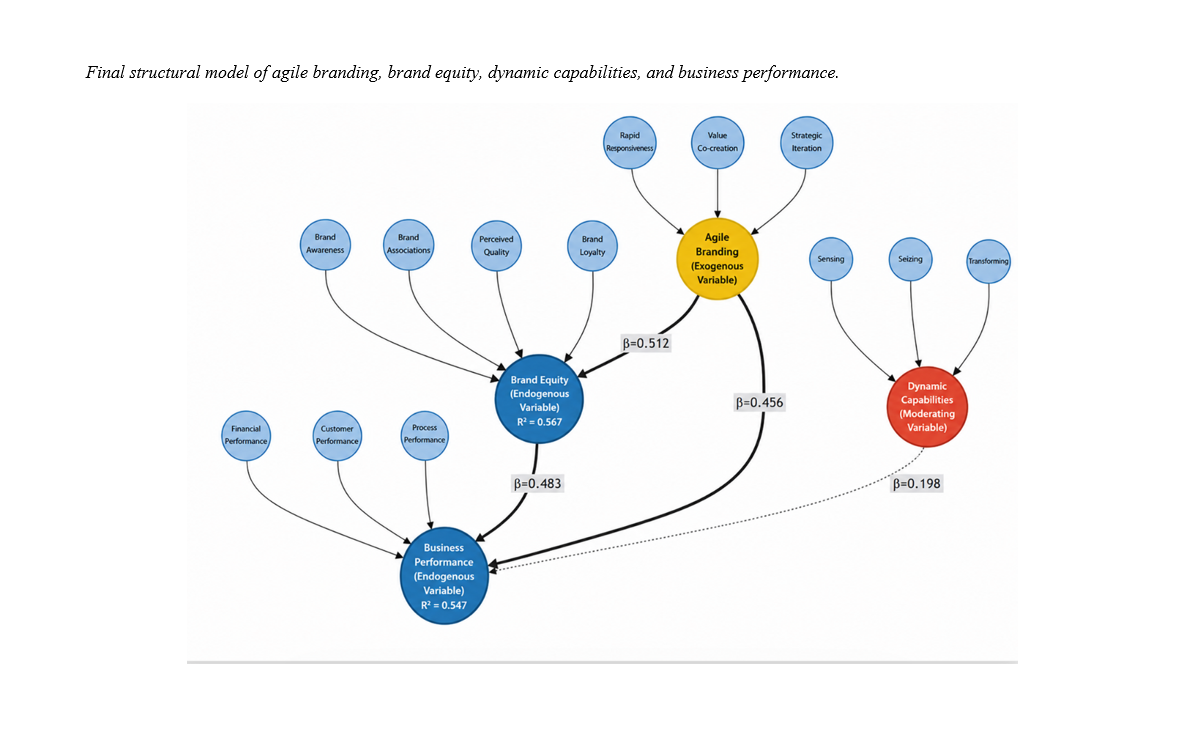
The e-learning market is a rapidly changing business ecosystem shaped by technological innovation, shifting educational policies, and evolving learner expectations. Static and linear branding approaches may therefore be inadequate for educational startups that must build trust while adapting quickly to market change. This study developed and tested an agile branding framework for educational startups. A quantitative, applied, descriptive-correlational design was used. The target population comprised founders and senior managers of 300 educational startups operating in Districts 2, 8, and 17 of Tehran, Iran. A proportionate stratified random sample of 169 individuals was invited to participate, and 158 valid questionnaires were analyzed (response rate = 93.5%). Data were collected using a researcher-developed instrument and analyzed with partial least squares structural equation modeling. Agile branding was operationalized through rapid responsiveness, value co-creation, and strategic iteration. The findings indicated significant positive effects of agile branding on business performance (β = 0.456, p < 0.001) and brand equity (β = 0.512, p < 0.001). Brand equity positively predicted business performance (β = 0.483, p < 0.001) and significantly mediated the relationship between agile branding and business performance (indirect β = 0.289, p < 0.001). Dynamic capabilities significantly strengthened the association between brand equity and business performance (β = 0.198, p = 0.004). The model explained 56.7% of the variance in brand equity and 54.7% of the variance in business performance; predictive relevance was supported for both endogenous constructs (Q² = 0.384 and 0.361, respectively). These results position agile branding as a strategic organizational capability that can help educational startups strengthen brand equity and improve performance in volatile digital education markets.
Downloads
References
Aaker, D. A. (1991). Managing brand equity: Capitalizing on the value of a brand name. Free Press. https://www.scirp.org/reference/referencespapers?referenceid=2474691
Cochran, W. G. (1977). Sampling techniques (3rd ed.). Wiley. https://books.google.com/books?hl=en&lr=&id=xbNn41DUrNwC&oi=fnd&pg=PA1&dq=Cochran,+W.+G.+(1977).+Sampling+techniques,+Wiley.+%09&ots=TYyVdFuknY&sig=F0T_sEXzA4Ag1x0Nz_3WGHWcsRM
Denning, S. (2018). The Age of Agile: How Smart Companies Are Transforming the Way Work Gets Done. AMACOM.
Eisenhardt, K. M., & Martin, J. A. (2000). Dynamic capabilities: What are they? Strategic Management Journal, 21(10-11), 1105-1121. https://doi.org/10.1002/1097-0266(200010/11)21:10/11<1105::AID-SMJ133>3.0.CO;2-E
Fornell, C., & Larcker, D. F. (1981). Evaluating structural equation models with unobservable variables and measurement error. Journal of Marketing Research, 18(1), 39-50. https://doi.org/10.1177/002224378101800104
Hair, J. F., Hult, G. T. M., Ringle, C. M., & Sarstedt, M. (2022). A primer on partial least squares structural equation modeling (PLS-SEM) (3rd ed.). SAGE. https://doi.org/10.1007/978-3-030-80519-7
Hodges, C., Moore, S., Lockee, B., Trust, T., & Bond, A. (2020). The difference between emergency remote teaching and online learning. https://er.educause.edu/articles/2020/3/the-difference-between-emergency-remote-teaching-and-online-learning
Keller, K. L., & Swaminathan, V. (2020). Strategic brand management: Building, measuring, and managing brand equity (5th ed.). Pearson. https://www.pearson.com/nl/en_NL/higher-education/subject-catalogue/marketing/keller-strategic-brandmanagement-5e.html
Kotler, P., & Keller, K. L. (2022). Marketing management (16th ed.). Pearson. https://books.google.com/books?hl=en&lr=&id=X2cAAwAAQBAJ&oi=fnd&pg=PP1&dq=Kotler,+P.+and+K.+L.+Keller+(2022).+Marketing+management,+Pearson.+%09&ots=r53GiPkO-1&sig=sS5JhjJbL9Cd2HKspBc67nL6Fiw
Lawshe, C. H. (1975). A quantitative approach to content validity. Personnel Psychology, 28(4), 563-575. https://doi.org/10.1111/j.1744-6570.1975.tb01393.x
Osterwalder, A., Pigneur, Y., Smith, A., & Etiemble, F. (2020). The invincible company: How to constantly reinvent your organization with inspiration from the world's best business models. Wiley. https://books.google.com/books?hl=en&lr=&id=vtHSDwAAQBAJ&oi=fnd&pg=PP21&dq=Osterwalder,+A.,+et+al.+(2020).+The+invincible+company:+How+to+constantly+reinvent+your+organization+with+inspiration+from+the+world%27s+best+business+models,+Wiley.+%09&ots=JOBR2iUKjr&sig=RwvZjsFfdonHrhNJTF33koF88lY
Polit, D. F., & Beck, C. T. (2006). The content validity index: Are you sure you know what's being reported? Critique and recommendations. Research in Nursing & Health, 29(5), 489-497. https://doi.org/10.1002/nur.20147
Ries, E. (2011). The lean startup: How today's entrepreneurs use continuous innovation to create radically successful businesses. Crown Business. https://books.google.com/books?hl=en&lr=&id=r9x-OXdzpPcC&oi=fnd&pg=PR9&dq=Ries,+E.+(2011).+The+lean+startup:+How+today%27s+entrepreneurs+use+continuous+innovation+to+create+radically+successful+businesses,+Crown+Business.++&ots=0u18EfuCdU&sig=C1veUsGnYI5twGeQNcw9vFs9AMA
Teece, D. J. (2007). Explicating dynamic capabilities: The nature and microfoundations of (sustainable) enterprise performance. Strategic Management Journal, 28(13), 1319-1350. https://doi.org/10.1002/smj.640
Teece, D. J. (2018). Dynamic capabilities as (workable) management systems theory. Journal of Management & Organization, 24(3), 359-368. https://doi.org/10.1017/jmo.2017.75
Teece, D. J., Pisano, G., & Shuen, A. (1997). Dynamic capabilities and strategic management. Strategic Management Journal, 18(7), 509-533. https://doi.org/10.1002/(SICI)1097-0266(199708)18:7<509::AID-SMJ882>3.0.CO;2-Z
World Economic, F. (2023). The future of jobs report 2023. World Economic Forum. https://www.weforum.org/reports/the-future-of-jobs-report-2023/