Providing Solutions to Improve the Level of Participation of Facebook users in Iraq in the Field of Tourism
DOI:
https://doi.org/10.61838/kman.aitech.4599Keywords:
participation, social network, Facebook, tourismAbstract
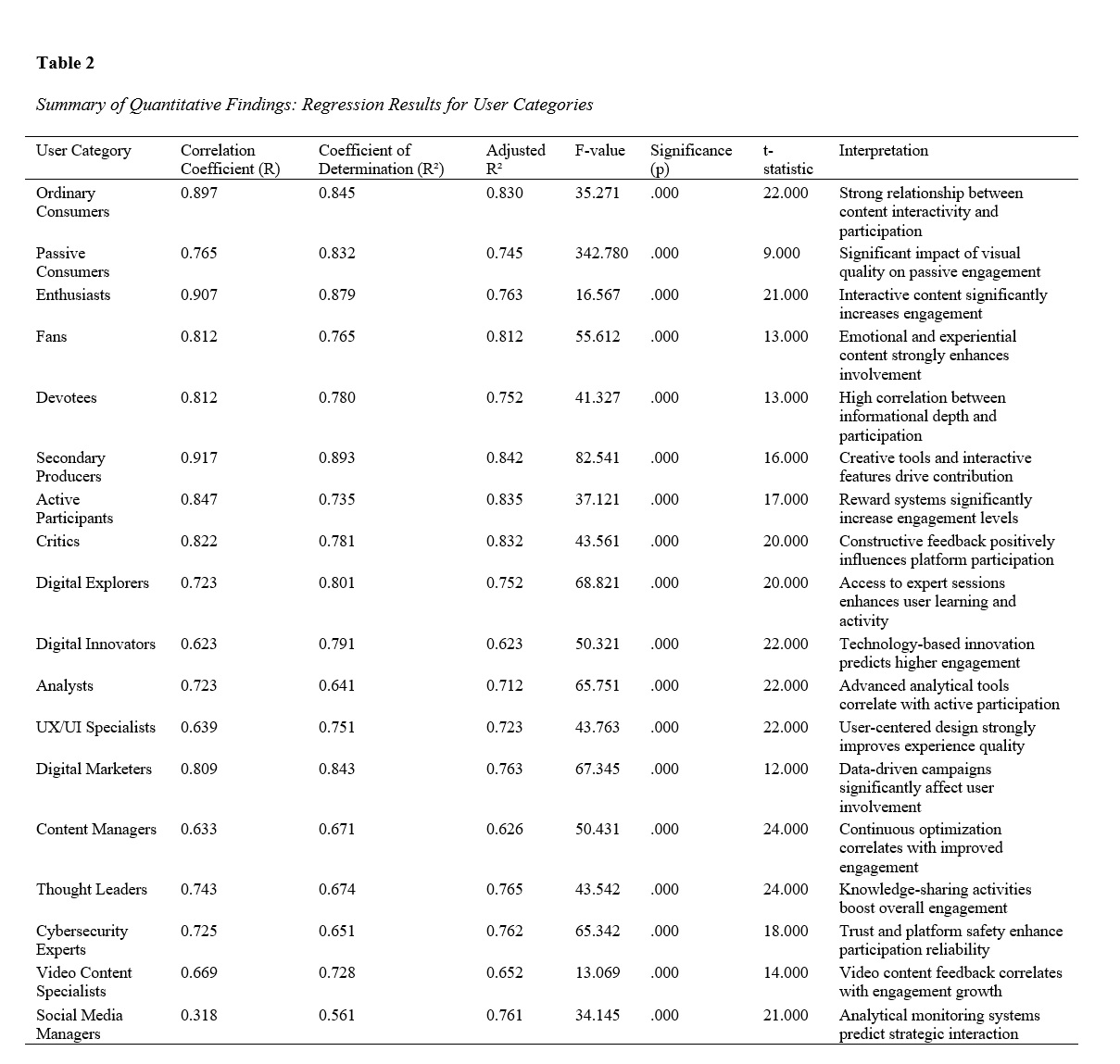
This study was conducted with the aim of providing strategies to increase the level of participation of Facebook social network users in Iraq’s tourism sector. The research employed a descriptive–survey method, and the statistical population included 4,000 Facebook participants engaged in discussions related to Iraqi tourism. Using Morgan’s sampling table, a sample size of 382 individuals was determined. Data were collected through library sources, scholarly articles, qualitative interviews, and questionnaire distribution in the quantitative phase. The reliability of the questionnaire components was examined using Cronbach’s alpha, and the results indicated that the coefficients exceeded 0.7. The findings of the study identified 17 types of consumers along with strategies corresponding to each group, including: ordinary consumers (providing entertaining and interactive content), passive consumers (focusing on improving content quality and visual information), enthusiasts (investing in appealing and interactive content), fans (emphasizing attractive and user-generated content), and devotees (offering quick-access resources and intellectual challenges). Additional categories included secondary producers, active participants, critics, digital explorers, digital innovators, analysts, UX/UI specialists, digital marketers, content managers, thought leaders, cybersecurity experts, video content specialists, and social media managers. Furthermore, the study proposed several strategies for enhancing Facebook users’ participation levels in the tourism domain.
Downloads
References
Al-Romeedy, B. S., & Alharethi, T. (2025). Leveraging green human resource management for sustainable tourism and hospitality: A mediation model for enhancing green reputation. Discover Sustainability, 6(1), 67. https://doi.org/10.1007/s43621-025-00829-2
Anopchand, P. H. Z. R. D. (2024). The Impact of Social Media on Hospitality and Tourism Management Students’ Academic Performance. International Journal of Academic Research in Business and Social Sciences, 14(2). https://doi.org/10.6007/ijarbss/v14-i2/20809
Ardakani, M., & Asgharkia, A. (2011). Investigating the Role of Mass Media Use in the Level of Social Participation of Students in the Faculties of Social Sciences at the University of Tehran and Allameh Tabataba'i University Allameh Tabataba'i University]. Tehran. https://elmnet.ir/doc/10485856-21561
Bahyar, P., & Dehdashti Shahrokh, Z. (2018). The Impact of Individual and Social Factors on Consumer Participation in Virtual Communities. Business Management Quarterly, 10(1), 121-144. https://jibm.ut.ac.ir/article_65791.html?lang=en
Coronil, A. G., Moreno, S. B., Pesantez, L. B., Tobar, M., & Guillermo, A. G. (2023). Social media impact of tourism managers: a decision tree approach in happiness, social marketing and sustainability. Management Development, 42(6), 436-457. https://doi.org/10.1108/JMD-04-2023-0131
Ghanian, M., & Hasheminejad, A. (2016). An Analysis of Motivators for Participation in Sustainable Tourism Development from the Perspective of Local Residents in the Dez Protected Area. Journal of the Iranian Geographical Society, 14(49), 61-77. https://mag.iga.ir/article_700865_en.html
Haghighatnasab, M., & Ghasemi, M. (2022). The Impact of Content Quality and Brand Interaction on Purchasing Behavior with the Mediating Role of Users' Cognitive and Emotional Engagement on Social Networks. New Marketing Research Quarterly, 3(46). https://nmrj.ui.ac.ir/article_27114.html?lang=en
Haksoro, C., Priyana, Y., & Hakim, R. (2024). Analysis of geotourism promotion strategies based on social media in Karanganyar Regency, Indonesia. IOP Conference Series: Earth and Environmental Science,
Hudson, S., Roth, M. S., Madden, T. J., & Hudson, R. (2014). The effects of social media on emotions, brand relationship quality, and word of mouth: An empirical study of music festival attendees. Tourism Management, 47, 68-76. https://doi.org/10.1016/j.tourman.2014.09.001
Kilipiri, E., Papaioannou, E., & Kotzaivazoglou, I. (2023). Social media and influencer marketing for promoting sustainable tourism destinations: The Instagram case. Sustainability, 15(8), 6374. https://doi.org/10.3390/su15086374
Kristina, H. (2011). Consumer activity in social media: Managerial approaches to consumers'social media behavior. Journal of Consumer Behaviour, 10, 356-364. https://doi.org/10.1002/cb.376
Lee, S., Lee, N., Lee, T. J., & Hyun, S. S. (2024). The influence of social support from intermediary organizations on innovativeness and subjective happiness in community-based tourism. Journal of Sustainable Tourism, 32(4), 795-817. https://doi.org/10.1080/09669582.2023.2175836
Loisa, R., Utami, L. S. S., Pandrianto, N., & Irena, L. (2023). Cultural Content in the Youth's Social Media on Likupang Super Priority Tourism Destination. International Journal of Application on Social Science and Humanities, 1(1), 1210-1220. https://doi.org/10.24912/ijassh.v1i1.25795
Mollen, A., & Wilson, H. (2010). Engagement, telepresence and interactivity in online consumer experience: reconciling scholastic and managerial perspectives. Journal of Business Research, 63(9-10), 919-925. https://doi.org/10.1016/j.jbusres.2009.05.014
Petrovčič, A., Reisdorf, B. C., & Prevodnik, K. (2022). A Typology of Aging Internet Users: Exploring Digital Gradations in Internet Skills and Uses. Social Science Computer Review, 41(5). https://doi.org/10.1177/08944393221117753
Santos, S., Vasconcelos, M., & Ferreira, S. (2023). Tourists' Engagement on Tourism Organizations' Facebook Pages: The Role of User-Generated Content.
Shafiei Sabet, N., & HaratiFard, S. (2019). Empowering Local Stakeholders for Participation in Sustainable Tourism Development with the Mediating Role of Perceived Tourism Impacts. Journal of Tourism Planning and Development, 8(2). https://tourismpd.journals.umz.ac.ir/article_2416.html?lang=en
Toma, F. (2025). Digital Nomads on Tourism Destinations Economies by Mediation of Marketing of Destinations in Horn of Africa. 139-164. https://doi.org/10.4018/979-8-3373-0076-4.ch006
Tosifian, M., & Ramezani, A. (2018). Investigating the Impact of Luxury Brands' Marketing Efforts on Brand Equity and Consumer Behavior (Case Study: Iranian Consumers of Luxury Brands on Social Media). Technology Growth Quarterly, 14(54). https://sid.ir/paper/145045/en
Downloads
Additional Files
Publication Timeline
- Submitted
- Revised
- Accepted