A New Model for Qualitative Research: Connecting Triangulation, Crystallization, and Artificial Intelligence
DOI:
https://doi.org/10.61838/kman.aitech.4475Abstract
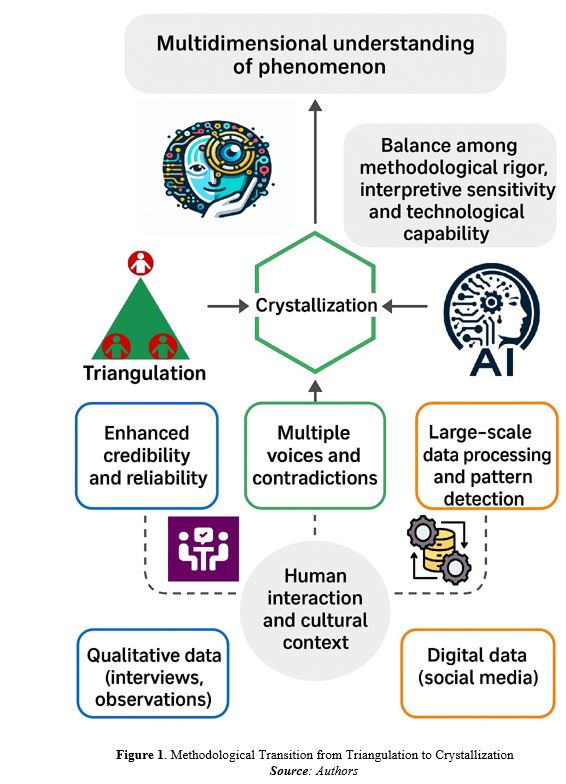
This study examines the methodological transition from triangulation to crystallization and investigates the emerging role of artificial intelligence (AI) in qualitative research. The central research question addressed whether traditional approaches, such as triangulation and crystallization, are sufficient to capture the complexity of meaning-making in the digital era. Findings suggest that, while triangulation enhances data validity, it tends to favor convergence and may overlook the polyphony of data. Crystallization embraces diversity and contradictions, providing a richer portrayal of phenomena, yet faces challenges when confronted with the vast volume of digital data. To address these limitations, this research proposes an innovative model that incorporates AI as an “algorithmic co-analyst” within the qualitative research process. The model creatively integrates triangulation, crystallization, and algorithmic analysis, enabling the detection of hidden patterns, amplification of contradictions, and improved scalability of qualitative inquiry. The primary contribution of this study lies in presenting a multi-paradigmatic framework that preserves methodological rigor, deepens interpretive richness, and leverages technological capacities to grasp the complexity of the digital world better. This approach opens a new horizon for the future of qualitative research, demonstrating that the integration of humans, data, and algorithms provides an effective pathway for studying multilayered and dynamic social phenomena.
.
Downloads
References
Abbaszadeh, M., & Hoseinpour, E. (2011). The application of triangulation in qualitative research (with emphasis on the grounded theory approach). Methodology of Social Sciences and Humanities, 17(67), 147-166. https://method.rihu.ac.ir/article_784_c68d86c65191d9ceddd7c5c92187a952.pdf
Abbaszadeh, M., & Pashaie, S. (2025). Algorithmic Interviewers and the Reconfiguration of Knowledge Production: Toward a Critical Intelligent Methodology in AI-Based Qualitative Research. Methodology of Social Sciences and Humanities, -. https://doi.org/10.30471/mssh.2025.10961.2640
Abbaszadeh, M., Pashaie, S., Piątkowska, M., & Zubović, V. (2025). Application of Cyber-Constructive Triangulation in Qualitative Research: Simultaneous Analysis of Human, Machine, and Data Interactions. AI and Tech in Behavioral and Social Sciences. https://journals.kmanpub.com/index.php/aitechbesosci/article/view/4321
Abbaszadeh, M., & Soltani Bahram, S. (2016). Understanding multi-genre representations in the transition from trinity to crystallization. Methodology of Social Sciences and Humanities, 22(88), 123-142. https://method.rihu.ac.ir/article_1259_b8c39378fe8768fe96fcf7c2ec288d17.pdf
Ahmadi, H., Heidary, H., Iman, M. T., & Ghafarinasab, E. (2019). Methodological Analysis in Iranian Sociological Research. Methodology of Social Sciences and Humanities, 25(101), 15-32.
Anttiroiko, A.-V. (2015). Networks in Manuel Castells’ theory of the network society. 35-31.
Baş, F. (2025). Artificial Intelligence, Human and Society in the Context of Ulrich Beck’s Risk Society Theory. Eskişehir Osmangazi Üniversitesi İlahiyat Fakültesi Dergisi, 12(Din ve Yapay Zeka), 43-59. https://doi.org/10.51702/esoguifd.1612313
Beck, U. (1998). Politics of risk society. Environmentalism. Critical Concepts, 1(1), 256-266.
Biggiero, L. (2001). Sources of complexity in human systems. Nonlinear Dynamics, Psychology, and Life Sciences, 5(1), 3-19. https://doi.org/10.1023/A:1009515211632
Castells, M. (2004). Informationalism, networks, and the network society: a theoretical blueprint. The network society: A cross-cultural perspective, 3-45.
Cherkasova, I. P., Reva, T. N., Palanchuk, N. V., Pashneva, S. A., & Kozhevnikova, M. A. (2021). Crystallisation of meaning as a technique for forming intercultural communicative competence within the real–virtual dichotomy. SHS Web of Conferences,
Cremin, C. J., Dash, S., & Huang, X. (2022). Big data: historic advances and emerging trends in biomedical research. Current Research in Biotechnology, 4, 138-151. https://doi.org/10.1016/j.crbiot.2022.02.004
Decrop, A. (1999). Triangulation in qualitative tourism research. Tourism management, 20(1), 157-161. https://doi.org/10.1016/S0261-5177(98)00102-2
Ellingson, L. L. (2009). Engaging crystallization in qualitative research: An introduction. Sage.
Flick, U. (2013). The SAGE handbook of qualitative data analysis.
Foucault, M. (2020). Power/knowledge. In The new social theory reader (pp. 73-79). Routledge. https://doi.org/10.4324/9781003060963-10
Hitch, D. (2024). Artificial intelligence augmented qualitative analysis: the way of the future? Qualitative Health Research, 34(7), 595-606. https://doi.org/10.1177/10497323231217392
LaMarre, A., & Chamberlain, K. (2022). Innovating qualitative research methods: Proposals and possibilities. Methods in Psychology, 6, 100083. https://doi.org/10.1016/j.metip.2021.100083
Morgan, H. (2024). Using triangulation and crystallization to make qualitative studies trustworthy and rigorous. The Qualitative Report, 29(7), 1844-1856. https://doi.org/10.46743/2160-3715/2024.6071
Nageye, A. Y., Jimale, A. D., Abdullahi, M. O., & Ahmed, Y. A. (2024). Emerging trends in data science and big data analytics: A bibliometric analysis. International Journal of Electronics and Communication Engineering, 11(5), 84-98. https://doi.org/10.14445/23488549/IJECE-V11I5P109
Niloy, A. C., Bari, M. A., Sultana, J., Chowdhury, R., Raisa, F. M., Islam, A., Mahmud, S., Jahan, I., Sarkar, M., & Akter, S. (2024). Why do students use ChatGPT? Answering through a triangulation approach. Computers and Education: Artificial Intelligence, 6, 100208. https://doi.org/10.1016/j.caeai.2024.100208
Pal, S. (2023). A paradigm shift in research: Exploring the intersection of artificial intelligence and research methodology. International journal of innovative research in engineering & multidisciplinary physical sciences, 11(3), 1-7. https://doi.org/10.37082/IJIRMPS.v11.i3.230125
Park, Y. S., Konge, L., & Artino Jr, A. R. (2020). The positivism paradigm of research. Academic medicine, 95(5), 690-694. https://doi.org/10.1097/ACM.0000000000003093
Pashaie, S., Abbaszadeh, M., Abdavi, F., & Golmohammadi, H. (2023). Improving the validity of mixed and multi-methods through triangulation in new sports management research. Research in Sport Management and Marketing, 4(2), 16-27. https://doi.org/10.22098/rsmm.2023.12593.1216
Pashaie, S., karimi, j., abaszadeh, m., & golmohammadi, h. (2025). Challenges and Opportunities of Artificial Intelligence in Higher Education from the Perspective of Sports Science Researchers. Research on Educational Sport, -. https://doi.org/10.22089/res.2025.17597.2601
Rouse, J. (1994). Power/knowledge. The cambridge companion to Foucault, 2, 1-192.
Saini, S. (2014). Spherical Crystallization: An Overview. Int. J. Drug Delivery Technol, 4(4), 72-80.
Sanbonmatsu, D. M., Cooley, E. H., & Butner, J. E. (2021). The impact of complexity on methods and findings in psychological science. Frontiers in psychology, 11, 580111. https://doi.org/10.3389/fpsyg.2020.580111
Stewart, H., Gapp, R., & Harwood, I. (2017). Exploring the alchemy of qualitative management research: Seeking trustworthiness, credibility and rigor through crystallization. The Qualitative Report, 22(1), 1-1-1-19.
Tabatabaee, A., Hasani, P., Mortazavi, H., & Tabatabaeichehr, M. (2013). Strategies to enhance rigor in qualitative research [Review Article]. North Khorasan University of Medical Sciences, 5(3), 663-670. https://doi.org/10.29252/jnkums.5.3.663
Tayebi Abolhasani, A. (2019). Introduction to Research Methodology: Standard procedures for qualitative data analysis. Science and Technology Policy Letters, 09(2), 67-96. https://stpl.ristip.sharif.ir/article_21535_d7df0f8d67cc7fe6f58b150cc004f39f.pdf
Vulpe, S.-N., Rughiniș, R., Țurcanu, D., & Rosner, D. (2024). AI and cybersecurity: a risk society perspective. Frontiers in Computer Science, 6, 1462250. https://doi.org/10.3389/fcomp.2024.1462250
Wibawa, A. P., & Kurniawan, F. (2024). Advancements in natural language processing: Implications, challenges, and future directions. Telematics and Informatics Reports, 16, 100173. https://doi.org/10.1016/j.teler.2024.100173
Xu, Y., Liu, X., Cao, X., Huang, C., Liu, E., Qian, S., Liu, X., Wu, Y., Dong, F., & Qiu, C.-W. (2021). Artificial intelligence: A powerful paradigm for scientific research. The Innovation, 2(4). https://doi.org/10.1016/j.xinn.2021.100179
Downloads
Additional Files
Publication Timeline
- Submitted
- Revised
- Accepted
Issue
Section
License
Copyright (c) 2024 Mohammad Abbaszadeh, Sajjad Pashaie , Vedran Zubovi (Author)

This work is licensed under a Creative Commons Attribution-NonCommercial 4.0 International License.