Design and Analysis of Human Resource Development Strategies in Remote Work Conditions: An Applied Study in the Iraqi Ministry of Planning
DOI:
https://doi.org/10.61838/kman.aitech.4380Keywords:
Human resource development, remote work, strategy, factor analysis, Iraqi Ministry of Planning, digital training, coaching, organizational cultureAbstract
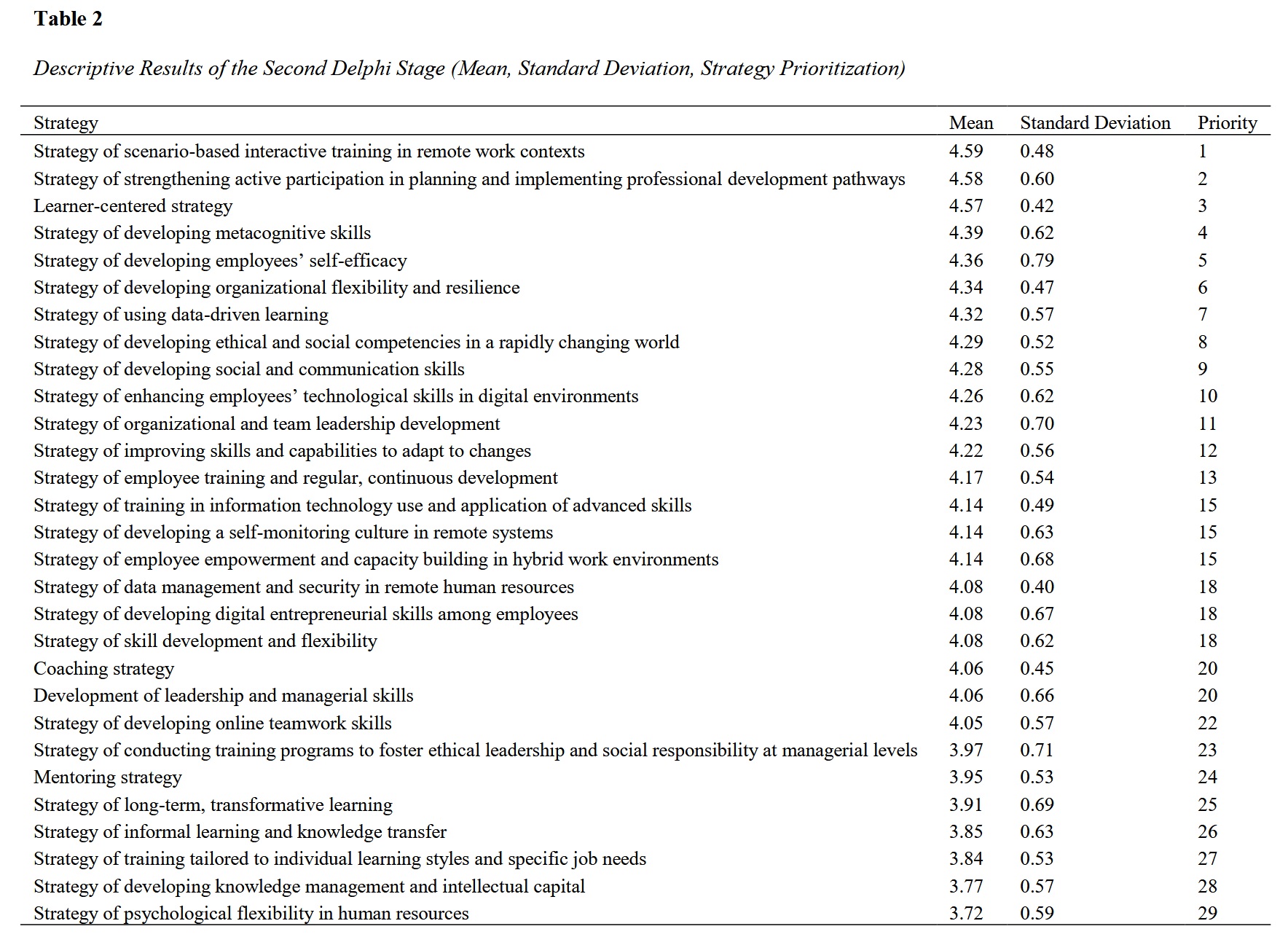
With the growing expansion of remote work and the transformation of workplace structures, organizations—particularly in the public sector—have encountered new challenges in the field of human resource development. This transformation requires the redesign of strategies tailored to technology-driven, non-face-to-face work environments. The purpose of this study is to identify and analyze effective human resource development strategies under remote work conditions, with a focus on the operational context of the Iraqi Ministry of Planning. This study employed a mixed-methods approach (qualitative–quantitative) and was conducted in three stages. In the first stage, through a systematic review of the scientific literature, 33 initial strategies were collected. Subsequently, by implementing two rounds of the Delphi method with the participation of 14 experts, the final list of 29 strategies was extracted. In the third stage, exploratory factor analysis was applied to identify the conceptual dimensions of the strategies, resulting in three main axes: “individual and professional empowerment,” “team and organizational cultural development,” and “digital transformation of human resources.” The findings revealed that human resource development in the context of remote work requires a comprehensive, technology-oriented, and flexible perspective that must align with the characteristics of virtual work environments and the requirements of public organizations. Furthermore, recommendations were provided for designing blended training programs, strengthening virtual interactions, and enhancing employees’ technological empowerment. By localizing global approaches within Iraq’s administrative structures, this study has taken an innovative step toward formulating human resource development policies under remote work conditions.
Downloads
References
Al-Shameri, A. S. A. S., Omar, S. S., Al-Azam, S., Abkar, M. M. A., & Alawadhi, T. H. A. A. (2023). A Review of Employees Training and Development in Navigating through Pandemic COVID-19: Malaysian Perspective. Proceedings of the International Conference on Industrial Engineering and Operations Management,
Ameri, M., Kruse, D., Park, S. R., Rodgers, Y., & Schur, L. (2022). Telework during the pandemic: patterns, challenges, and opportunities for people with disabilities. Disability and Health Journal, 101406. https://doi.org/10.2139/ssrn.4281142
Anakpo, G., Nqwayibana, Z., & Mishi, S. (2023). The impact of work-from-home on employee performance and productivity: a systematic review. Sustainability, 15(5), 4529. https://doi.org/10.3390/su15054529
Bahri, E. S. (2025). The Identification of Competency-based Human Resource Development Strategy. International Journal of Strategic Studies, 2(1), 1-7. https://doi.org/10.59921/icestra.v2i1.50
Buomprisco, G., Ricci, S., Perri, R., & De Sio, S. (2021). Health and telework: New challenges after COVID-19 pandemic. European Journal of Environment and Public Health, 5(2), em0073. https://doi.org/10.21601/ejeph/9705
Carnevale, J. B., & Hatak, I. (2020). Employee adjustment and well-being in the era of COVID-19: Implications for human resource management. Journal of Business Research, 116, 183-187. https://doi.org/10.1016/j.jbusres.2020.05.037
Day, D. V. (2024). Leadership Development in the PostPandemic World Preparing Leaders for the New Normal. Leadership & Organization Development Journal, 45(1), 45-63. https://doi.org/10.1108/LODJ-06-2023-0406
de Macêdo, T. A. M., Cabral, E. L. D. S., Silva Castro, W. R., de Souza Junior, C. C., da Costa Junior, J. F., Pedrosa, F. M., & Másculo, F. S. (2020). Ergonomics and telework: A systematic review. Work, 66(4), 777-788. https://doi.org/10.3233/WOR-203224
Ekuma, K. (2024). Artificial intelligence and automation in human resource development: A systematic review. Human Resource Development Review, 23(2), 199-229. https://doi.org/10.1177/15344843231224009
Fousiani, K., Sypes, C., & Armenta, B. M. (2023). Applying for remote jobs? You'd better be competent! Teleworking turns recruiters attention to candidate competence over warmth-related skills. Personality and individual differences, 204, 112063. https://doi.org/10.1016/j.paid.2022.112063
Gamage, A., & Luthans, F. (2024). Developing Digital and Entrepreneurial Skills in Employees A New HRD Strategy for the 21st Century. Journal of Workplace Learning, 36(1), 3-20. https://doi.org/10.1108/JWL-05-2023-0183
Garavan, T. N., & McCarthy, A. (2008). Collective learning processes and human resource development. Advances in Developing Human Resources, 10(4), 451-471. https://doi.org/10.1177/1523422308320473
Griffin, M. A., & Hesketh, B. (2003). The influence of cognitive ability on job performance A test of the job demands-control model. Journal of Applied Psychology, 88(3), 493-500. https://doi.org/10.1037/0021-9010.88.3.493
Harkiolakis, T., & Komodromos, M. (2023). Supporting knowledge workers' health and well-being in the post-lockdown era. Administrative Sciences, 13(2), 49. https://doi.org/10.3390/admsci13020049
Hayes, S. C., Strosahl, K. D., & Wilson, K. G. (2024). Acceptance and Commitment Therapy The Process and Practice of Mindful Change. Guilford Press ISBN - 9781462547034. https://www.amazon.com/AcceptanceCommitmentTherapyPracticeMindful/dp/1462547039
Hodzic, S., Prem, R., Nielson, C., & Kubicek, B. (2024). When telework is a burden rather than a perk: The roles of knowledge sharing and supervisor social support in mitigating adverse effects of telework during the COVID‐19 pandemic. Applied Psychology, 73(2), 599-621. https://doi.org/10.1111/apps.12491
Hong, H.-J. (2010). Bicultural Competence and Its Impact on Team Effectiveness. International Journal of Cross Cultural Management. https://doi.org/10.1177/1470595809359582
Jang, S., & Ardichvili, A. (2020). The role of HRD in CSR and sustainability: a content analysis of corporate responsibility reports. European Journal of Training and Development, 44(6/7), 549-573. https://doi.org/10.1108/EJTD-01-2020-0006
Jenkins, S. (2013). David Clutterbuck, mentoring and coaching. International Journal of Sports Science & Coaching, 8(1), 139-254. https://doi.org/10.1260/1747-9541.8.1.139
Kazekami, S. (2020). Mechanisms to improve labor productivity by performing telework. Telecommunications Policy, 44(2), 101868. https://doi.org/10.1016/j.telpol.2019.101868
Lepak, D. P., Bartol, K. M., & Erhardt, N. L. (2005). A contingency framework for the delivery of HR practices. Human Resource Management Review, 15(2), 139-159. https://doi.org/10.1016/j.hrmr.2005.06.001
Marlina, M., Mkumbachi, R. L., Mane, A., & Daud, L. R. (2023). Environmental care character education based on local wisdom for marine resource management. Jambura Geo Education Journal, 4(2), 199-207. https://doi.org/10.34312/jgej.v4i2.21920
Maurer, T. J. (2001). Career-relevant learning and development, worker age, and beliefs about self-efficacy for development. Journal of Management, 27(2), 123-140. https://doi.org/10.1177/014920630102700201
McIlongo, M., & Strydom, K. (2021). The significance of mentorship in supporting the career advancement of women in the public sector. Heliyon, 7(6). https://doi.org/10.1016/j.heliyon.2021.e07321
Mininni, G., & Manuti, A. (2020). Pleasures and pains about remote work experience during the COVID-19 global pandemic: A diatextual approach. Linguística: Revista de Estudos Linguísticos da Universidade do Porto, 1, 221-244.
Mustajab, D., Bauw, A., Rasyid, A., Irawan, A., Akbar, M. A., & Hamid, M. A. (2020). Working from home phenomenon as an effort to prevent COVID-19 attacks and its impacts on work productivity. Tijab (The International Journal of Applied Business), 4(1), 13-21. https://doi.org/10.20473/tijab.V4.I1.2020.13-21
Newman, C., Mulrine, S., Brittain, K., Dawson, P., Mason, C., Spencer, M., & Scott, J. (2023). Challenges and improvements associated with transitions between hospitals and care homes during the COVID-19 pandemic: a qualitative study with care home and healthcare staff in England. Age and Ageing, 52(9), afad146. https://doi.org/10.1093/ageing/afad146
O'Neill, T. A., & McLarnon, M. J. (2021). The Future of Work Managing Remote Work in a PostPandemic World. International Journal of Human Resource Management.
O'Neill, T. A., & McLarnon, M. J. (2024). Empowering Employees in Hybrid Work Environments HRD Strategies for Remote and Onsite Teams. International Journal of Human Resource Management, 35(3), 471-490.
Ollo-López, A., Goñi-Legaz, S., & Erro-Garcés, A. (2020). Home-based telework: usefulness and facilitators. International Journal of Manpower. https://doi.org/10.1108/IJM-02-2020-0062
Otoo, F. N. K. (2022). Examining the influence of human resource development practices on organizational commitment of small and medium scale enterprises. European Journal of Management Issues, 30(4), 195-204. https://doi.org/10.15421/192217
PiwowarSulej, K., & et al. (2024). A Contribution to Sustainable Human Resource Development in the Era of the COVID19 Pandemic. Journal of Business Ethics. https://doi.org/10.1007/s10551-023-05456-3
Racine, N., McArthur, B. A., Cooke, J. E., Eirich, R., Zhu, J., & Madigan, S. (2021). Global prevalence of depressive and anxiety symptoms in children and adolescents during COVID-19: a meta-analysis. JAMA Pediatrics, 175(11), 1142-1150. https://doi.org/10.1001/jamapediatrics.2021.2482
Rokhsani, J., Ebrahimpoor, H., Setareh Ardabili, F., Rasouli, I., & Hassanzadeh, M. (2020). Developing a human resource development model in government organizations with an entrepreneurial approach: Using grounded theory. Productivity Management (Transcending Management), 14(54), 74-102.
Rothbard, N. P., Beetz, A. M., & Harari, D. (2021). Balancing the scales: A configurational approach to work-life balance. Annual Review of Organizational Psychology and Organizational Behavior, 8(1), 73-103. https://doi.org/10.1146/annurev-orgpsych-012420-061833
Sahut, J. M., & Lissillour, R. (2023). The adoption of remote work platforms after the Covid-19 lockdown: New approach, new evidence. Journal of Business Research, 154, 113345. https://doi.org/10.1016/j.jbusres.2022.113345
Soga, M., & Gaston, K. J. (2022). Towards a unified understanding of human-nature interactions. Nature Sustainability, 5(5), 374-383. https://doi.org/10.1038/s41893-021-00818-z
Sweet, M., & Scott, D. M. (2022). Insights into the future of telework in Canada: Modeling the trajectory of telework across a pandemic. Sustainable Cities and Society, 87, 104175. https://doi.org/10.1016/j.scs.2022.104175
Tims, M., & Bakker, A. B. (2024). The Role of Machine Learning in Personalized HRD Tailoring Development Programs Based on Employee Needs. Human Resource Development Quarterly, 35(2), 125-145. https://doi.org/10.1002/hrdq.21489
Wahyuningsih, Y., & Suyitno, S. (2022). Application of Elements of Human Resource Management Strategic: Does it Affect the Work Performance of Koperasi Kencana Makmur Lamongan Employees? International Journal of Science, Technology & Management, 3(6), 1857-1868. https://doi.org/10.46729/ijstm.v3i6.605
Wang, H., Xiao, Y., Wang, H., Zhang, H., & Chen, X. (2023). Who knows me understands my needs: The effect of home-based telework on work engagement. Psychology research and behavior management, 619-635. https://doi.org/10.2147/PRBM.S402159
Werner, J. M. (2014). Human resource management and HRD: connecting the dots or ships passing in the night? Routledge.
Downloads
Additional Files
Publication Timeline
- Submitted
- Revised
- Accepted
Issue
Section
License
Copyright (c) 2024 Mostafa Hussain Salman Al-Tamimi (Author); Ghasem Eslami (Corresponding Author); Mohammad Mahdi Farahi , Fariborz Rahimnia (Author)

This work is licensed under a Creative Commons Attribution-NonCommercial 4.0 International License.