The Future of AI in Healthcare: A Survey of Medical Professors’ Opinions
DOI:
https://doi.org/10.61838/kman.aitech.4365Keywords:
Artificial Intelligence, Professor, Medical Sciences, PerceptionAbstract
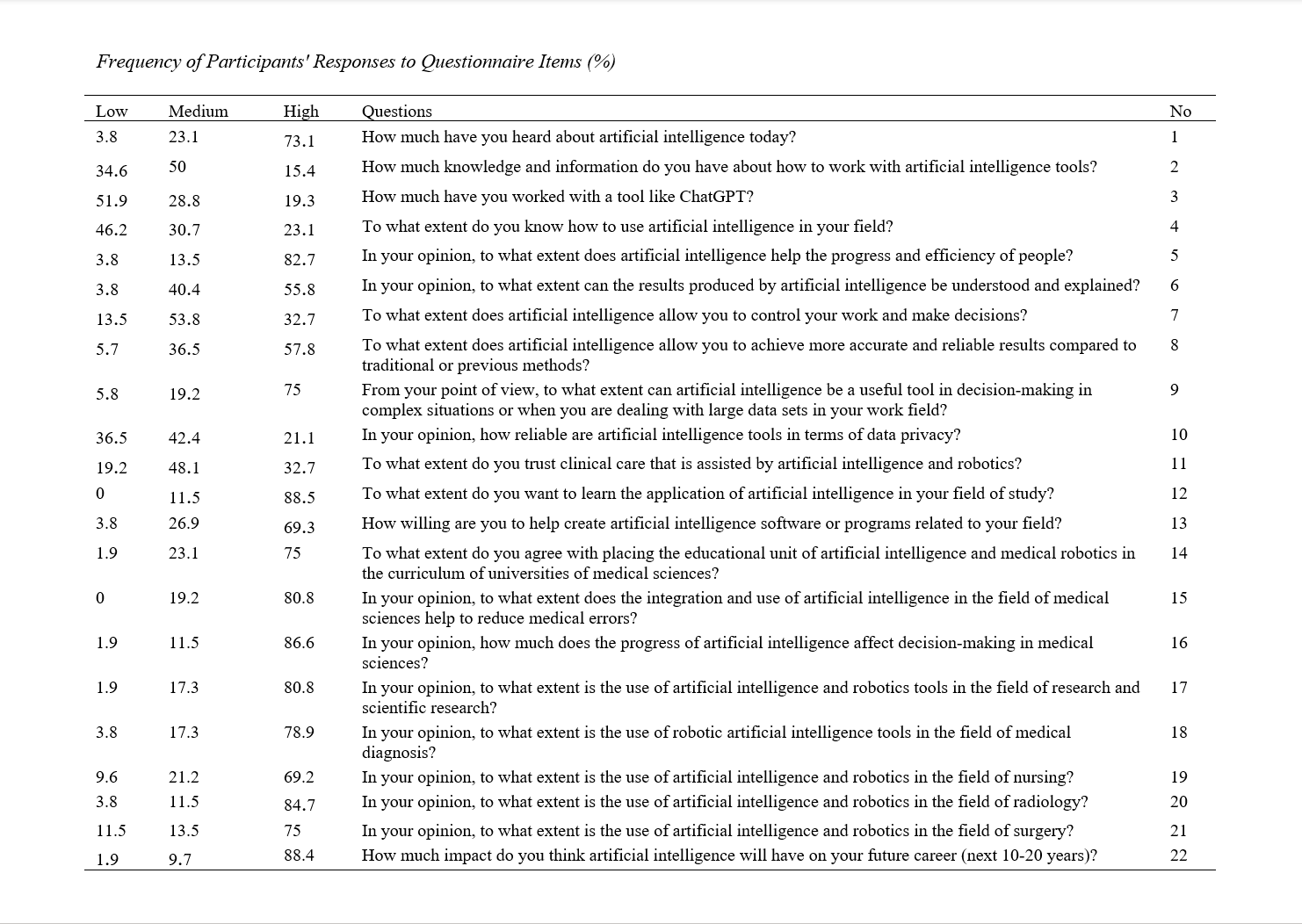
Nowadays, the use of artificial intelligence (AI) in medical sciences has been growing significantly, impacting diagnosis, care, and treatment of diseases. AI systems also serve as clinical assistants. Given that all healthcare professionals begin their education at universities, the aim of this research was to assess the awareness and attitudes of medical university professors toward incorporating an AI course in medical sciences. This descriptive-analytical study was conducted during 2024 at Torbat Heydarieh University of Medical Sciences. The study population included all faculty members, both academic and non-academic, totaling 152 participants. Data were collected using a composite questionnaire covering four dimensions: familiarity, awareness, willingness to learn, and professors’ perspectives on AI. The validity of the questionnaire was confirmed, and its reliability was established with a Cronbach’s alpha coefficient of 73%. Data were analyzed using SPSS version 26. In this study, significant correlations were found between familiarity, awareness, willingness to learn, and professors’ perspectives regarding AI, as well as their gender, age, and work experience. Professors with 11-20 years of work experience demonstrated greater familiarity compared to their counterparts. However, younger professors with less than 10 years of experience had higher levels of awareness. The willingness to learn about AI was consistent across all levels of work experience. Professors expressed positive views on integrating AI into medical practice and adding it to the curriculum. Based on the findings of this study, incorporating an AI course into the medical curriculum for students can contribute to modern medical advancements and enhance the efficiency of healthcare delivery. Additionally, organizing AI training workshops for professors would be beneficial in this regard.
Downloads
References
Adarkwah, M., Amponsah, S., Van Wyk, M., Huang, R., Tlili, A., Shehata, B., & et al. (2023). Awareness and acceptance of ChatGPT as a generative conversational AI for transforming education by Ghanaian academics: A two-phase study. Journal of Applied Learning & Teaching, 6, 1-16. https://doi.org/10.37074/jalt.2023.6.2.26
Azimi, M., Mohammadi, Z., & Rafieinasab, F. (2022). A Survey of Academic Librarians' Perceptions of Artificial Intelligence Technology: A Case Study (Librarians of Shahid Chamran University of Ahvaz and Jundishapur University of Medical Sciences). Journal of Library and Information Science, 24, 154-177. https://lis.aqr-libjournal.ir/article_135606_d9374fc24c78df68011fa971540ec274.pdf?lang=en
Buchanan, C., Howitt, M. L., Wilson, R., & et al. (2021). Predicted Influences of Artificial Intelligence on Nursing Education: Scoping Review. JMIR Nursing, 4(1), e23933. https://doi.org/10.2196/23933
Buzzelli, M., & Asafo-Adjei, E. (2022). Experiential learning and the university's host community: rapid growth, contested mission and policy challenge. Higher Education, 85. https://link.springer.com/article/10.1007/s10734-022-00849-1
Hashimoto, D. A., Ward, T. M., & Meireles, O. R. (2020). The Role of Artificial Intelligence in Surgery. Advances in Surgery, 54, 89-101. https://doi.org/10.1016/j.yasu.2020.05.010
Khanna, D., & Sabri, M. (2018). USE OF ARTIFICIAL INTELLIGENCE IN HEALTHCARE AND MEDICINE. SSRN Electronic Journal, 5, 21-25. https://www.researchgate.net/profile/Mustafa-Sabri-3/publication/354450866_USE_OF_ARTIFICIAL_INTELLIGENCE_IN_HEALTHCARE_AND_MEDICINE/links/61390973c76de21e319f6f24/USE-OF-ARTIFICIAL-INTELLIGENCE-IN-HEALTHCARE-AND-MEDICINE.pdf
McGrath, C., Cerratto Pargman, T., Juth, N., & Palmgren, P. J. (2023). University teachers' perceptions of responsibility and artificial intelligence in higher education - An experimental philosophical study. Computers and Education: Artificial Intelligence, 4, 100-139. https://doi.org/10.1016/j.caeai.2023.100139
Mehdipour, Y., & Bardbar, F. (2014). The attitude of nursing managers in the use of artificial intelligence systems in nursing decisions: 2014.
Pacheco-Mendoza, S., Guevara, C., Mayorga-Albán, A., & Fernández-Escobar, J. (2023). Artificial Intelligence in Higher Education: A Predictive Model for Academic Performance. Education Sciences, 13(10), 990. https://doi.org/10.3390/educsci13100990
Prinsloo, P., & Slade, S. (2017). An elephant in the learning analytics room: the obligation to act. Proceedings of the ACM Conference on Learning at Scale, 46-55. https://doi.org/10.1145/3027385.3027406
Sassis, L., Kefala-Karli, P., Sassi, M., & Zervides, C. (2021). Exploring Medical Students' and Faculty's Perception on Artificial Intelligence and Robotics. A Questionnaire Survey. Journal of Artificial Intelligence for Medical Sciences, 2. https://link.springer.com/article/10.2991/jaims.d.210617.002
Tajaldeen, A., & Alghamdi, S. (2020). Evaluation of radiologist's knowledge about the Artificial Intelligence in diagnostic radiology: a survey-based study. Acta Radiologica Open, 9(7), 2058460120945320. https://doi.org/10.1177/2058460120945320
Topol, E. J. (2019). High-performance medicine: the convergence of human and artificial intelligence. Nature medicine, 25(1), 44-56. https://doi.org/10.1038/s41591-018-0300-7
Zheng, B., Wu, M. N., Zhu, S. J., & et al. (2021). Attitudes of medical workers in China toward artificial intelligence in ophthalmology: a comparative survey. BMC Health Services Research, 21(1), 1067. https://doi.org/10.1186/s12913-021-07044-5
Downloads
Additional Files
Publication Timeline
- Submitted
- Revised
- Accepted
Issue
Section
License
Copyright (c) 2024 Sara Montazerian (Author); Yousef Mehdipour (Corresponding Author)

This work is licensed under a Creative Commons Attribution-NonCommercial 4.0 International License.