Interconnected Worlds: Human-AI Collaboration in International Technology Transfer for Industry 5.0
DOI:
https://doi.org/10.61838/kman.aitech.3.2.10Keywords:
Human-AI Collaboration, International Technology Transfer, Human-Centered ApproachAbstract
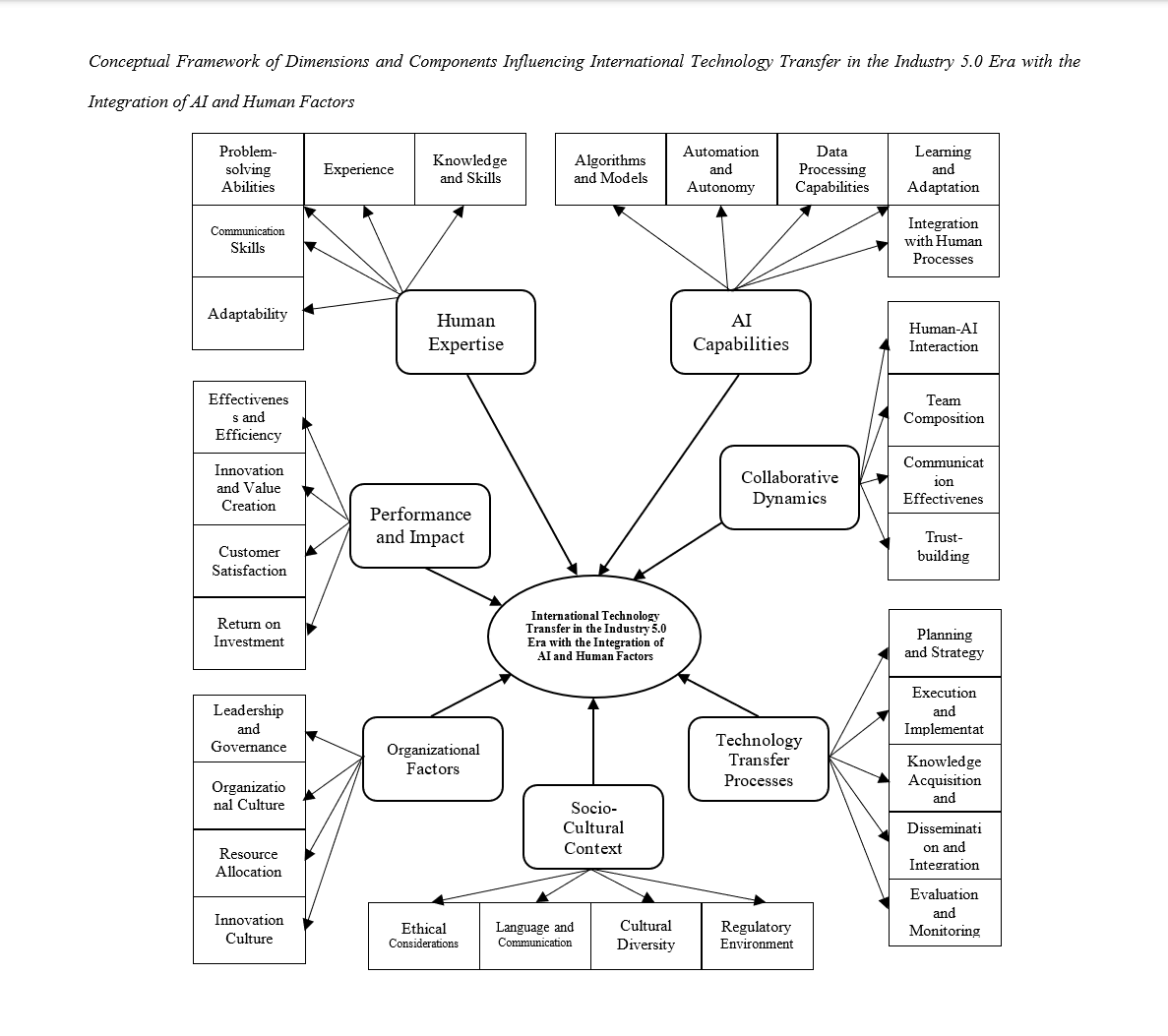
In the contemporary era marked by rapid technological advancements and intense competition across global markets, successful technology transfer has emerged as a strategic imperative for organizations. With the advent of the Industry 5.0 era, integrating cutting-edge artificial intelligence (AI) with human expertise and creativity unlocks new avenues for innovation and value creation. However, international technology transfer is fraught with numerous challenges, including cultural disparities, varying legal and regulatory frameworks, as well as technical and organizational complexities. This research endeavors to present an integrated model to facilitate seamless technology transfer within the Industry 5.0 framework, taking into account both human and technological factors. The research adopted a qualitative approach to data collection through the meta-synthesis method, encompassing a comprehensive review of the literature, analysis, and synthesis of existing findings. The validity of the research was affirmed based on established criteria, holding meetings with the research team members, leveraging expert insights, and conducting a thorough auditing process to achieve theoretical consensus, while its reliability was determined through the critical appraisal skills program. The findings identified 118 indicators and 31 components across 7 main dimensions: AI capabilities, human expertise, technology transfer processes, organizational factors, socio-cultural context, collaborative dynamics, and performance and impact. Based on these findings, it is proposed that organizations prioritize integrating AI and human expertise, fostering constructive interactions, developing an understanding of cultural contexts, nurturing an innovation-supportive environment, and embracing continuous learning to achieve successful technology transfer. Furthermore, continuous evaluation of the performance and impact of technology transfer is imperative for process optimization.
Downloads
References
Abrash, M. (2021). Creating the future: Augmented reality, the next human-machine interface. 2021 IEEE International Electron Devices Meeting (IEDM),
Alves, J., Lima, T. M., & Gaspar, P. D. (2023). Is industry 5.0 a human-centred approach? A systematic review. Processes, 11(1), 193. https://doi.org/10.3390/pr11010193
Berretta, S., Tausch, A., Ontrup, G., Gilles, B., Peifer, C., & Kluge, A. (2023). Defining human-AI teaming the human-centered way: A scoping review and network analysis. Frontiers in Artificial Intelligence, 6. https://doi.org/10.3389/frai.2023.1250725
Bocklisch, F., & Huchler, N. (2023). Humans and cyber-physical systems as teammates? Characteristics and applicability of the human-machine-teaming concept in intelligent manufacturing. Frontiers in Artificial Intelligence, 6. https://doi.org/10.3389/frai.2023.1247755
Brückner, A., Hein, P., Hein-Pensel, F., Mayan, J., & Wölke, M. (2023). Human-centered HCI practices leading the path to Industry 5.0: A systematic literature review. International Conference on Human-Computer Interaction,
Calp, M. H., & Bütüner, R. (2022). Society 5.0: Effective technology for a smart society. Artificial Intelligence and Industry 4.0,
Carayannis, E. G., Canestrino, R., & Magliocca, P. (2023). From the dark side of industry 4.0 to society 5.0: Looking "beyond the box" to developing human-centric innovation ecosystems. IEEE Transactions on Engineering Management. https://doi.org/10.1109/TEM.2023.3239552
Carayannis, E. G., & Morawska, J. (2023). University and education 5.0 for emerging trends, policies and practices in the concept of industry 5.0 and society 5.0. Industry 5.0: Creative and Innovative Organizations,
Ciccarelli, M., Papetti, A., & Germani, M. (2023). Exploring how new industrial paradigms affect the workforce: A literature review of Operator 4.0. Journal of Manufacturing Systems, 70, 464-483. https://doi.org/10.1016/j.jmsy.2023.08.016
Cunha, L., Silva, D., & Maggioli, S. (2022). Exploring the status of the human operator in Industry 4.0: A systematic review. Frontiers in Psychology, 13, 889129. https://doi.org/10.3389/fpsyg.2022.889129
Granata, I., Faccio, M., & Boschetti, G. (2024). Industry 5.0: prioritizing human comfort and productivity through collaborative robots and dynamic task allocation. Procedia Computer Science, 232, 2137-2146. https://doi.org/10.1016/j.procs.2024.02.144
Hirsch-Kreinsen, H. (2023). Industry 4.0: Options for human-oriented work design. Sci, 5(1), 9. https://doi.org/10.3390/sci5010009
Irpan, M., & Shaddiq, S. (2024). Industry 4.0 and Industry 5.0-Inception, conception, perception, and rethinking loyalty employment. International Journal of Economics, Management, Business, and Social Science (IJEMBIS), 4(1), 95-114. https://doi.org/10.1016/j.jmsy.2021.10.006
Jin, X., Liu, Q., & Long, H. (2021). Impact of cost-benefit analysis on financial benefit evaluation of investment projects under back propagation neural network. Journal of Computational and Applied Mathematics, 384, 113172. https://doi.org/10.1016/j.cam.2020.113172
Kazancoglu, Y., Mangla, S. K., Berberoglu, Y., Lafci, C., & Madaan, J. (2023). Towards industry 5.0 challenges for the textile and apparel supply chain for the smart, sustainable, and collaborative industry in emerging economies. Information Systems Frontiers, 1-16. https://doi.org/10.1007/s10796-023-10430-5
Lee, J. S., Ham, Y., Park, H., & Kim, J. (2022). Challenges, tasks, and opportunities in teleoperation of excavator toward human-in-the-loop construction automation. Automation in Construction, 135, 104119. https://doi.org/10.1016/j.autcon.2021.104119
Leng, J., Zhu, X., Huang, Z., Li, X., Zheng, P., Zhou, X., & Liu, Q. (2024). Unlocking the power of industrial artificial intelligence towards Industry 5.0: Insights, pathways, and challenges. Journal of Manufacturing Systems, 73, 349-363. https://doi.org/10.1016/j.jmsy.2024.02.010
Leon-Roa, C., Zuñiga-Collazos, A., Castillo, H. S. V., Guarin, H. P., Franco, C. M. G., Gómez, D. C. R., & Acosta, E. B. G. (2024). Valorization of research results for knowledge and technology transfer in public higher education institutions. Journal of Open Innovation: Technology, Market, and Complexity, 10(1), 100245. https://doi.org/10.1016/j.joitmc.2024.100245
Mourtzis, D., Angelopoulos, J., & Panopoulos, N. (2022). A literature review of the challenges and opportunities of the transition from Industry 4.0 to society 5.0. Energies, 15(17), 6276. https://doi.org/10.3390/en15176276
Murphy, C., Carew, P. J., & Stapleton, L. (2023). A human-centred systems manifesto for smart digital immersion in Industry 5.0: A case study of cultural heritage. AI & SOCIETY, 1-16. https://doi.org/10.1007/s00146-023-01693-2
Olsson, A. K., Eriksson, K. M., & Carlsson, L. (2024). Management toward Industry 5.0: a co-workership approach on digital transformation for future innovative manufacturing. European Journal of Innovation Management. https://doi.org/10.1108/EJIM-09-2023-0833
Ozmen Garibay, O., Winslow, B., Andolina, S., Antona, M., Bodenschatz, A., Coursaris, C., & Xu, W. (2023). Six human-centered artificial intelligence grand challenges. International Journal of Human-Computer Interaction, 39(3), 391-437. https://doi.org/10.1080/10447318.2022.2153320
Passalacqua, M., Cabour, G., Pellerin, R., Léger, P. M., & Doyon-Poulin, P. (2024). Human-centered AI for industry 5.0 (HUMAI5.0): Design framework and case studies
Human-centered AI. Chapman and Hall/CRC. https://doi.org/10.1201/9781003320791-27
Piller, F. T., & Nitsch, V. (2022). How digital shadows, new forms of human-machine collaboration, and data-driven business models are driving the future of Industry 4.0: A Delphi study
Forecasting Next Generation Manufacturing: Digital Shadows, Human-Machine Collaboration, and Data-driven Business Models. Cham: Springer International Publishing. https://doi.org/10.1007/978-3-031-07734-0_1
Pinto, R., Žilka, M., Zanoli, T., Kolesnikov, M. V., & Gonçalves, G. (2024). Enabling professionals for Industry 5.0: The self-made programme. Procedia Computer Science,
Pizoń, J., & Gola, A. (2023). Human-machine relationship-Perspective and future roadmap for Industry 5.0 solutions. Machines, 11(2), 203. https://doi.org/10.3390/machines11020203
Rauch, E., Linder, C., & Dallasega, P. (2020). Anthropocentric perspective of production before and within Industry 4.0. Computers & Industrial Engineering, 139, 105644. https://doi.org/10.1016/j.cie.2019.01.018
Ravi, R., & Janodia, M. D. (2022). Factors affecting technology transfer and commercialization of university research in India: A cross-sectional study. Journal of the Knowledge Economy, 13(1), 787-803. https://doi.org/10.1007/s13132-021-00747-4
Ren, M., Chen, N., & Qiu, H. (2023). Human-machine collaborative decision-making: An evolutionary roadmap based on cognitive intelligence. International Journal of Social Robotics, 15(7), 1101-1114. https://doi.org/10.1007/s12369-023-01020-1
Rožanec, J. M., Novalija, I., Zajec, P., Kenda, K., Tavakoli Ghinani, H., Suh, S., & Soldatos, J. (2023). Human-centric artificial intelligence architecture for industry 5.0 applications. International Journal of Production Research, 61(20), 6847-6872. https://doi.org/10.1080/00207543.2022.2138611
Sandelowski, M., & Barroso, J. (2007). Handbook for Synthesizing Qualitative Research. New York: Springer Publishing Company. https://books.google.com/books?hl=en&lr=&id=rjNMH0g8fFsC&oi=fnd&pg=PR5&dq=Sandelowski,+M.+and+J.+Barroso+(2007).+Handbook+for+Synthesizing+Qualitative+Research,+New+York:+Springer+Publishing+Company.+%09&ots=I2fkZVjrd_&sig=hxwXn5tLwbiR6hWsFY__uaPbjPo
Sharabati, A. A. A., Allahham, M., AbuSaimeh, H., Ahmad, A. Y. B., Sabra, S., & Daoud, M. K. (2023). Effects of artificial integration and big data analysis on economic viability of solar microgrids: mediating role of cost benefit analysis. Operational Research in Engineering Sciences: Theory and Applications, 6(3). https://doi.org/10.1186/s40359-023-00133-9
Siegel, D., Bogers, M. L., Jennings, P. D., & Xue, L. (2023). Technology transfer from national/federal labs and public research institutes: Managerial and policy implications. Research Policy, 52(1), 104646. https://doi.org/10.1016/j.respol.2022.104646
Simms, C., & Frishammar, J. (2024). Technology transfer challenges in asymmetric alliances between high-technology and low-technology firms. Research Policy, 53(3), 104937. https://doi.org/10.1016/j.respol.2023.104937
Stern, H., & Freitag, M. (2022). Human-centered design of hybrid cyber-physical production systems
Digitization of the Work Environment for Sustainable Production. https://doi.org/10.30844/WGAB_2022_6
Wang, B., Zheng, P., Yin, Y., Shih, A., & Wang, L. (2022). Toward human-centric smart manufacturing: A human-cyber-physical systems (HCPS) perspective. Journal of Manufacturing Systems, 63, 471-490. https://doi.org/10.1016/j.jmsy.2022.05.005
Wang, B., Zhou, H., Li, X., Yang, G., Zheng, P., Song, C., & Wang, L. (2024). Human digital twin in the context of Industry 5.0. Robotics and Computer-Integrated Manufacturing, 85, 102626. https://doi.org/10.1016/j.rcim.2023.102626
Zhang, C., Wang, Z., Zhou, G., Chang, F., Ma, D., Jing, Y., & Zhao, D. (2023). Towards new-generation human-centric smart manufacturing in Industry 5.0: A systematic review. Advanced Engineering Informatics, 57, 102121. https://doi.org/10.1016/j.aei.2023.102121
Zizic, M. C., Mladineo, M., Gjeldum, N., & Celent, L. (2022). From industry 4.0 towards industry 5.0: A review and analysis of paradigm shift for the people, organization and technology. Energies, 15(14), 5221. https://doi.org/10.3390/en15145221
Downloads
Additional Files
Publication Timeline
Issue
Section
License
Copyright (c) 2024 Arezoo Zamany (Author); Abbas Khamseh (Corresponding Author); Sayedjavad Iranbanfard (Author)

This work is licensed under a Creative Commons Attribution-NonCommercial 4.0 International License.