Design and Evaluation of a Machine Learning-Guided Intervention Strategy for Managing Dental Anxiety and Pain in Children
Keywords:
Machine Learning, Algorithm-Guided Intervention, Dental Anxiety, Dental Pain, ChildrenAbstract
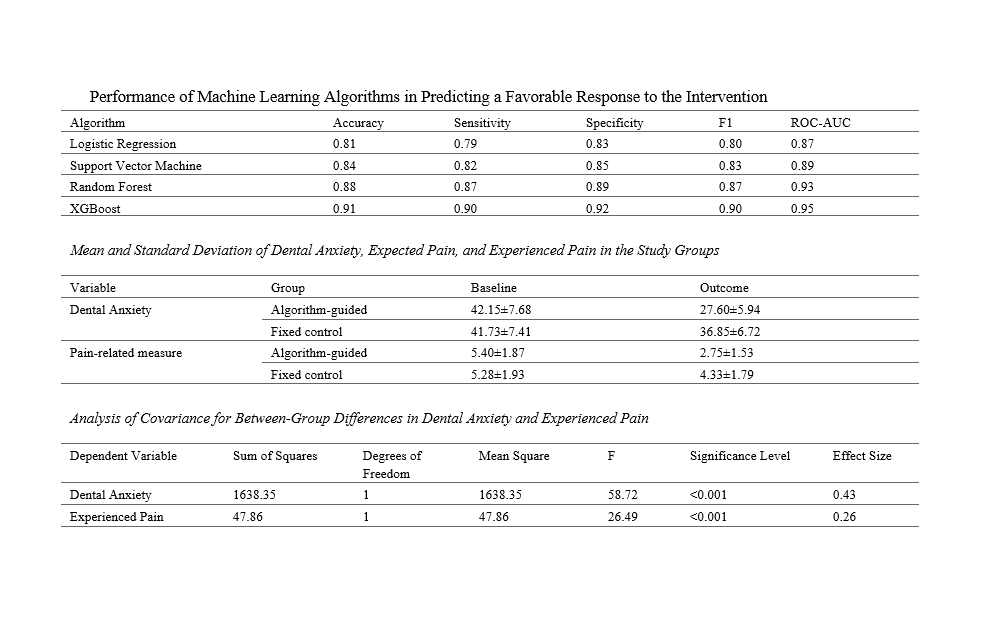
The present study aimed to develop and evaluate a machine learning-guided strategy for allocating non-pharmacological interventions and to compare its clinical outcomes with a fixed standard intervention for managing dental anxiety and pain in children. The study was conducted in two phases. In the first phase, data from 300 children aged 6–12 years, including demographic characteristics, dental history, baseline anxiety, expected pain, and responses to non-pharmacological interventions, were collected. Four algorithms, including logistic regression, support vector machine, random forest, and XGBoost, were trained and evaluated. In the second phase, 80 independent children were randomly assigned to an algorithm-guided intervention group or a control group. In the experimental group, the intervention type was selected according to the output of the machine learning model, whereas the control group received fixed visual-auditory distraction. Dental anxiety was assessed using the CFSS-DS, experienced pain using the Wong-Baker FACES Pain Rating Scale, and heart rate at different stages of treatment. The first-phase results showed that XGBoost had the best predictive performance, with an accuracy of 0.91 and an ROC-AUC of 0.95. In the second phase, the algorithm-guided group showed greater reductions in dental anxiety and experienced pain than the fixed-intervention control group. Children in the algorithm-guided group also demonstrated lower heart-rate responses, better behavioral cooperation, and greater parental satisfaction. These findings support the comparative clinical performance of algorithm-guided intervention allocation versus a fixed visual-auditory distraction strategy. Because the control condition used a single fixed intervention and individual counterfactual treatment effects were not estimated, the results should not be interpreted as isolating the causal effect of personalization itself.
Downloads
References
Acharya, S., Godhi, B. S., Saxena, V., Assiry, A. A., Alessa, N. A., Dawasaz, A. A., & et al. (2024). Role of artificial intelligence in behavior management of pediatric dental patients-a mini review. J Clin Pediatr Dent, 48(3), 24-30. https://doi.org/10.22514/jocpd.2024.055
Almarzouq, S. S. F. S., Chua, H., Yiu, C. K. Y., & Lam, P. P. Y. (2024). Effectiveness of nonpharmacological behavioural interventions in managing dental fear and anxiety among children: a systematic review and meta-analysis. Healthcare (Basel), 12(5), 537. https://doi.org/10.3390/healthcare12050537
Bahrololoomi, Z., Zein Al-Din, J., Maghsoudi, N., & Sajedi, S. (2024). Efficacy of virtual reality distraction in reduction of pain and anxiety of pediatric dental patients in an Iranian population: a split-mouth randomized crossover clinical trial. Int J Dent, 2024, 1290410. https://doi.org/10.1155/2024/1290410
Bocklage, C., Selden, R., Tumsuden, O., Nanney, E., Graves, C., & et al. (2025). A software-based observational coding approach for evaluating paediatric dental pain, anxiety, and fear. Int J Paediatr Dent, 35(2), 241-258. https://doi.org/10.1111/ipd.13227
Cuthbert, M. I., & Melamed, B. G. (1982). A screening device: children at risk for dental fears and management problems. ASDC J Dent Child, 49(6), 432-436. https://cir.nii.ac.jp/crid/1572824499955170560
Enshaei, Z., Sadeghi Kaji, K., & Saied-Moallemi, Z. (2024). Development and validation of the Iranian version of the Children's Experiences of Dental Anxiety Measure (CEDAM). Clin Exp Dent Res, 10(1), e830. https://doi.org/10.1002/cre2.830
Helal, N. M., & Sabbagh, H. (2026). Predicting dental anxiety and cooperative behavior in children using machine learning: a cross-sectional predictive modeling study. Dent J (Basel), 14(3), 170. https://doi.org/10.3390/dj14030170
Ishitani, H., Tanaka, Y., & Ono, Y. (2026). Effect of personalized AI-generated picture books on anxiety during first dental visits in young children: two case reports. Case Rep Dent, 2026, 9947164. https://doi.org/10.1155/crid/9947164
Kaur, K., Saini, R. S., Binduhayyim, R. I. H., Mosaddad, S. A., & Heboyan, A. (2025). Analyzing nonpharmacological behavior management in children with dental anxiety: a systematic review and meta-analysis. Health Sci Rep, 8(8), e71176. https://doi.org/10.1002/hsr2.71176
Kong, X., Song, N., Chen, L., & Li, Y. (2024). Non-pharmacological interventions for reducing dental anxiety in pediatric dentistry: a network meta-analysis. BMC Oral Health, 24, 1151. https://doi.org/10.1186/s12903-024-04919-x
Liu, J., Hu, J., Qi, Y., Wu, X., & Gan, Y. (2025). Personalized stress optimization intervention to reduce adolescents' anxiety: a randomized controlled trial leveraging machine learning. J Anxiety Disord, 110, 102964. https://doi.org/10.1016/j.janxdis.2024.102964
Mir Mohammadi, M. R., Shokrizadeh Arani, L., Taghdisi Kashani, A., Amiri, S., & Nickfarjam, A. M. (2025). Evaluating the effectiveness of virtual reality in reducing dental anxiety in children aged 6-12: a randomized clinical trial. Int J Paediatr Dent, 35(6), 1124-1132. https://doi.org/10.1111/ipd.70002
Naeimi, S. M., Darvish, S., Nazemi Salman, B., & Luchian, I. (2024). Artificial intelligence in adult and pediatric dentistry: a narrative review. Bioengineering (Basel), 11(5), 431. https://doi.org/10.3390/bioengineering11050431
Rokhshad, R., Zhang, P., Mohammad-Rahimi, H., Shobeiri, P., & Schwendicke, F. (2024). Current applications of artificial intelligence for pediatric dentistry: a systematic review and meta-analysis. Pediatr Dent, 46(1), 27-35. https://www.ingentaconnect.com/content/aapd/pd/2024/00000046/00000001/art00004
Sun, I. G., Chu, C. H., Lo, E. C. M., & Duangthip, D. (2024). Global prevalence of early childhood dental fear and anxiety: a systematic review and meta-analysis. J Dent, 142, 104841. https://doi.org/10.1016/j.jdent.2024.104841
Tasgaonkar, A., Rathi, N., Tasgaonkar, M., Agrawal, P., Tapkir, A., & Mehta, V. (2026). A randomised controlled trial comparing effectiveness of audio-visual aid and AI-personalised video self-modelling interventions to reduce dental fear and anxiety in paediatric patients. Eur Arch Paediatr Dent. https://doi.org/10.1007/s40368-026-01241-8
Downloads
Publication Timeline
- Submitted
- Revised
- Accepted