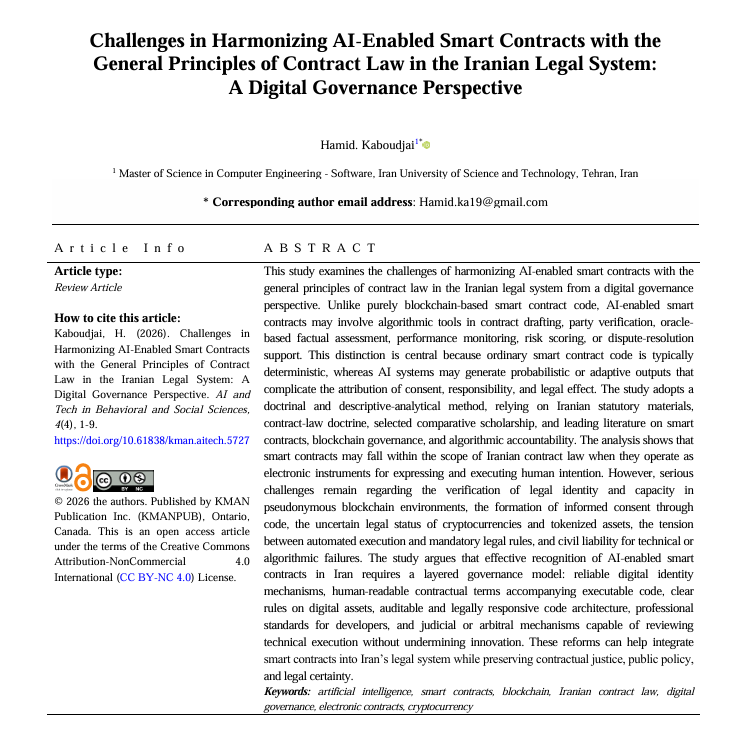
Challenges in Harmonizing AI-Enabled Smart Contracts with the General Principles of Contract Law in the Iranian Legal System: A Digital Governance Perspective
Keywords:
artificial intelligence, smart contracts, blockchain, Iranian contract law, digital governance, electronic contracts, cryptocurrencyAbstract
This study examines the challenges of harmonizing AI-enabled smart contracts with the general principles of contract law in the Iranian legal system from a digital governance perspective. Unlike purely blockchain-based smart contract code, AI-enabled smart contracts may involve algorithmic tools in contract drafting, party verification, oracle-based factual assessment, performance monitoring, risk scoring, or dispute-resolution support. This distinction is central because ordinary smart contract code is typically deterministic, whereas AI systems may generate probabilistic or adaptive outputs that complicate the attribution of consent, responsibility, and legal effect. The study adopts a doctrinal and descriptive-analytical method, relying on Iranian statutory materials, contract-law doctrine, selected comparative scholarship, and leading literature on smart contracts, blockchain governance, and algorithmic accountability. The analysis shows that smart contracts may fall within the scope of Iranian contract law when they operate as electronic instruments for expressing and executing human intention. However, serious challenges remain regarding the verification of legal identity and capacity in pseudonymous blockchain environments, the formation of informed consent through code, the uncertain legal status of cryptocurrencies and tokenized assets, the tension between automated execution and mandatory legal rules, and civil liability for technical or algorithmic failures. The study argues that effective recognition of AI-enabled smart contracts in Iran requires a layered governance model: reliable digital identity mechanisms, human-readable contractual terms accompanying executable code, clear rules on digital assets, auditable and legally responsive code architecture, professional standards for developers, and judicial or arbitral mechanisms capable of reviewing technical execution without undermining innovation. These reforms can help integrate smart contracts into Iran’s legal system while preserving contractual justice, public policy, and legal certainty.
Downloads
References
Afzali Mehr, M. (2019). Conflict of laws in contractual and non-contractual obligations. Shahr-e Danesh Legal Studies and Research Institute.
Ahangaran, M. R., & Ahmadi, A. (2019). Electronic contracts: From formation to termination. Majd.
Antonopoulos, A. M., & Wood, G. (2018). Mastering Ethereum: Building smart contracts and DApps. O'Reilly Media.
Atzei, N., Bartoletti, M., & Cimoli, T. (2017). A survey of attacks on Ethereum smart contracts (SoK). Principles of security and trust,
Bahrkazemi, M., & Mahmoudi, A. R. (2024). Challenges arising from the conclusion of smart contracts in Iran and Iraq. Comparative Studies on the Law of Islamic Countries, 2(3), 29-46.
Clack, C. D., Bakshi, V. A., & Braine, L. (2016). Smart contract templates: Foundations, design landscape and research directions (arXiv, Issue. https://arxiv.org/abs/1608.00771
Council of, M. (2019). Resolution on cryptocurrency mining and the use of cryptocurrencies in domestic transactions.
Dehghani Tafti, M., Afzali Mehr, M., & Eskini, R. (2021). A comparative study of the law governing digital smart contracts from the perspective of private international law in the Iranian legal system and Rome I Regulation. Law of New Technologies, 2(4), 203-225. https://mtlj.usc.ac.ir/article_148754_en.html
Durovic, M., & Janssen, A. (2019). The formation of smart contracts and beyond: Shaking the fundamentals of contract law. Smart contracts and blockchain technology: Role of contract law,
European, P., & Council. (2024). Regulation (EU) 2024/1689 laying down harmonised rules on artificial intelligence (Artificial Intelligence Act). https://researchportal.unamur.be/en/publications/regulation-eu-20241689-laying-down-harmonised-rules-on-artificial/
Khordmand, M. (2019). A jurisprudential analysis of cryptocurrency mining and exchange with a focus on the Bitcoin network. Islamic Economics Knowledge, 10(2), 109-124.
Mik, E. (2017). Smart contracts: Terminology, technical limitations and real world complexity. Law, Innovation and Technology, 9(2), 269-300. https://doi.org/10.1080/17579961.2017.1378468
Naser, M. (2018). Smart contracts: A comparative study of Iranian and American law. Majd. https://jplr.atu.ac.ir/article_10182_en.html
Naser, M., & Sadeghi, H. (2019). Validation and legal challenges of using smart contracts: A comparative study of the legal systems of Iran and the United States. Private Law Research, 7(27), 225-288. https://jecjl.com/index.php/jecjl/article/view/174?articlesBySimilarityPage=1
Nejatzadegan, S., & Soltani, M. (2022). Evaluation of the general conditions for the validity of smart contracts from the perspective of Iranian and American law. Journal of Legal Research, 25, 303-335.
O'Shields, R. (2017). Smart contracts: Legal agreements for the blockchain. North Carolina Banking Institute, 21, 177-194. https://scholarship.law.unc.edu/cgi/viewcontent.cgi?article=1435&context=ncbi
Rahbari, E., & Rezaei, A. (2011). The role of electronic agents in contract formation. Private Law Studies, 41(4), 159-178.
Rashvand Boukani, M., & Naser, M. (2019). The intention of contracting parties in smart contracts: Conditions of validity and methods of verification. Islamic Law Research Journal, 20(1), 271-300.
Raskin, M. (2017). The law and legality of smart contracts. Georgetown Law Technology Review, 1(2), 305-341. https://papers.ssrn.com/sol3/papers.cfm?abstract_id=2959166
Rezaei, A. (2008). Electronic commerce law. Mizan. https://csjlp.org/index.php/csjlp/article/view/372?articlesBySimilarityPage=15
Sadiku, M. N. O., Eze, K. G., & Musa, S. M. (2018). Smart contracts: A primer. Journal of Scientific and Engineering Research, 5(5), 538-541.
Savelyev, A. (2017). Contract law 2.0: Smart contracts as the beginning of the end of classic contract law. Information & Communications Technology Law, 26(2), 116-134.
Scherer, M. U. (2016). Regulating artificial intelligence systems: Risks, challenges, competencies, and strategies. Harvard Journal of Law & Technology, 29(2), 353-400. https://papers.ssrn.com/sol3/papers.cfm?abstract_id=2609777
Shahidi, M. (2011). Civil law: Vol. 1. Formation of contracts and obligations. Majd. https://jecjl.com/index.php/jecjl/article/view/102?articlesBySimilarityPage=7
Shiravi, A. H., & Mohammadi, M. (2009). Contract formation through intelligent system agency. Comparative Law Review, 16, 23-46. https://journals.kmanpub.com/index.php/aitechbesosci/article/view/5727
Supreme Council for Combating Money, L. (2018). Resolution prohibiting the use of Bitcoin and other virtual currencies in monetary and financial institutions.
Szabo, N. (1997). Formalizing and securing relationships on public networks. First Monday, 2(9). https://doi.org/10.5210/fm.v2i9.548
Werbach, K., & Cornell, N. (2017). Contracts ex machina. Duke Law Journal, 67(2), 313-382. https://www.jstor.org/stable/26672953
Yeung, K. (2018). Algorithmic regulation: A critical interrogation. Regulation & Governance, 12(4), 505-523. https://doi.org/10.1111/rego.12158
Zhou, H., Fard, A. M., & Makanju, A. (2022). The state of Ethereum smart contracts security: Vulnerabilities, countermeasures, and tool support. Journal of Cybersecurity and Privacy, 2(2), 358-378. https://doi.org/10.3390/jcp2020019
Downloads
Publication Timeline
- Submitted
- Revised
- Accepted