A Structural Model of Classic Film Noir Within the SLP Framework: A Systematic Content Analysis of the Interaction Among Visual, Narrative, and Character Structures
Keywords:
Classic film noir, SLP framework, visual style, narrative logic, characterization, structural genre analysis, film noir cinemaAbstract
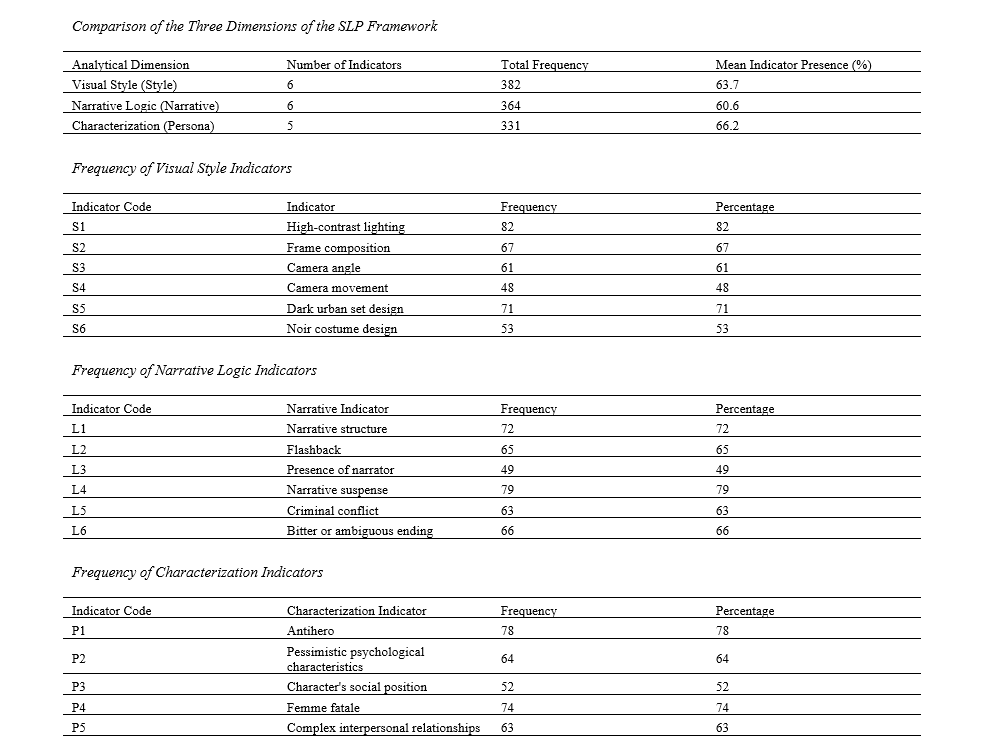
Classic film noir is one of the most influential stylistic movements in the history of cinema, distinguished by visual darkness, complex narrative structures, and morally ambiguous characters. Although this genre has been widely examined, much existing scholarship has treated its visual, narrative, and character dimensions separately, with limited attention to the systematic interaction among these structural levels. This study proposes a preliminary structural model of classic film noir within the SLP framework and examines the co-occurrence of visual style, narrative logic, and characterization. Methodologically, the study adopts a quantitative-analytical design based on systematic content analysis. The research population consisted of classic American film noir productions from the 1940s and 1950s, from which 100 prominent films were selected through purposive sampling. Data were collected through direct observation of the films and binary coding of indicators related to visual style, narrative logic, and characterization. Intercoder reliability was assessed using Cohen's kappa coefficient (κ = .81). The findings showed that characterization indicators had the highest mean presence (66.2%), followed by visual style (63.7%) and narrative logic (60.6%). High-contrast lighting, narrative suspense, and the presence of the antihero were among the most frequently observed indicators. Phi correlation analysis indicated that several pre-defined indicators appeared in clustered co-occurrence patterns. These results suggest that classic film noir may be understood as a multilayered system shaped by the association of visual, narrative, and character elements. The proposed model is therefore interpreted as an exploratory content-analysis model rather than as a fully validated causal or computational model.
Downloads
References
Antoniak, K. (2020). Film noir: (Re)constructing the definition. Rocznik Komparatystyczny, 11, 265-277. https://doi.org/10.18276/rk.2020.11-14
Brammer, R., Hackett, L. J., & Coghlan, J. (2025). From noir to neo-noir: The evolution, hybridity, and liminality of the classic crime genre. M/C Journal, 28(1). https://doi.org/10.5204/mcj.3150
Cohen, J. (1960). A coefficient of agreement for nominal scales. Educational and Psychological Measurement, 20(1), 37-46. https://doi.org/10.1177/001316446002000104
Dennon, A. (2017). The emergence of the feminist fatale in American film noir https://digitalcommons.cwu.edu/etd/630/
Dickos, A. (2002). Street with no name: A history of the classic American film noir. University Press of Kentucky. https://books.google.com/books?hl=en&lr=&id=fzITxfrGT4IC&oi=fnd&pg=PR9&dq=Dickos,+A.+(2002).+Street+with+no+name:+A+history+of+the+classic+American+film+noir,+University+Press+of+Kentucky.+%09&ots=tlXkOSHtH8&sig=abxB1htt5gAn3xmKRWGYi-Fdpq0
Dorval, P. (2024). The Crimson Curtain (1952) in the mirror of A Double Life (1947): The film noir tradition (plot, characters, setting). Shakespeare on Screen in Francophonia, 6. https://hal.science/hal-04905887/
Duan, P., Wang, Y., & Niu, W. (2023). Materialized languages and objectified bodies: Film noir from the perspective of the Theatre of Cruelty. TECHART: Journal of Arts and Imaging Science, 10(2), 7-12. https://doi.org/10.15323/techart.2023.6.10.2.7
Hockley, L. (2021). Film noir: Archetypes or stereotypes? In Jung and Film (pp. 177-193). Routledge. https://doi.org/10.4324/9781315783284-13
Krippendorff, K. (2019). Content analysis: An introduction to its methodology. SAGE. https://doi.org/10.4135/9781071878781
Markhaichuk, N., Riabukha, N., & Tarasov, V. (2021). Black movies: Genre memory of the noir film language in the system of audiovisual transformations (1970s-2010s). The Journal of V. N. Karazin Kharkiv National University: Theory of Culture and Philosophy of Science, 63, 57-67. https://doi.org/10.26565/2306-6687-2021-63-07
McHugh, M. L. (2012). Interrater reliability: The kappa statistic. Biochemia Medica, 22(3), 276-282. https://doi.org/10.11613/BM.2012.031
Murphy, R. (2019). British film noir. In European Film Noir (pp. 84-111). Manchester University Press. https://doi.org/10.7765/9781526141361.00010
Neuendorf, K. A. (2017). The content analysis guidebook. SAGE. https://doi.org/10.4135/9781071873045
Patton, M. Q. (2015). Qualitative research & evaluation methods. SAGE. https://cir.nii.ac.jp/crid/1971430859763109203/holdings
Pazdrijan, E. (2018). Noir film i femme fatale http://repository.ffri.uniri.hr/object/ffri:1340
Porter, Y. D. (2025). Shadowed identities: The (Mis)representation of minorities in classic film noir https://pdxscholar.library.pdx.edu/honorstheses/1647/
Rodriguez Martinez, D. (2022). Film noir sensibilities https://conservancy.umn.edu/items/a95e1ea7-c3ef-4d4b-ba13-91d8cdd91173
Shetley, V. (2026). Dark film, blood money: The economic unconscious of American neo-noir cinema. https://intellectdiscover.com/content/books/9781835952290
Smith, S. G. (2024). The filter and the viewer: On audience discretion in film noir. Film-Philosophy, 28(2), 375-394. https://doi.org/10.3366/film.2024.0273
Vanden Bossche, D. (2023). Looking for low-key: Noir and neo-noir from a cinematographic perspective. Journal of Media and Communication Studies, 15(1), 1-12. https://doi.org/10.5897/JMCS2022.0788
Wager, J. B. (2017). Jazz and cocktails: Rethinking race and the sound of film noir. University of Texas Press. https://doi.org/10.7560/312261
Zhang, Y. (2024). Analysis of technological development and enhancement in modern film noir. Art and Society, 3(3), 70-73. https://doi.org/10.56397/AS.2024.06.08
Zhou, Y. (2022). Noir elements of neo-noir: An analysis of Quentin Tarantino and David Fincher. Frontiers in Art Research, 4(16). https://doi.org/10.25236/FAR.2022.041608
Downloads
Publication Timeline
- Submitted
- Revised
- Accepted