Designing a Paradigmatic Model for Boxing Development in Iraq: A Grounded Theory Approach and Data-Based Analysis
Keywords:
boxing development, Iraq, grounded theory, sport management, sport policy, sport governance, martial sportsAbstract
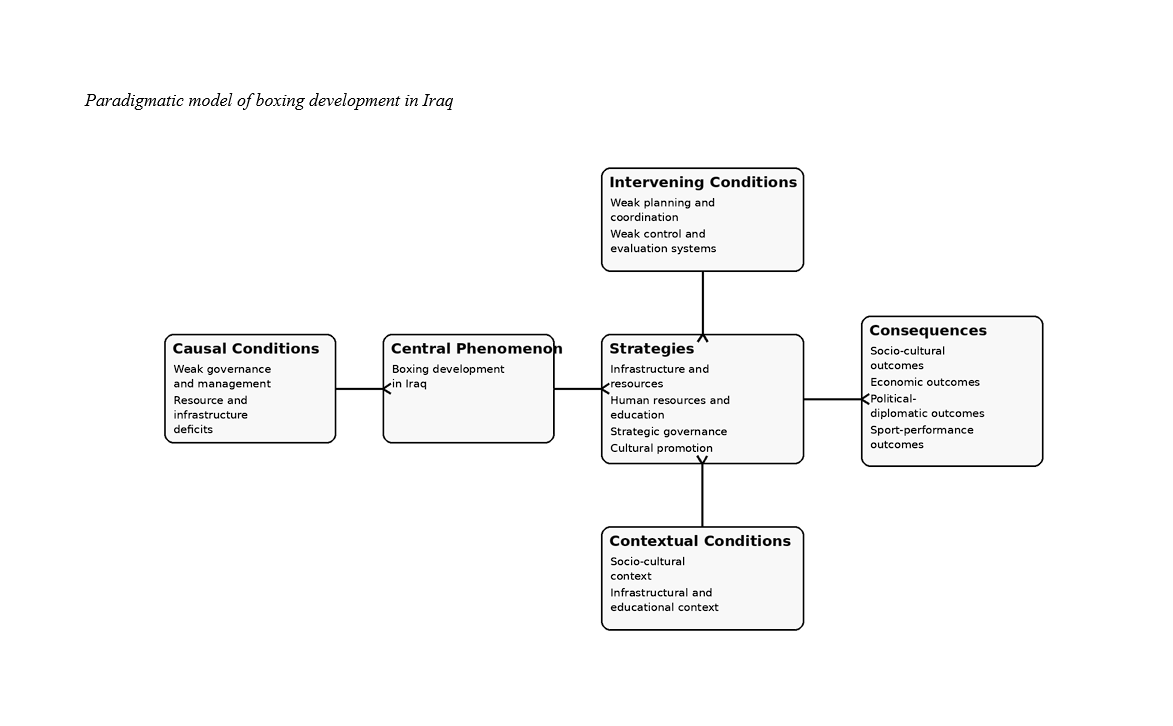
This qualitative study designed a paradigmatic model for the development of boxing in Iraq. Boxing has considerable potential to support social cohesion, youth development, economic activity, women’s empowerment, and sport diplomacy, yet its development in Iraq remains constrained by governance weaknesses, resource shortages, infrastructural deficits, socio-cultural barriers, weak planning, and limited monitoring systems. The study used grounded theory based on the Strauss and Corbin approach. Data were collected through semi-structured interviews with 20 participants, including boxing coaches, Iraqi Boxing Federation officials, university academics, and international boxing referees. Purposive and snowball sampling continued until theoretical saturation was reached. The interview data were coded and analyzed using MAXQDA. The analysis produced 153 open codes, 34 axial codes, and 14 selective categories. The findings showed that boxing development in Iraq is shaped by causal conditions, contextual conditions, intervening conditions, strategies, and consequences. Causal conditions included weak governance and resource deficits. Contextual conditions included socio-cultural barriers and insufficient educational and physical infrastructure. Intervening conditions included weak planning, coordination, control, and evaluation. Recommended strategies included infrastructure development, human resource development, strategic governance, international cooperation, digital systems, school-based talent identification, media campaigns, and cultural promotion. Expected consequences included social cohesion, employment generation, improved international representation, sport diplomacy, women’s participation, professional league development, and better athletic performance. The model indicates that boxing development in Iraq cannot be achieved through fragmented interventions. Rather, it requires integrated, simultaneous, and coordinated action across institutional, cultural, financial, educational, and performance domains.
Downloads
References
Charmaz, K. (2014). Constructing grounded theory. SAGE. https://afshinsafaee.ir/wp-content/uploads/2022/10/Introducing-qualitative-methods-Charmaz-Kathy-Constructing-grounded-theory-2014-SAGE-Publications-libgen.li_.pdf
Coalter, F. (2007). A wider social role for sport: Who's keeping the score? Routledge. https://doi.org/10.4324/9780203014615
Coalter, F. (2013). Sport for development: What game are we playing? Routledge. https://doi.org/10.4324/9780203861257
Corbin, J., & Strauss, A. (2015). Basics of qualitative research: Techniques and procedures for developing grounded theory. SAGE. https://www.researchgate.net/profile/Brad-Wuetherick/publication/277197202_Review_Basics_of_Qualitative_Research_Techniques_and_Procedures_for_Developing_Grounded_Theory_3e_Corbin_and_Strauss/links/55d44f6f08ae0a34172296a1/Review-Basics-of-Qualitative-Research-Techniques-and-Procedures-for-Developing-Grounded-Theory-3e-Corbin-and-Strauss.pdf
Dowling, M., Leopkey, B., & Smith, L. (2018). Governance in sport: A scoping review. Journal of Sport Management, 32(5), 438-451. https://doi.org/10.1123/jsm.2018-0032
Giulianotti, R. (2011). Sport, peacemaking and conflict resolution: A contextual analysis and modelling of the sport, development and peace sector. Ethnic and Racial Studies, 34(2), 207-228. https://doi.org/10.1080/01419870.2010.522245
Gordon, B., Wright, P. M., Hemphill, M. A., & Sauni, P. (2021). Inside the black box of a long-term sport-based youth development boxing academy in New Zealand. Sport in Society, 25(10), 1912-1929. https://doi.org/10.1080/17430437.2021.1920928
Hartmann, D., & Kwauk, C. (2011). Sport and development: An overview, critique, and reconstruction. Journal of Sport and Social Issues, 35(3), 284-305. https://doi.org/10.1177/0193723511416986
Houlihan, B., & Green, M. (2008). Comparative elite sport development: Systems, structures and public policy. Butterworth-Heinemann. https://doi.org/10.1016/B978-0-7506-8281-7.50004-X
Hoye, R., & Cuskelly, G. (2007). Sport governance. Elsevier. https://doi.org/10.4324/9780080466965
Ouyang, Y., Lee, P. C., & Ko, L. M. (2023). A systematic review of the development of sport policy research (2000-2020). Sustainability, 15(1), 389. https://doi.org/10.3390/su15010389
Schulenkorf, N., Sherry, E., & Rowe, K. (2016). Sport for development: An integrated literature review. Journal of Sport Management, 30(1), 22-39. https://doi.org/10.1123/jsm.2014-0263
Spaaij, R. (2009). Personal and social change in and through sport: Cross-cutting themes. Sport in Society, 12(9), 1265-1268. https://doi.org/10.1080/17430430903137803
Strauss, A., & Corbin, J. (1998). Basics of qualitative research: Techniques and procedures for developing grounded theory. SAGE. https://moodle.znu.edu.ua/pluginfile.php/196150/mod_resource/content/1/
Svensson, P. G., & Woods, H. (2017). A systematic overview of sport for development and peace organisations. Journal of Sport for Development, 5(9), 36-48. https://jsfd.org/2017/09/20/a-systematic-overview-of-sport-for-development-and-peace-organisations/
Thompson, A., Lachance, E. L., Parent, M. M., & Hoye, R. (2023). A systematic review of governance principles in sport. European Sport Management Quarterly, 23(6), 1863-1888. https://doi.org/10.1080/16184742.2022.2077795
United Nations Department of Economic Social Affairs. (2009). Sport for development and peace. https://social.desa.un.org/issues/sport-for-development-and-peace
Downloads
Publication Timeline
- Submitted
- Revised
- Accepted