Modeling Marketing Strategies in Small and Medium-Sized Food Industry Enterprises Using Reinforcement Learning and Natural Language Processing Approaches
DOI:
https://doi.org/10.61838/kman.aitech.5032Keywords:
Marketing Strategies, Small and Medium Enterprises, Food Industry, DQN Algorithm, DistilBERT AlgorithmAbstract
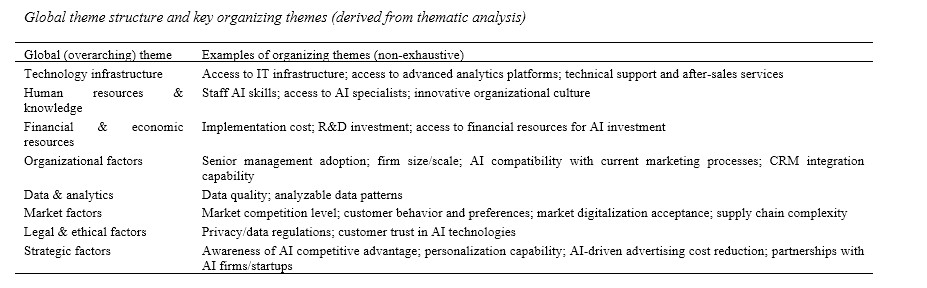
In the age of digital transformations, artificial intelligence serves as a crucial tool for revising marketing patterns, especially for small and medium-sized food industry enterprises that face fierce competition, resource scarcity, diverse customer preferences, and infrastructure limitations. This study aims to design a local model to enhance marketing strategies for these businesses using DQN and DistilBERT algorithms, examining the effective factors, optimizing dynamic decision-making, and analyzing customer behavior. The research methodology employed a mixed qualitative-quantitative approach with an interpretivist philosophy and inductive strategy. In the qualitative phase, semi-structured interviews with 12 experts (theoretical saturation after 10 interviews) and thematic analysis using Attride-Stirling's method were conducted. In the quantitative phase, a five-point Likert scale questionnaire based on 25 organizing themes was distributed to 384 managers and experts (Cronbach's alpha: 0.78 to 0.88; Kolmogorov-Smirnov test: p < 0.08). Findings showed that the average factors ranged from 3.45 to 4.25, with the highest averages for "technology adoption by senior managers" (4.25) and "personalization capability" (4.25). The DQN model achieved an accuracy of 0.94, MSE of 0.15, F1-Score of 0.92, and an average reward of 98.5, while DistilBERT achieved an accuracy of 0.91, Cross-Entropy of 0.12, Precision of 0.89, and Recall of 0.90. The DQN model outperformed with 130 samples, showing errors under 0.3. The conclusion suggests that DQN is suitable for dynamic optimization, and DistilBERT is effective for textual customer analysis. This native model, combining local factors (such as privacy laws and innovative culture), is predicted to increase the competitiveness of food SMEs by 25% in conversion rates and reduce forecasting costs by 15%, offering a practical solution for the Iranian market.
Downloads