Bridging the TPACK Gap: AI Integration in Iranian EFL Context
DOI:
https://doi.org/10.61838/kman.aitech.4091Keywords:
TPACK, AI in EFL, Teacher Perceptions, AI Ethics, Professional DevelopmentAbstract
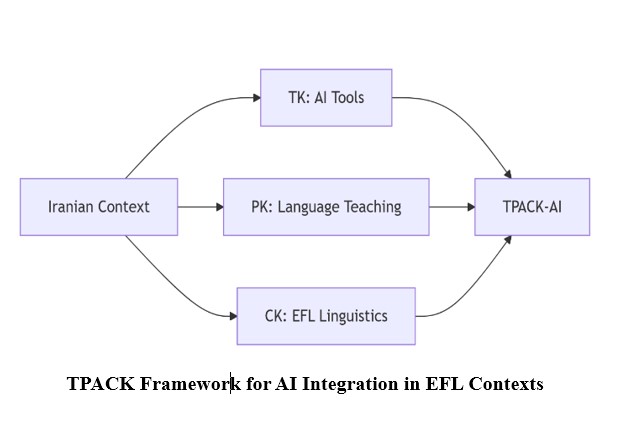
This mixed-methods study, grounded in the Technological Pedagogical Content Knowledge (TPACK) framework, explores Iranian EFL teachers' perceptions and experiences regarding AI integration. Combining a systematic literature review with survey data from 25 teachers, the research reveals strong enthusiasm for AI’s potential to enhance personalization, engagement, and efficiency. However, significant barriers impede effective implementation: pronounced ethical concerns regarding data privacy and bias, a critical need for pedagogical training aligning AI with language teaching goals, and marked disparities in access between well-resourced and underfunded institutions. Qualitative insights further emphasized demands for equitable tool access and strategies preserving essential human interaction, reframing AI as a scaffold rather than a replacement. The findings highlight a critical TPACK misalignment, where contextual constraints dominate. The study concludes that realizing AI's potential requires TPACK-aligned professional development, policy interventions bridging resource gaps, and collaborative frameworks balancing innovation with socio-emotional learning. Implications hold global relevance for similar educational contexts.
Downloads
References
Abatan, A., Jacks, B. S., Ugwuanyi, E. D., Nwokediegwu, Z. Q. S., Obaigbena, A., Daraojimba, A. I., & Lottu, O. A. (2024). The role of environmental health and safety practices in the automotive manufacturing industry. Engineering Science & Technology Journal, 5(2), 531-542. https://doi.org/ https://doi.org/10.51594/estj.v5i2.830
Akinwalere, S., & Ivanov, V. (2022). Artificial Intelligence in Higher Education: Challenges and Opportunities’. Border Crossing, 12(1), 1-15. https://www.ceeol.com/search/article-detail?id=1059714
Alharbi, M. (2024). The role of artificial intelligence in advancing English as a foreign language teaching at Saudi universities. World Journal on Educational Technology: Current Issues, 16(3), 181-200. https://doi.org/https://doi.org/10.18844/wjet.v16i3.9311
Baker, S. E., & Edwards, R. (2012). How many qualitative interviews is enough. http://eprints.ncrm.ac.uk/id/eprint/2273/4/how_many_interviews.pdf
Barnes, E., & Hutson, J. (2024). Navigating the ethical terrain of AI in higher education: Strategies for mitigating bias and promoting fairness. Forum for Education Studies,
Biu, P. W., Nwokediegwu, Z. Q. S., Daraojimba, O. H., Majemite, M. T., & Obaigben, A. (2024). Advancements in geodata analytics: Implications for US energy policy and business investment. World Journal of Advanced Research and Reviews, 21(1), 1422-1439. https://pdfs.semanticscholar.org/7be2/2fc512231693cd08a0c25b4eace32ac473de.pdf
Braun, V., & Clarke, V. (2006). Using thematic analysis in psychology. Qualitative research in psychology, 3(2), 77-101. https://www.tandfonline.com/doi/abs/10.1191/1478088706QP063OA
Bryman, A. (2016). Social research methods. Oxford university press. https://books.google.com/books?hl=en&lr=&id=N2zQCgAAQBAJ&oi=fnd&pg=PP1&dq=Bryman,+A.+(2016).+*Social+research+methods*+(5th+ed.).+Oxford+University+Press.&ots=dqNwKWK2vf&sig=X2ddCFc-dARNxPTLL7jAA50Yt2I
Cachat-Rosset, G., & Klarsfeld, A. (2023). Diversity, equity, and inclusion in artificial intelligence: an evaluation of guidelines. Applied Artificial Intelligence, 37(1), 2176618. https://www.tandfonline.com/doi/abs/10.1080/08839514.2023.2176618
Chen, X., Xie, H., Zou, D., & Hwang, G.-J. (2020). Application and theory gaps during the rise of artificial intelligence in education. Computers and Education: Artificial Intelligence, 1, 100002. https://www.sciencedirect.com/science/article/pii/S2666920X20300023
Chen, X., Zou, D., Xie, H., Cheng, G., & Liu, C. (2022). Two decades of artificial intelligence in education. Educational Technology & Society, 25(1), 28-47. https://www.jstor.org/stable/48647028
Creswell, J. W., & Creswell, J. D. (2017). Research design: Qualitative, quantitative, and mixed methods approaches. Sage publications. https://us.sagepub.com/en-us/nam/research-design/book270550
Dai, K., & Liu, Q. (2024). Leveraging artificial intelligence (AI) in English as a foreign language (EFL) classes: Challenges and opportunities in the spotlight. Computers in Human Behavior, 159, 108354. https://www.sciencedirect.com/science/article/pii/S074756322400222X
de Oliveira Silva, A., & dos Santos Janes, D. (2022). The emergence of ChatGPT and its implications for education and academic research in the 21st century. Review of Artificial Intelligence in Education, 3, e6-e6. https://raie.emnuvens.com.br/revista/article/view/6
Dizon, G., & Tang, D. (2020). Intelligent personal assistants for autonomous second language learning: An investigation of Alexa. The JALT Call Journal, 16(2), 107-120. http://www.castledown.com/journals/jaltcall/article/view/jaltcall.v16n2.273
Falaiye, T., Elufioye, O. A., Awonuga, K. F., Ibeh, C. V., Olatoye, F. O., & Mhlongo, N. Z. (2024). Financial inclusion through technology: a review of trends in emerging markets. International Journal of Management & Entrepreneurship Research, 6(2), 368-379. https://www.researchgate.net/profile/Titilola-Falaiye/publication/378297617_FINANCIAL_INCLUSION_THROUGH_TECHNOLOGY_A_REVIEW_OF_TRENDS_IN_EMERGING_MARKETS/links/65d40d8be51f606f997ba5c7/FINANCIAL-INCLUSION-THROUGH-TECHNOLOGY-A-REVIEW-OF-TRENDS-IN-EMERGING-MARKETS.pdf
Fitria, T. N. (2021). Artificial intelligence (AI) in education: Using AI tools for teaching and learning process. Prosiding seminar nasional & call for paper STIE AAS,
Fukuda‐Parr, S., & Gibbons, E. (2021). Emerging consensus on ‘ethical AI’: Human rights critique of stakeholder guidelines. Global Policy, 12, 32-44. https://onlinelibrary.wiley.com/doi/abs/10.1111/1758-5899.12965
Gašević, D., Siemens, G., & Sadiq, S. (2023). Empowering learners for the age of artificial intelligence. 4, 100130. https://www.sciencedirect.com/science/article/pii/S2666920X23000097
Guest, G., Bunce, A., & Johnson, L. (2006). How many interviews are enough? An experiment with data saturation and variability. Field methods, 18(1), 59-82. https://journals.sagepub.com/doi/abs/10.1177/1525822x05279903
Gutiérrez, L. (2023). Artificial intelligence in language education: Navigating the potential and challenges of chatbots and NLP. Research Studies in English Language Teaching and Learning, 1(3), 180-191. https://pdfs.semanticscholar.org/d54e/643298a64522d25052c59f7a843c15e1a131.pdf
Hsu, T.-C., Chang, C., & Jen, T.-H. (2024). Artificial intelligence image recognition using self-regulation learning strategies: effects on vocabulary acquisition, learning anxiety, and learning behaviours of English language learners. Interactive Learning Environments, 32(6), 3060-3078. https://www.tandfonline.com/doi/abs/10.1080/10494820.2023.2165508
Junaidi, J. (2020). Artificial intelligence in EFL context: rising students’ speaking performance with Lyra virtual assistance. International Journal of Advanced Science and Technology Rehabilitation, 29(5), 6735-6741. https://repository.unilak.ac.id/1512/3/Artificial%20Intelligence%20in%20EFL%20Context-%20Rising%20Students%E2%80%99%20Speaking%20Performance%20with%20Lyra%20Virtual%20Assistance.pdf
Kolog, E. A., Odoi Devine, S. N., Egala, S. B., Amponsah, R., Budu, J., & Farinloye, T. (2022). Rethinking the implementation of artificial intelligence for a sustainable education in Africa: Challenges and solutions. In Management and Information Technology in the Digital Era: Challenges and Perspectives (pp. 27-46). Emerald Publishing Limited. https://www.emerald.com/insight/content/doi/10.1108/s1877-636120220000029003/full/html
Lampou, R. (2023). The integration of artificial intelligence in education: Opportunities and challenges. Review of Artificial Intelligence in Education, 4, e15-e15. https://educationai-review.org/revista/article/view/15
Leta, F. M., & Vancea, D. P. C. (2023). Ethics in education: Exploring the ethical implications of artificial intelligence implementation. Ovidius university annals, economic sciences series, 23(1), 413-421. https://ibn.idsi.md/sites/default/files/j_nr_file/Full%20Vol.%20XXIII%20Issue%201%202023.pdf#page=427
Luo, M., & Cheng, L. (2020). Exploration of interactive foreign language teaching mode based on artificial intelligence. 2020 International Conference on Computer Vision, Image and Deep Learning (CVIDL),
Ma, G. (2020). The current situations of mobile assisted language learning. International Conference on Machine Learning and Big Data Analytics for IoT Security and Privacy,
Mishra, P., & Koehler, M. J. (2006). Technological pedagogical content knowledge: A framework for teacher knowledge. Teachers college record, 108(6), 1017-1054. https://journals.sagepub.com/doi/abs/10.1111/j.1467-9620.2006.00684.x
Morrison, K. (2017). Research methods in education. Routledge. https://doi.org/ https://doi.org/10.4324/9781315456539
Noviyanti, S. D. (2020). Artificial intelligence (AI)-Based pronunciation checker: an alternative for independent learning in pandemic situation. ELT Echo: The Journal of English Language Teaching in Foreign Language Context, 5(2), 162-169. https://www.academia.edu/download/82039539/pdf_51.pdf
Ogunjobi, O. A., Eyo-Udo, N. L., Egbokhaebho, B. A., Daraojimba, C., Ikwue, U., & Banso, A. A. (2023). Analyzing historical trade dynamics and contemporary impacts of emerging materials technologies on international exchange and us strategy. Engineering Science & Technology Journal, 4(3), 101-119. https://doi.org/https://doi.org/10.51594/estj.v4i3.554
Onesi-Ozigagun, O., Ololade, Y. J., Eyo-Udo, N. L., & Ogundipe, D. O. (2024). Revolutionizing education through AI: a comprehensive review of enhancing learning experiences. International Journal of Applied Research in Social Sciences, 6(4), 589-607. https://www.researchgate.net/profile/Nsisong-Eyo-Udo/publication/388105499_REVOLUTIONIZING_EDUCATION_THROUGH_AI_A_COMPREHENSIVE_REVIEW_OF_ENHANCING_LEARNING_EXPERIENCES/links/678a2d8898c4e967fa6711dd/REVOLUTIONIZING-EDUCATION-THROUGH-AI-A-COMPREHENSIVE-REVIEW-OF-ENHANCING-LEARNING-EXPERIENCES.pdf
Pokrivčáková, S. (2019). Preparing teachers for the application of AI-powered technologies in foreign language education. Journal of language and cultural education. https://sciendo.com/pdf/10.2478/jolace-2019-0025
Popescu, A. (2023). AI's secret weapon in education. ChatGPT–The Future of Personalized Learning. Bulletin of the Transilvania University of Brasov. Series V: Economic Sciences, 45-52. https://webbut.unitbv.ro/index.php/Series_V/article/view/6816
Sari, N. (2023). The role of artificial intelligence (AI) in developing English language learner’s communication skills. Journal on Education, 6(01), 750-757. https://core.ac.uk/download/pdf/568058705.pdf
Schmidt, T., & Strasser, T. (2022). Artificial intelligence in foreign language learning and teaching: a CALL for intelligent practice. Anglistik: International Journal of English Studies, 33(1), 165-184. https://www.researchgate.net/profile/Torben-Schmidt-3/publication/360638238_Artificial_Intelligence_in_Foreign_Language_Learning_and_Teaching/links/656ae2dbce88b87031281fd9/Artificial-Intelligence-in-Foreign-Language-Learning-and-Teaching.pdf
Umar, U. (2024). Advancements in English Language Teaching: Harnessing the Power of Artificial Intelligence. Foreign Language Instruction Probe, 3 (1), 29-42. https://doi.org/https://doi.org/10.54213/flip.v3i1.402
Vuong, Q.-H., La, V.-P., Nguyen, M.-H., Jin, R., La, M.-K., & Le, T.-T. (2023). How AI’s self-prolongation influences people’s perceptions of its autonomous mind: the case of US residents. Behavioral Sciences, 13(6), 470. https://www.mdpi.com/2076-328X/13/6/470
Vygotsky, L. S. (1978). Mind in society: The development of higher psychological processes (Vol. 86). Harvard university press. https://books.google.com/books?hl=en&lr=&id=RxjjUefze_oC&oi=fnd&pg=PA1&dq=Vygotsky,+L.+S.+(1978).+Mind+in+society:+Development+of+higher+psychological+processes.+Harvard+UP&ots=okAZY3n-co&sig=cAbtnO_LM8pNybzuiVC9H78DqvU
Xu, X., Dugdale, D. M., Wei, X., & Mi, W. (2023). Leveraging artificial intelligence to predict young learner online learning engagement. American Journal of Distance Education, 37(3), 185-198. https://www.tandfonline.com/doi/abs/10.1080/08923647.2022.2044663
Xu, Z., Wijekumar, K., Ramirez, G., Hu, X., & Irey, R. (2019). The effectiveness of intelligent tutoring systems on K‐12 students' reading comprehension: A meta‐analysis. British Journal of Educational Technology, 50(6), 3119-3137. https://bera-journals.onlinelibrary.wiley.com/doi/abs/10.1111/bjet.12758
Downloads
Additional Files
Publication Timeline
- Submitted
- Revised
- Accepted
Issue
Section
License
Copyright (c) 2024 Mohammad Reza Khodadust (Corresponding Author); Azin Khodadust, Fatemeh Faramarzi Kohnehshahri, Somayyeh Hashemi (Author)

This work is licensed under a Creative Commons Attribution-NonCommercial 4.0 International License.