Effectiveness of Emotion-Focused Family Therapy on Marital Intimacy and Psychological Flexibility in Couples with Marital Conflict
Keywords:
Emotion-Focused Family Therapy, Marital Intimacy, Psychological Flexibility, Marital Conflict, CouplesAbstract
Objective: This study aimed to investigate the effectiveness of emotion-focused family therapy in improving marital intimacy and psychological flexibility among couples experiencing marital conflict.
Methods and Materials: This applied study employed a quasi-experimental pretest–posttest design with a control group. The statistical population consisted of couples with marital conflict who attended counseling and family service centers in 2026. Using purposive sampling, 30 couples were recruited and randomly assigned to an experimental group and a control group, with 15 couples in each group. The experimental group received emotion-focused family therapy, whereas the control group received no intervention during the study period. Data were collected using the Thompson and Walker Marital Intimacy Scale and the Cognitive Flexibility Inventory developed by Dennis and Vander Wal. The collected data were analyzed using multivariate analysis of covariance (MANCOVA) followed by univariate analysis of covariance (ANCOVA) in SPSS version 26, with pretest scores statistically controlled when examining posttest differences between the groups.
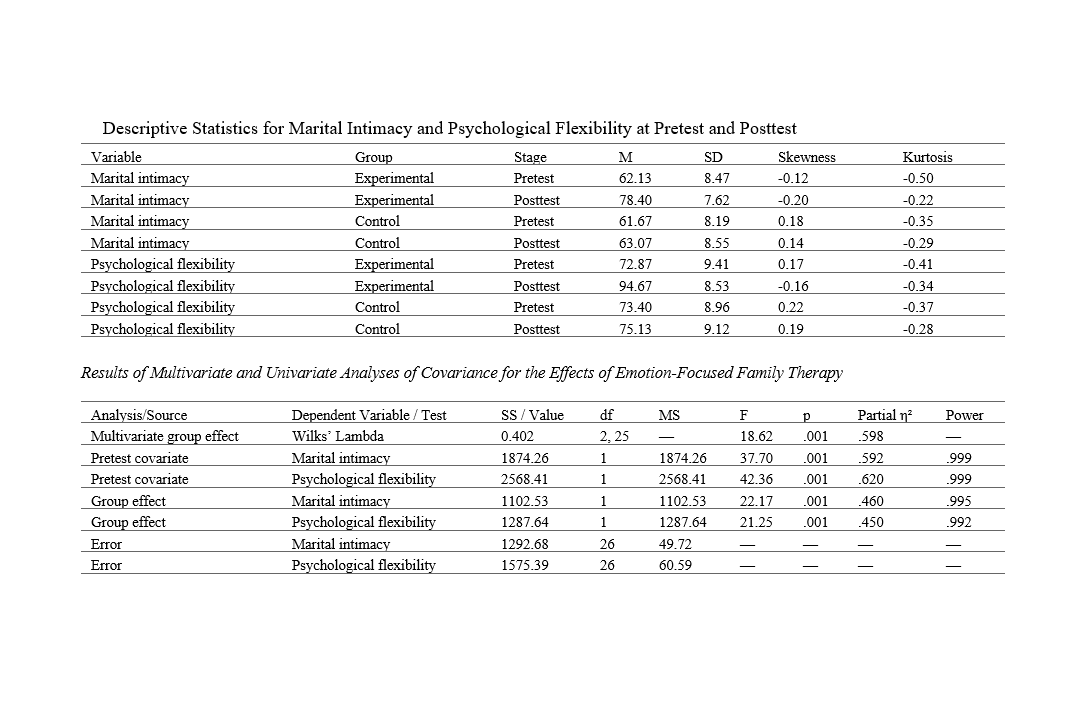
Findings: The multivariate analysis indicated that the overall effect of group membership on the combined dependent variables was statistically significant (p < .001), demonstrating a significant difference between the experimental and control groups after controlling for baseline scores. The univariate analyses further showed that emotion-focused family therapy produced a significant increase in marital intimacy compared with the control condition, F(1, 26) = 22.17, p < .001, partial η² = .460. A statistically significant intervention effect was also observed for psychological flexibility, F(1, 26) = 21.25, p < .001, partial η² = .450. The effect sizes indicated that approximately 46.0% of the adjusted variance in marital intimacy and 45.0% of the adjusted variance in psychological flexibility were attributable to group membership, supporting a substantial intervention effect on both outcomes.
Conclusion: Emotion-focused family therapy appears to be an effective intervention for enhancing marital intimacy and psychological flexibility among couples experiencing marital conflict. By facilitating emotional experience and regulation, restructuring maladaptive interactional patterns, and strengthening emotional connection between partners, this therapeutic approach may improve both relational closeness and couples’ capacity to respond flexibly to stressful interpersonal situations. Its application in couple and family counseling settings is therefore supported, while future studies should examine the durability of these effects using larger samples and long-term follow-up assessments.
Downloads
References
Behrang, K., Karaei, A., Shahbazi, M., & Abbaspour, Z. (2022). The Effectiveness of Emotionally Focused Couple Therapy on Intimacy and Marital Harmony in Distressed Couples. Journal of Health Reports and Technology, 8(1), e118504.
Carr, A. (2025). Couple Therapy and Systemic Interventions for Adult-Focused Problems: The Evidence Base. Journal of Family Therapy, 47(1), e12481. https://doi.org/10.1111/1467-6427.12481
Haghighatbayan, N., Nasiri, S., Malekian, M., Mousavi, S. M., & Jafari, S. (2022). Comparing the Effectiveness of Emotion-Focused Therapy and Acceptance and Commitment Therapy on Post-Traumatic Stress and Post-Traumatic Growth in Individuals with Post-Traumatic Stress Disorder in Tehran. Journal of Mashhad University of Medical Sciences, 65(6), e23422.
Karakurt, G., Katta, P., Apte, S., Choi, J., Doan, C., Gole, S., & Jordan, S. (2023). Using Micro-Analyzing Tools to Investigate Therapist Skills in Emotionally Focused Couples Therapy with Couples in a High-Conflict Relationship. Journal of systemic therapies, 42(1), 74-95. https://doi.org/10.1521/jsyt.2023.42.1.74
Lu, L., Wilder, S., & Prager, K. J. (2025). Intimacy Reduces Withdrawal after Conflict in Cohabiting Couples. Journal of Social and Personal Relationships, 42(10). https://doi.org/10.1177/02654075251355074
Ma, H., Cariola, L., & Gillanders, D. (2025). Exploring the Role of Psychological Flexibility in Relationship Functioning among Couples Coping with Prostate Cancer: A Cross-Sectional Study. Supportive Care in Cancer, 33(3), 186. https://doi.org/10.1007/s00520-025-09229-8
Ma, H., Yang, Y., Li, Y., Cariola, L., & Gillanders, D. (2025). Effectiveness of Psychological Interventions in Improving Relationship Functioning among Couples Coping with Prostate Cancer: A Systematic Review and Meta-Analysis. Psycho-Oncology, 34(1), e70080. https://doi.org/10.1002/pon.70080
McKibben, W. B., Lenz, A. S., & Alvero, A. (2024). A Meta-Analysis of the Association between the Hold Me Tight Program and Couples' Relationship Adjustment. Counseling Outcome Research and Evaluation, 16(1), 77-91. https://doi.org/10.1080/21501378.2024.2413052
Mirzazade, Z., Molazade, J., Hadianfard, H., & Taghavi, M. R. (2025). The Effect of Emotionally Focused Couple Therapy (EFCT) on Shame and Intimacy in Couples: A Randomized Controlled Trial. BMC psychology, 13, 1111. https://doi.org/10.1186/s40359-025-03415-3
Rafiei, M., Salehi, A., Yousefi, T., Samadi, S., & Jafari, S. (2022). The Effectiveness of Emotion-Focused Therapy and Intensive Short-Term Dynamic Psychotherapy on Personality Organization and Ego Strength in Individuals with Tension-Type Headache. Journal of Mashhad University of Medical Sciences, 65(6), e23688.
Sherlow-Levin, A., Ben Shahar, I., Goldman, R., & Bar-Kalifa, E. (2024). Applying the Rupture Resolution Rating System to Emotion-Focused Couple Therapy. Journal of marital and family therapy, 50(4), 801-820. https://doi.org/10.1111/jmft.12723
Spengler, P. M., Lee, N. A., Wiebe, S. A., & Wittenborn, A. K. (2024). A Comprehensive Meta-Analysis on the Efficacy of Emotionally Focused Couple Therapy. Couple and family psychology: Research and practice, 13(2), 81-99. https://doi.org/10.1037/cfp0000233
Tseng, C. F., Wittenborn, A. K., Morgan, P. C., & Liu, T. (2024). Exploring the Effectiveness of Emotionally Focused Therapy for Depressive Symptoms and Relationship Distress among Couples in Taiwan: A Single-Arm Pragmatic Trial. Journal of marital and family therapy, 50(1), 202-217. https://doi.org/10.1111/jmft.12681
van Diest, S. L., den Oudsten, B. L., Aaronson, N. K., Beaulen, A., Verboon, P., Aarnoudse, B., & van Lankveld, J. J. D. M. (2023). Emotionally Focused Couple Therapy in Cancer Survivor Couples with Marital and Sexual Problems: A Replicated Single-Case Experimental Design. Frontiers in psychology, 14, 1123821. https://doi.org/10.3389/fpsyg.2023.1123821
White VanBoxel, J. M. (2024). Exploring Associations among Baseline Emotion Regulation and Change in Relationship Satisfaction among Couples in a Randomized Controlled Trial of Emotionally Focused Therapy Compared to Usual Care. Family Process. https://doi.org/10.1111/famp.12972
Zahedi, H., Alizadeh-Dibazari, Z., Mirghafourvand, M., Sahebihagh, M. H., & Hosseinzadeh, M. (2024). The Effectiveness of Couple-Based Interventions on the Marital Outcomes of Women with Genital and Breast Cancer and Their Partners: A Systematic Review and Meta-Analysis. BMC Cancer, 24, 391. https://doi.org/10.1186/s12885-024-12088-x
Downloads
Additional Files
Publication Timeline
- Submitted
- Revised
- Accepted