Explaining the Formation Process and Examining the Causes and Consequences of Unhealthy Relationships in Iranian Families and Providing Guidelines for Their Reduction: A Constructivist Grounded Theory Study
Keywords:
Constructivist Grounded Theory, Dysfunctional Family Relationships, Iranian Family, Marital Problems, Unhealthy RelationshipsAbstract
Objective: This study aimed to explain the process through which unhealthy relationships develop in Iranian families, identify their underlying causes and consequences, and formulate context-sensitive guidelines for preventing and reducing such relationships.
Methods and Materials: This qualitative study employed Charmaz’s constructivist grounded theory approach. Participants were 15 divorced Iranian women residing in Tehran in 2025 who had experienced unhealthy marital relationships. Participants were recruited through criterion-based purposive sampling, and data collection continued until theoretical saturation was achieved. Data were obtained through in-depth semi-structured interviews and analyzed concurrently with data collection using open, focused, and theoretical coding. Constant comparison, iterative category development, and theoretical integration were applied to construct an explanatory model of unhealthy family relationships.
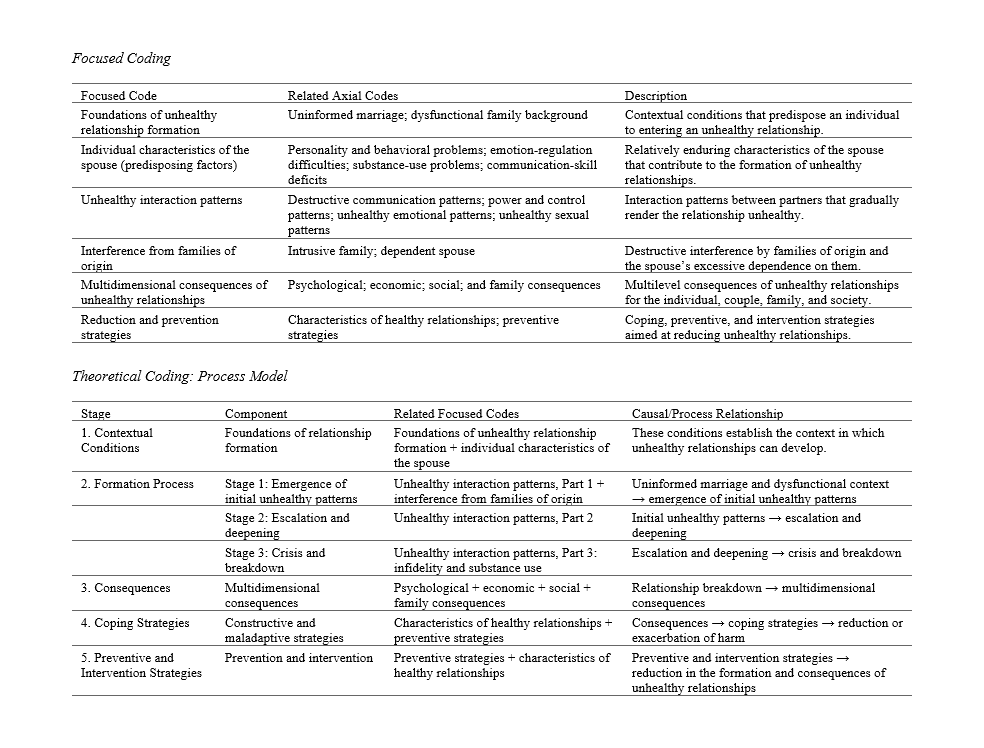
Findings: Data analysis generated 105 open codes, 18 axial codes, and six focused categories. The emergent theoretical model, conceptualized as the “Vicious Cycle of Unhealthy Relationships in Iranian Families,” demonstrated that unhealthy relationships develop through an interconnected process involving contextual conditions, relationship deterioration, multidimensional consequences, coping responses, and preventive or intervention strategies. Contextual conditions consisted primarily of uninformed marriage and dysfunctional family backgrounds. The developmental process progressed from the establishment of initial unhealthy patterns to their escalation and deepening, followed by relational crisis and breakdown. Consequences were manifested across psychological, economic, social, and familial domains. Participants adopted both constructive and maladaptive coping strategies. The findings further indicated that, without timely intervention, unhealthy relationship patterns may become self-perpetuating and potentially transmitted across generations.
Conclusion: Unhealthy relationships in Iranian families represent a multidimensional and dynamic phenomenon rooted simultaneously in individual, couple, family, and broader social processes. Effective reduction therefore requires multilevel, culturally sensitive interventions emphasizing premarital preparation, couple counseling, communication and emotion-regulation skills, early identification of dysfunctional patterns, and family-centered support programs.
Downloads
References
Aflatouni, M., Khodadadi Sangdeh, J., & Farahbakhsh, K. (2022). The Role of Adjustment in the Early Stages of Marriage in Its Stabilization. Cultural Psychology, 6(1), 235-257.
Albuja, A. F., West, A., & Gaither, S. E. (2022). Two or More: A Comparative Analysis of Multiracial and Multicultural Research. Cambridge University Press. https://dukespace.lib.duke.edu/server/api/core/bitstreams/1bb48b0b-41a9-4983-bdf0-1d7db3d2dc49/content
Dewi, S. F., Montessori, M., Saputra, R. A., Farsalena, S., Fatmariza, F., Febriani, R., & Yulika, F. (2019). The Role of Culture in Cross-Cultural Marriage among Minangkabau Women. Journal of International Women's Studies, 20(9), 68-82. https://vc.bridgew.edu/cgi/viewcontent.cgi?article=2199&context=jiws
Ghasemi, S., Etemadi, O., & Ahmadi, S. A. (2016). Identifying Interactive Harms between Couples and the Spouse's Family and Their Consequences: A Qualitative Study. Journal of Qualitative Research in Health Sciences, 5(3), 250-262.
Girgis, S., Anderson, R. T., & George, R. (2020). What Is Marriage?: Man and Woman: A Defense. Encounter Books. https://books.google.com/books/about/What_Is_Marriage.html?id=TpfxW4tOVAQC
Gottman, J. M., & Tabares, A. (2018). The Effects of Briefly Interrupting Marital Conflict. Journal of marital and family therapy, 44(1), 61-72. https://doi.org/10.1111/jmft.12243
Griffin, J. M., Kruger, S., & Maturana, G. (2019). Personal Infidelity and Professional Conduct in 4 Settings. Proceedings of the National Academy of Sciences of the United States of America, 116(33), 16268-16273. https://doi.org/10.1073/pnas.1905329116
He, Q., Zhong, M., Tong, W., Lan, J., Li, X., Ju, X., & Fang, X. (2018). Forgiveness, Marital Quality, and Marital Stability in the Early Years of Chinese Marriage: An Actor-Partner Interdependence Mediation Model. Frontiers in psychology, 9, 1520. https://doi.org/10.3389/fpsyg.2018.01520
Hosseini, S., Mousavi, S. A. M., & Shomalyoskoei, A. (2026). The Mediating Role of Frustration Tolerance in the Relationship Between Early Maladaptive Schemas, Self-Differentiation, and Marital Conflict in Individuals Applying for Divorce. Applied Family Therapy Journal, 7(4), 1-12. https://doi.org/10.61838/kman.aftj.6332
Huang, Y. T., Chen, M. H., Hu, H. F., Ko, N. Y., & Yen, C. F. (2020). Role of Mental Health in the Attitude toward Same-Sex Marriage among People in Taiwan: Moderating Effects of Gender, Age, and Sexual Orientation. Journal of the Formosan Medical Association, 119(1 Pt 1), 150-156. https://doi.org/10.1016/j.jfma.2019.03.011
Huntington, C., Stanley, S. M., Doss, B. D., & Rhoades, G. K. (2022). Happy, Healthy, and Wedded? How the Transition to Marriage Affects Mental and Physical Health. Journal of Family Psychology, 36(4), 608-617. https://doi.org/10.1037/fam0000913
Isa Morad, A. (2023). Problem Identification of Dimensions in the Iranian Family: A Psychological Analysis. Cultural Psychology, 7(2), 268-287.
Kanaani, M. A., & Alijani, M. (2021). Infidelity Relationships and Their Contexts: A Qualitative Study in Rasht. Sociology of Social Institutions, 8(18), 273-296.
Koçyiğit, M., & Uzun, M. (2024). Couple Burnout and Marital Satisfaction: Serial Mediation by Mindfulness and Emotion Regulation. The American Journal of Family Therapy, 52(5), 575-593. https://psycnet.apa.org/record/2024-73511-001
Krok, D., Telka, E., & Moroń, M. (2023). Marital Satisfaction, Partner Communication, and Illness Acceptance among Couples Coping with Breast Cancer: A Dyadic Approach. Psycho-Oncology, 32(8), 1240-1247. https://doi.org/10.1002/pon.6174
Masoumirad, H., Jahangir, P., & Rezakhani, S. (2026). Presenting a Model for Predicting Marital Burnout Based on Experiential Avoidance and Relationship Beliefs with the Mediation of Forgiveness in Married Women Referring to Counseling Centers in Tehran. Applied Family Therapy Journal, 7(1), 1-12. https://doi.org/10.61838/kman.aftj.6332
Obioma, I. F., Raina, M., Jaga, A., Asekun, W. A., Misurya, P., & Hernandez Bark, A. S. (2025). Gender and Marital Burnout within Four Countries: Examining the Effects of Conflict Negotiation Styles. Journal of Social and Personal Relationships, 42(12), 3509-3533. https://doi.org/10.1177/02654075251371383
Pincus, L. (2023). Marriage: Studies in Emotional Conflict and Growth. Taylor & Francis. https://www.taylorfrancis.com/books/edit/10.4324/9781003395355/marriage-lily-pincus
Sarmadi, Y., & Ahmadi, K. (2021). The Extent of Damages Caused by Marital Infidelity among Couples. Family Research, 17(1), 81-98.
Schuler, C., Ntow, G. E., Berner, R., Thet Naing Oo, S., & Pfister, R. E. (2025). Family Systems Care Approaches and Methodologies for Maternal, Newborn and Child Health in Low- and Middle-Income Countries: A Scoping Review. Global Health Action, 18(1), 2567714.
Sharifi Saei, M. H. (2023). Consequences of Marital Infidelity in Iran: A Meta-Synthesis Study. Contemporary Sociological Research, 12(22), 165-204.
Sharifi Saei, M. H., & Azad Armaki, T. (2021). Factors in the Formation of Marital Infidelity in Iran: A Meta-Synthesis Study. Iranian Social Problems, 12(3), 33-74.
Shi, Y., & Whisman, M. A. (2023). Marital Satisfaction as a Potential Moderator of the Association between Stress and Depression. Journal of affective disorders, 327, 155-158. https://doi.org/10.1016/j.jad.2023.01.093
Ślusarczyk, W., Kwiatkowska, K., & Czyżkowska, A. (2024). Satisfaction with the Marital Relationship and the Religiosity of the Spouses. Kwartalnik Naukowy Fides et Ratio, 57(1), 9-24.
Smith-Acuña, S. (2026). Systems Theory in Action: Applications for Individual, Couple, and Family Therapy. John Wiley & Sons.
South, S. C., & Dashineau, S. (2025). Psychopathology and Romantic Relationships: An AMPD Perspective. In Clinical Applications of the DSM-5 Alternative Model for Personality Disorders (pp. 207-224). https://psycnet.apa.org/record/2027-12677-013
Downloads
Additional Files
Publication Timeline
- Submitted
- Revised
- Accepted