A Structural Model of Mothers’ Authoritative Parenting Based on Attachment Styles: The Mediating Roles of Psychological Flexibility and Risk Aversion
Keywords:
Authoritative parenting, attachment styles, psychological flexibility, risk aversion, mothersAbstract
Objective: This study aimed to develop and test a structural model of mothers’ authoritative parenting based on attachment styles, with psychological flexibility and risk aversion as mediating variables.
Methods and Materials: This correlational study employed structural equation modeling. The statistical population comprised all mothers of elementary school students in Shiraz, Iran. Based on Kline’s sample-size guideline, 250 mothers were selected through stratified random sampling. Data were collected using the Parenting Styles and Dimensions Questionnaire developed by Robinson et al. (2001), the Adult Attachment Scale developed by Collins and Read (1990), the Acceptance and Action Questionnaire developed by Bond et al. (2011), and Leahy’s Risk Aversion Scale (2012). The data were analyzed using Pearson correlation coefficients, structural equation modeling, path analysis, and bootstrap procedures.
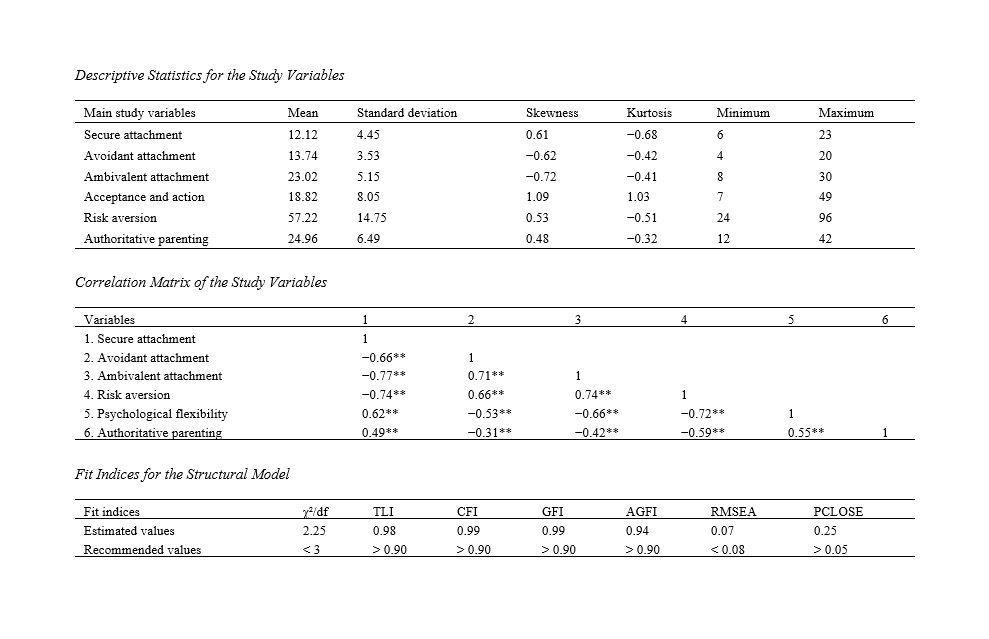
Findings: The final structural model demonstrated an acceptable fit to the observed data. Secure attachment had significant direct and indirect relationships with authoritative parenting through psychological flexibility and risk aversion. Avoidant attachment exerted a significant negative direct effect on authoritative parenting and also produced a significant negative indirect effect through risk aversion. Ambivalent attachment did not have a significant direct effect on authoritative parenting; however, it was indirectly associated with authoritative parenting through psychological flexibility and risk aversion. Psychological flexibility was a significant positive predictor of authoritative parenting, whereas risk aversion was a significant negative predictor. The bootstrap results confirmed the significance of the proposed mediating pathways. Collectively, attachment styles, psychological flexibility, and risk aversion explained 40% of the variance in mothers’ authoritative parenting.
Conclusion: The findings supported the proposed theoretical model and indicated that attachment styles contribute to mothers’ authoritative parenting both directly and indirectly through psychological flexibility and risk aversion. Enhancing psychological flexibility and reducing excessive risk aversion may diminish the adverse effects of insecure attachment patterns and promote more authoritative parent–child interactions.
Downloads
References
Abdollahzadeh Rafi, M., Rafiei Baldaji, M., Mohammadi, H., & Mohammadi, M. (2021). The role of psychological flexibility in parenting and maternal depression in predicting symptoms of conduct disorder in adolescents. Journal of psychiatric nursing, 9(3), 39-49.
Akdemir, K., Banko-Bal, Ç., & Sevimli-Celik, S. (2023). Giving children permission for risky play: Parental variables and parenting styles. Journal of Outdoor and Environmental Education, 26(3), 289-306. https://doi.org/10.1007/s42322-023-00122-8
Bao, L., Kristen, A., Liu, H., Dys, S. P., Gao, Y., Wu, Q., Xiao, B., Xu, J.-J., Zhang, H., Zhang, W., Zhang, Z., & Moretti, M. M. (2025). A Pilot Study of an Attachment‐Based Parenting Intervention for Parents of Adolescents in China: Translation, Modifications, and Preliminary Effectiveness. Family Process, 64(2). https://doi.org/10.1111/famp.70040
Castillo, M. (2020). Negative childhood experiences and risk aversion: Evidence from children exposed to domestic violence (IZA Discussion Paper, Issue. https://docs.iza.org/dp13320.pdf
Chinawa, F. C., Omeje, O., Anike, R. U., Ekwo, J. C., Douglas, J. U., Nwodo, T. O., & Okolo, J. (2024). Parental monitoring and parenting styles as predictors of deviant behaviour among undergraduate students. GPH-International Journal of Educational Research, 7(1), 1-12.
Fonseca, A., Moreira, H., & Canavarro, M. C. (2020). Uncovering the links between parenting stress and parenting styles: The role of psychological flexibility within parenting and global psychological flexibility. Journal of Contextual Behavioral Science, 18, 59-67. https://doi.org/10.1016/j.jcbs.2020.08.004
Hendry, A., Gibson, S. P., Davies, C., McGillion, M., & Gonzalez-Gomez, N. (2023). Toward a dimensional model of risk and protective factors influencing children's early cognitive, social, and emotional development during the COVID-19 pandemic. Infancy, 28(1), 158-186. https://doi.org/10.1111/infa.12495
Leahy, R. L., Tirch, D. D., & Melwani, P. S. (2012). Processes underlying depression: Risk aversion, emotional schemas, and psychological flexibility. International Journal of Cognitive Therapy, 5(4), 362-379. https://doi.org/10.1521/ijct.2012.5.4.362
Mikulincer, M., & Shaver, P. R. (2016). Attachment in Adulthood: Structure, Dynamics, and Change (2nd ed.). Guilford Press.
Pan, B., Wang, Y., Xu, P., Gong, Y., Zhao, C., Miao, J., & Li, Y. (2024). The complex longitudinal influence of paternal and maternal parental psychological flexibility on child problem behavior: Exploring the role of parenting styles. BMC psychology, 12(1), 793. https://doi.org/10.1186/s40359-024-02291-7
Refahi, Z., & Taheri, M. (2019). Predicting mothers' parenting styles based on their early maladaptive schemas and attachment styles. Woman and Society Quarterly, 10(37), 167-196.
Ren, M., Luo, X., Cheng, L., Wu, M., Wang, Y., & Han, X. (2025). Actor and Partner Effects of Coparenting on Marital Quality: Mediating Role of Marital Attachment. Family Relations. https://doi.org/10.1111/fare.13169
Savela, M. (2025). Parental Empowerment and Child–parent Attachment: A Qualitative Study of the Circle of Security-Parenting Programme. Health Education Journal. https://doi.org/10.1177/00178969251325366
Singh, A., & Pandey, N. (2025). Perceived Parenting and Attachment Style in Young Adults: A Review. Indian Journal of Positive Psychology, 16(1), 163-168.
Veríssimo, C., Pereira, L., Fernandes, A., & Martinho, R. (2024). Complex problem solving as a source of competitive advantage. Journal of Open Innovation: Technology, Market, and Complexity, 10(2), 100258. https://doi.org/10.1016/j.joitmc.2024.100258
Vigdal, J. S., & Brønnick, K. K. (2022). A systematic review of helicopter parenting and its relationship with anxiety and depression. Frontiers in psychology, 13, 872981. https://doi.org/10.3389/fpsyg.2022.872981
Yang, C., Li, F., & Khalid, N. F. (2025). Disordered Eating in Young Chinese Adults: Role of Parenting Styles, Attachment Anxiety, and Negative Coping Styles. BMC public health, 25(1). https://doi.org/10.1186/s12889-025-23071-x
Zaal, B. A. A., & GhR, S. M. (2020). Comparing the effects of forgiveness and self-compassion training on marital conflicts in females facing marital infidelity. MEJDS, 10, 192.
Zheng, W., Akaliyski, P., Ma, C., & Xu, Y. (2024). Cognitive flexibility and academic performance: Individual and cross-national patterns among adolescents in 57 countries. Personality and individual differences, 217, 112455. https://doi.org/10.1016/j.paid.2023.112455
Downloads
Additional Files
Publication Timeline
- Submitted
- Revised
- Accepted