Identifying the Development of Trust in Step-Parent–Child Relationships
DOI:
https://doi.org/10.61838/kman.aftj.5025Keywords:
Trust development, stepfamilies, qualitative research, emotional disclosure, communication, Georgia, family relationshipsAbstract
Objective: This study aimed to identify and describe the lived experiences, relational mechanisms, and developmental trajectories involved in the formation of trust between step-parents and children in Georgian stepfamilies.
Methods and Materials: A qualitative research design with a phenomenological approach was employed to explore participants’ subjective experiences of trust development. The study involved 20 participants from various regions of Georgia, including 10 step-parents and 10 step-children who had lived together for at least one year. Data were collected through semi-structured, in-depth interviews and analyzed thematically using NVivo 14 software. Interviews continued until theoretical saturation was reached. Data analysis followed Braun and Clarke’s six-phase framework for thematic analysis, with member checking and peer debriefing used to enhance credibility.
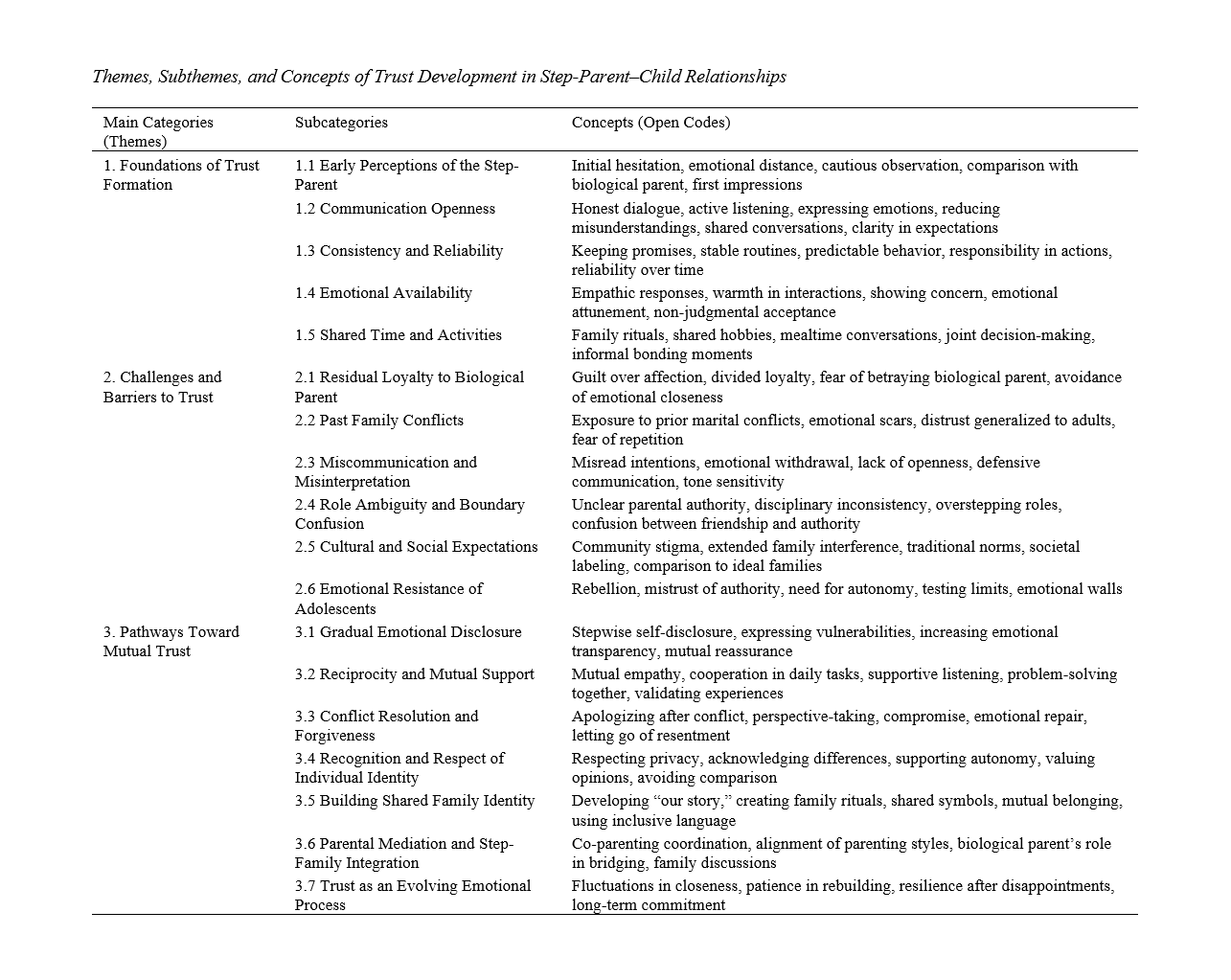
Findings: The analysis revealed three overarching themes: (1) Foundations of Trust Formation, encompassing emotional availability, communication openness, and behavioral consistency; (2) Challenges and Barriers to Trust, including divided loyalty, miscommunication, role ambiguity, and cultural stigma; and (3) Pathways Toward Mutual Trust, characterized by gradual emotional disclosure, reciprocity, forgiveness, and respect for individuality. Trust development was found to be a gradual, non-linear process shaped by both personal histories and sociocultural context. Participants emphasized that consistent empathy, reliability, and shared activities were critical to transforming emotional distance into mutual confidence.
Conclusion: Trust in step-parent–child relationships emerges through a dynamic interplay of emotional, communicative, and contextual factors. While challenges such as loyalty conflicts and role confusion initially hinder relationship growth, open communication, patience, and mutual respect enable families to reconstruct a sense of belonging and stability. The findings highlight the necessity of therapeutic and educational interventions that support empathy, emotional literacy, and boundary clarity in stepfamilies.
Downloads
References
Arat, E., Brons, A., & Poortman, A. R. (2024). Parental Involvement and Children’s Well-Being in Stepfamilies: The Role of Biological Relatedness and Gender. https://doi.org/10.31235/osf.io/6vhtw
Arganaraz, J., & Limb, G. E. (2025). Impact of Parental Divorce and Stepfamily Experience on Emerging Adult Native American Attachment. Child & Family Social Work. https://doi.org/10.1111/cfs.70066
Bandoro, G. H., & Aprilia, I. D. (2024). Cognitive Behavior Therapy Intervention for Parents of Autistic Children: Building Trust &Amp; Openness to the Environment. Picsar, 3(1), 92-100. https://doi.org/10.57142/picsar.v3i1.396
Buha, N., & Jelić, M. (2025). Children's Developmental Status and Parental Trust in Educators in Inclusive Preschools. Specijalna Edukacija I Rehabilitacija, 24(2), 165-180. https://doi.org/10.5937/specedreh24-54674
Carlsson, R. R., Brautsch, L. A. S., Kierkegaard, L., & Bonnesen, C. T. (2022). Parents’ Perceptions of Barriers &Amp; Facilitators for Adhering to Advice From Community Health Nurses. European journal of public health, 32(Supplement_3). https://doi.org/10.1093/eurpub/ckac131.437
Coman, L. (2025). Development of Social Interaction in Early Childhood: Determinant Factors and Implications for Future Social Evolution. 647-651. https://doi.org/10.54481/pcss2025.72
Dewan, T., Whiteley, A., MacKay, L. J., Martens, R., Noël, M., Barnard, C., Jordán, I., Janvier, A., & Thorne, S. (2024). Trust of Inpatient Physicians Among Parents of Children With Medical Complexity: A Qualitative Study. Frontiers in Pediatrics, 12. https://doi.org/10.3389/fped.2024.1443869
Ferrari, C., Moscatelli, M., Carrà, E., & Gaspar, M. F. (2025). Family Social Capital and Role Redefinitions in Italian Stepfamilies From the Perspective of Young Adult Children: A Mixed‐Methods Study. Child & Family Social Work. https://doi.org/10.1111/cfs.70047
Gao, F., Xu, C., Lv, Q., Zhao, Y., & Han, L. (2024). Parent-Child Communication and Educational Anxiety: A Longitudinal Analysis Based on the Common Fate Model. BMC psychology, 12(1). https://doi.org/10.1186/s40359-024-02093-x
H.Ganong, L., Coleman, M., Sanner, C., & Berkley, S. (2021). Effective Stepparenting: Empirical Evidence of What Works. Family Relations, 71(3), 900-917. https://doi.org/10.1111/fare.12624
Han, M. (2023). Influence of Family Structure on Children’s Well-Being – Challenges and Pathways to Promote Positive Development. SHS Web of Conferences, 180, 02008. https://doi.org/10.1051/shsconf/202318002008
Helgertz, J., & Tegunimataka, A. (2023). Stepfamily Formation and the Educational Outcomes of Children in Sweden. Journal of marriage and family, 86(1), 72-94. https://doi.org/10.1111/jomf.12931
Landon, O. J., H.Ganong, L., & Sanner, C. (2021). “Stop Going in My Room”: A Grounded Theory Study of Conflict Among Stepsiblings. Family Relations, 71(1), 256-278. https://doi.org/10.1111/fare.12595
LaPata, L., Applegate, J., & Yahirun, J. (2024). Adult Children’s College Completion by Parental Stepfamily Status and Race/Ethnicity. https://doi.org/10.25035/ncfmr/fp-24-24
Lin, I. F., Seltzer, J. A., Chin, J., Wiemers, E., Strauss, A., & Hotz, V. J. (2024). Time Help From Adult Children: Differences Among Biological and Step-Children in Non-Stepfamilies and Stepfamilies. Innovation in Aging, 8(Supplement_1), 540-540. https://doi.org/10.1093/geroni/igae098.1767
Oliver‐Blackburn, B. M. (2023). Stepchild-Stepparent Relationships and Resilience. https://doi.org/10.1093/acrefore/9780190228613.013.1453
Perry, A. E., & Rogers, M. (2025). Absenteeism in Children With ADHD Symptomology: The Roles of Parental Educational Support and Parent-Teacher Trust. Carleton Undergrad. J. Sci., 5(2). https://doi.org/10.22215/cujs.v5i2.5300
Ramlan, H., Kasnawi, T., Manda, D., Kamaruddin, S. A., Syukur, M., & Suardi. (2023). Hierarchy of Child Exploitation by Parents in Makassar City, Indonesia. International Journal of Arts and Humanities Studies, 3(4), 42-47. https://doi.org/10.32996/ijahs.2023.3.4.6
Sanner, C., H.Ganong, L., Coleman, M., & Berkley, S. (2022). Effective Parenting in Stepfamilies: Empirical Evidence of What Works. Family Relations, 71(3), 884-899. https://doi.org/10.1111/fare.12703
Schacht, R., Meeks, H., Fraser, A., & Smith, K. R. (2021). Was Cinderella Just a Fairy Tale? Survival Differences Between Stepchildren and Their Half-Siblings. Philosophical Transactions of the Royal Society B Biological Sciences, 376(1827). https://doi.org/10.1098/rstb.2020.0032
Schoeni, R. F., Freedman, V. A., Cornman, J. C., & Seltzer, J. A. (2022). The Strength of Parent–Adult Child Ties in Biological Families and Stepfamilies: Evidence From Time Diaries From Older Adults. Demography, 59(5), 1821-1842. https://doi.org/10.1215/00703370-10177468
Schröer, L., & Kok, R. (2025). Children's Perspective on Parental Lying and Its Effect on Trust: Co‐Creation of an Instrument and Pilot Results. Social Development, 34(4). https://doi.org/10.1111/sode.70026
Smith-Etxeberria, K., & Eceiza, A. (2021). Mother-Child and Father-Child Relationships in Emerging Adults From Divorced and Non-Divorced Families. Social Sciences, 10(10), 382. https://doi.org/10.3390/socsci10100382
Terrefe, T. A. (2024). From Fear and Distrust to Trust and Collaboration: Exploring Transitions in the Quality of Relationships in the Encounters Between Immigrant Parents and Child Welfare Services. International Journal on Child Maltreatment Research Policy and Practice, 7(4), 477-499. https://doi.org/10.1007/s42448-024-00201-3
Wagner, L., Molina, S., Alonso-Pérez, E., & Kreyenfeld, M. (2024). What Difference Does It Make? Parental Relationship Quality and Child Wellbeing in Step- And Nuclear Families. https://doi.org/10.31235/osf.io/tzdvw
Zhang, Y. (2025). Parenthood and Health. 1-6. https://doi.org/10.1002/9781118410868.wbehibs111.pub2
Downloads
Additional Files
Publication Timeline
- Submitted
- Revised
- Accepted