Prioritizing Predictors of Family Cohesion in Dual-Earner Households
DOI:
https://doi.org/10.61838/kman.aftj.5018Keywords:
Family cohesion, dual-earner couples, work–family balance, communication, marital quality, psychological well-beingAbstract
Objective: This study aimed to identify, categorize, and prioritize the key predictors of family cohesion in dual-earner households through a mixed-method approach integrating qualitative synthesis and quantitative ranking analysis.
Methods and Materials: The research employed a sequential exploratory mixed-method design. In the first phase, a qualitative thematic synthesis was conducted through a systematic literature review until theoretical saturation was achieved, focusing on determinants of family cohesion among dual-earner couples. Data were coded and analyzed using NVivo 14, resulting in the identification of six overarching themes and multiple subthemes. In the second phase, a structured questionnaire was developed from the qualitative findings and distributed to 170 dual-earner participants from Spain. Using SPSS version 26, ranking analysis and descriptive statistics were applied to prioritize the predictors. The reliability of the ranking scale was assessed using Cronbach’s alpha, and Kendall’s coefficient of concordance (W = 0.81) indicated high inter-rater agreement.
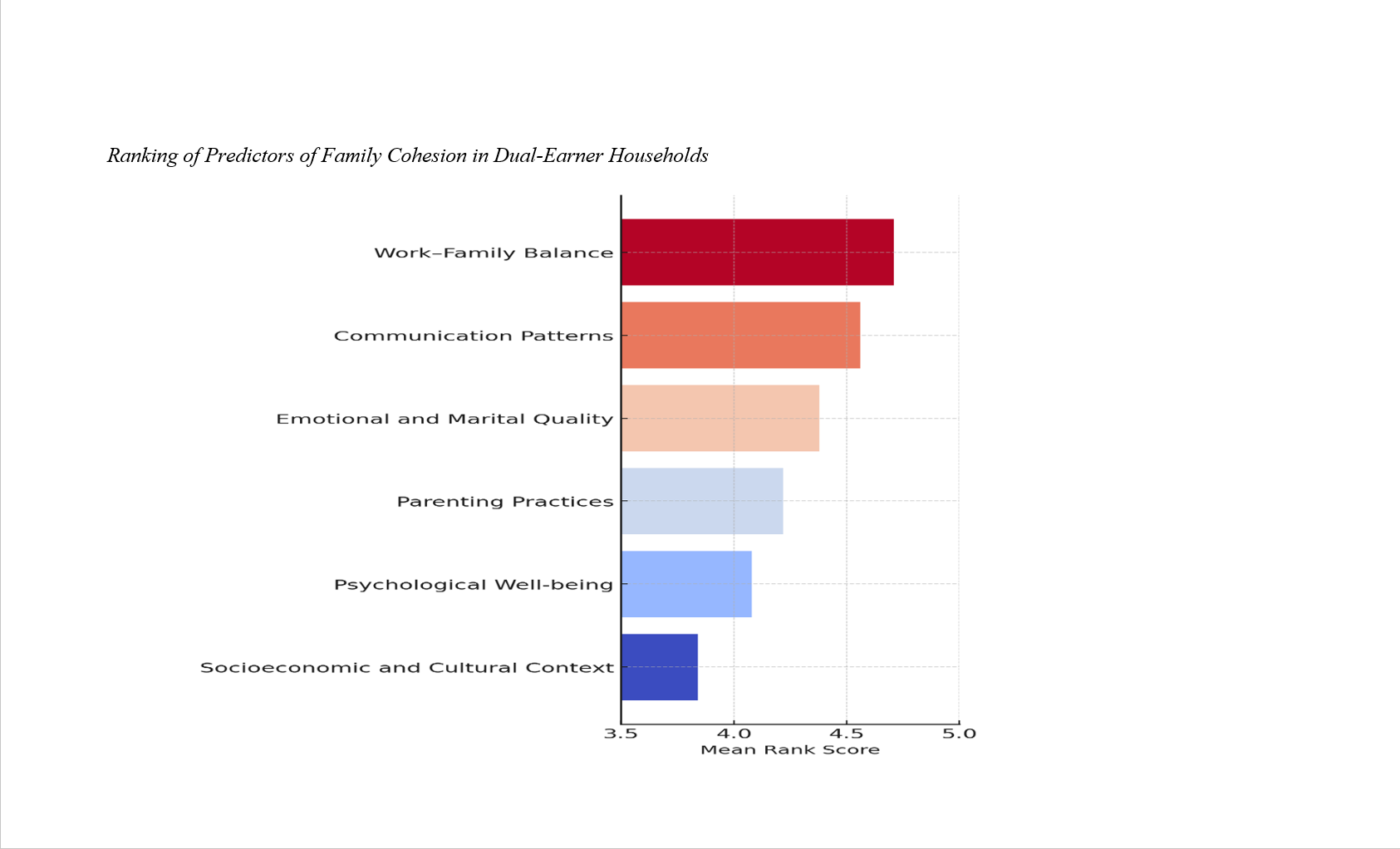
Findings: Quantitative results revealed that work–family balance ranked as the strongest predictor of family cohesion (M = 4.71), followed by communication patterns (M = 4.56) and emotional and marital quality (M = 4.38). Parenting practices (M = 4.22) and psychological well-being of partners (M = 4.08) were also significant but ranked lower, while socioeconomic and cultural context (M = 3.84) was perceived as moderately influential. The findings suggest that internal relational and emotional processes have a greater impact on family cohesion than external structural or socioeconomic variables.
Conclusion: Family cohesion in dual-earner households is primarily sustained through effective work–family integration, open communication, and emotional attunement between partners. These results underscore the importance of relational and psychological factors over structural determinants, providing a framework for family interventions, workplace policies, and future cross-cultural research.
Downloads
References
Avanti, F. T., & Setiawan, J. L. (2022). The Role of Trust and Forgiveness in Marital Intimacy on Husbands or Wives of Dual-Earner Couples in Surabaya. Jurnal Ilmu Keluarga Dan Konsumen. https://doi.org/10.24156/jikk.2022.15.2.117
Aycan, Z., & Eskin, M. (2005). Relative Contributions of Childcare, Spousal Support, and Organizational Support in Reducing Work–Family Conflict for Men and Women: The Case of Turkey. Sex Roles, 53(7), 453-471. https://doi.org/10.1007/s11199-005-7134-8
Beigi, M., Shirmohammadi, M., Au, W. C., Tochia, C., & Hashemian, A. (2021). Keep Calm and Work From Home: Strategies Used by Dual-Earner Households With School-Age Children. Academy of Management Proceedings, 2021(1), 10350. https://doi.org/10.5465/ambpp.2021.168
Dai, W. (2016). Dual-Earner Couples in the United States. In Encyclopedia of family studies (pp. 1-6). https://doi.org/10.1002/9781119085621.wbefs406
Dessyrianti, R. F., & Setiawan, J. L. (2023). Trust and Communication as Predictors of Marital Intimacy Among Individuals in Dual-Earner Marriages. Humanitas Indonesian Psychological Journal, 1-10. https://doi.org/10.26555/humanitas.v20i1.18
Li, X., Jin, B., Kelley, H. H., Cao, H., Zhou, N., Holmes, E., & Yorgason, J. (2024). Work-family conflicts and perceived fairness of housework division in dual-earner couples during COVID-19. Sex Roles, 90(1), 110-125. https://doi.org/10.1007/s11199-023-01422-5
Lim, Y. (2022). Structural Relationships Among Dual-Earner Parents’ Work-Family Conflict, Co-Parenting Quality, Children’s Executive Function Difficulties, and School Adjustment: An Application of the Actor-Partner Interdependence Model. Family and Environment Research, 60(4), 507-520. https://doi.org/10.6115/fer.2022.034
Liu, H., & Cheung, F. M. (2014). The Moderating Role of Empathy in the Work–Family Crossover Process Between Chinese Dual-Earner Couples. Journal of Career Assessment, 23(3), 442-458. https://doi.org/10.1177/1069072714547612
Ma, J., Xu, L., & Xuehe, Z. (2025). Work–family Conflict, Overwork and Mental Health of Female Employees in China. Frontiers in Public Health, 13. https://doi.org/10.3389/fpubh.2025.1483746
Pines, A. M., Neal, M. B., Hammer, L. B., & Icekson, T. (2011). Job burnout and couple burnout in dual-earner couples in the sandwiched generation. Social psychology quarterly, 74(4), 361-386. https://doi.org/10.1177/0190272511422452
Xie, J., Shi, Y., & Ma, H. (2017). Relationship between similarity in work-family centrality and marital satisfaction among dual-earner couples. Personality and individual differences, 113, 103-108. https://doi.org/10.1016/j.paid.2017.03.021
Xie, J., Zhou, Z. E., & Gong, Y. (2018). Relationship between proactive personality and marital satisfaction: A spillover-crossover perspective. Personality and individual differences, 128, 75-80. https://doi.org/10.1016/j.paid.2018.02.011
Yoo, J. (2021). Gender Role Ideology, Work–Family Conflict, Family–Work Conflict, and Marital Satisfaction Among Korean Dual-Earner Couples. Journal of Family Issues, 43(6), 1520-1535. https://doi.org/10.1177/0192513x211026966
Yoo, J. (2022). Gender role ideology, work-family conflict, family-work conflict, and marital satisfaction among Korean dual-earner couples. Journal of Family Issues, 43(6), 1520-1535. https://doi.org/10.1177/0192513X211026966
Downloads
Additional Files
Publication Timeline
- Submitted
- Revised
- Accepted