Causes of Desire Suppression and Sexual Avoidance in Postpartum Couples: A Qualitative Exploration
DOI:
https://doi.org/10.61838/kman.aftj.6.3.14Keywords:
Postpartum sexuality, sexual desire suppression, sexual avoidanceAbstract
Objective: This study aimed to explore and explain the underlying physical, psychological, relational, and sociocultural factors contributing to sexual desire suppression and avoidance among postpartum couples.
Methods and Materials: A qualitative exploratory design was adopted to capture the lived experiences of postpartum couples. Using purposive sampling, 18 married individuals (nine couples) from Taiwan who were between 12 and 24 months postpartum were recruited. Data were gathered through in-depth semi-structured interviews guided by open-ended questions about postpartum sexual changes, emotional experiences, and relational adjustments. Interviews were conducted face-to-face or via secure video conferencing, audio-recorded with consent, and transcribed verbatim. Data collection continued until theoretical saturation was achieved. NVivo 14 software was used for systematic coding and thematic analysis, employing iterative open, axial, and selective coding to develop categories and themes. Credibility was enhanced through member checking and peer debriefing, while dependability and confirmability were supported by an audit trail and reflexive memoing.
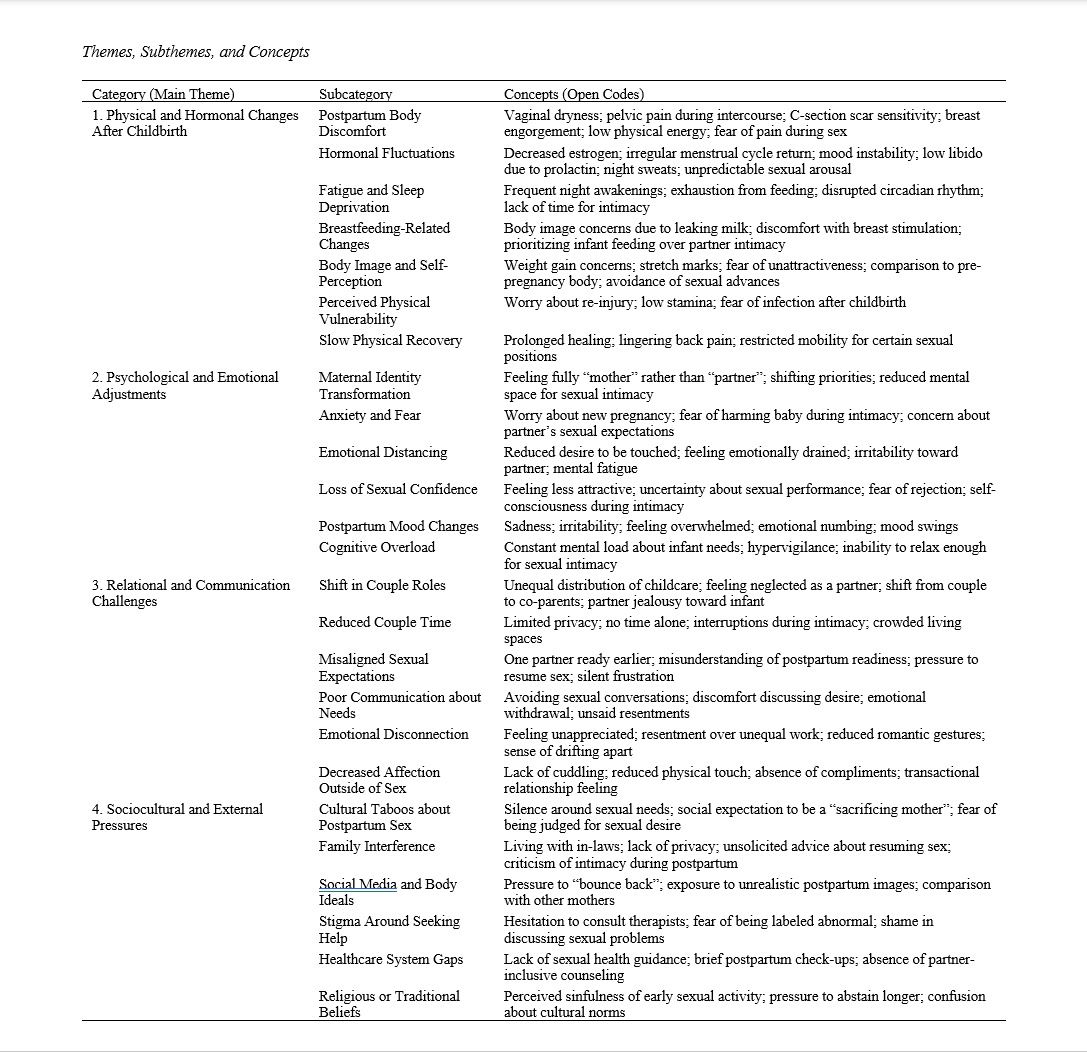
Findings: Analysis revealed four overarching themes shaping sexual desire suppression and avoidance: (1) physical and hormonal changes after childbirth — including pain, fatigue, hormonal fluctuations, and body image dissatisfaction; (2) psychological and emotional adjustments — such as maternal identity shift, anxiety, depressive symptoms, and cognitive overload; (3) relational and communication challenges — including inequitable parenting roles, reduced intimacy, misaligned sexual expectations, and limited sexual communication; and (4) sociocultural and external pressures — notably cultural taboos, family interference, social comparison, insufficient sexual health education, and moral beliefs affecting sexual readiness. These themes interacted dynamically, reinforcing avoidance patterns and delaying sexual recovery.
Conclusion: Sexual desire suppression and avoidance in the postpartum period result from the interplay of biological, psychological, relational, and cultural factors. Integrating sexual health counseling, mental health support, and culturally sensitive couple-based interventions into postpartum care could facilitate healthier sexual adaptation.
Downloads
References
Benuyenah, V., & Tran, P. B. (2020). Postpartum Psychological Pressure on Single Mothers: An Interpretative Phenomenological Analysis. Journal of Humanities and Applied Social Sciences, 3(3), 199-216. https://doi.org/10.1108/jhass-12-2019-0089
Clayton, A. H., Lucas, J., Derogatis, L. R., & Jordan, R. (2017). Phase I Randomized Placebo-Controlled, Double-Blind Study of the Safety and Tolerability of Bremelanotide Coadministered With Ethanol in Healthy Male and Female Participants. Clinical therapeutics, 39(3), 514-526.e514. https://doi.org/10.1016/j.clinthera.2017.01.018
Congden, K. A. (2016). Perinatal Education and Support Program: Baystate’s New Beginnings. The Journal of perinatal education, 25(2), 97-104. https://doi.org/10.1891/1058-1243.25.2.97
Dağ, İ., & Değer, V. B. (2025). The Importance of Psychological Well-Being for Women: Ways to Cope With Stress and Postnatal Depression. https://doi.org/10.5772/intechopen.1009206
Deif, R., Burch, E. M., Azar, J., Yonis, N., Gabal, M. A., Kramani, N. E., & Dakhlallah, D. (2021). Dysphoric Milk Ejection Reflex: The Psychoneurobiology of the Breastfeeding Experience. Frontiers in Global Women S Health, 2. https://doi.org/10.3389/fgwh.2021.669826
Drozdowskyj, E. S., Castro, E. G., López, E. T., Taland, I. B., & Actis, C. C. (2019). Factors Influencing Couples’ Sexuality in the Puerperium: A Systematic Review. Sexual Medicine Reviews, 8(1), 38-47. https://doi.org/10.1016/j.sxmr.2019.07.002
Eryilmaz, N., & Erenel, A. Ş. (2023). Sexuality and Counseling in Postpartum Women. Journal of Gazi University Health Sciences Institute, 5(2), 59-67. https://doi.org/10.59124/guhes.1261592
F, Y. I., Irfan, H., H.P, I., A.B, A., Patmini, E., Nugroho, A. E., & Rahman, M. N. (2015). Gangguan Hasrat Seksual Pada Wanita Pascasalin Dan Hubungannya Dengan Cara Persalinan. Jurnal Kesehatan Reproduksi, 2(1). https://doi.org/10.22146/jkr.7117
Fakahany, S. E., & El‐Kak, F. (2025). Sexual Function in Pregnancy and Postpartum: Breaking the Silence. Journal of Sexual Medicine, 22(1), 1-3. https://doi.org/10.1093/jsxmed/qdae140
Figueiredo, M. M. (2025). Experiencing Sexuality in the Perinatal Period: What Are the Challenges? European Psychiatry, 68(S1), S1137-S1137. https://doi.org/10.1192/j.eurpsy.2025.2300
Hajimirzaie, S. S., Tehranian, N., Golabpour, A., Khosravi, A., Mousavi, S. A., Keramat, A., & Mirzaii, M. (2025). Predicting Postpartum Female Sexual Interest/Arousal Disorder via Adiponectin and Biopsychosocial Factors: A Cohort-Based Decision Tree Study. Scientific reports, 15(1). https://doi.org/10.1038/s41598-025-12025-3
Hanafy, S., & Elesawy, F. M. (2015). Female Sexual Dysfunction During the Postpartum Period. Human Andrology, 5(4), 71-81. https://doi.org/10.1097/01.xha.0000475197.51922.f5
Kandemir, E. (2023). Sexual Dysfunction on Diabetes Mellitus. 55-61. https://doi.org/10.69860/nobel.9786053359111.6
Malary, M., Khani, S., Pourasghar, M., Moosazadeh, M., & Hamzehgardeshi, Z. (2015). Biopsychosocial Determinants of Hypoactive Sexual Desire in Women: A Narrative Review. Materia Socio Medica, 27(6), 383. https://doi.org/10.5455/msm.2015.27.383-389
Pope, R. (2025). Sexual Function Through Menopause: A Review of Basic Evaluation and Treatment. Bjog an International Journal of Obstetrics & Gynaecology. https://doi.org/10.1111/1471-0528.70041
Shvetsova, A. V. (2024). Modern Studies of Motherhood. What Do Trends (Not) Say? Rsuh/Rggu Bulletin Series Philosophy Social Studies Art Studies(3), 103-113. https://doi.org/10.28995/2073-6401-2024-3-103-113
Siregar, M. F. G., Azmeila, S., Sitompul, A. N. R., & Siregar, M. E. A. G. (2021). Literature Review: Menopause and Sexual Disorders. Open Access Macedonian Journal of Medical Sciences, 9(T3), 298-304. https://doi.org/10.3889/oamjms.2021.6345
Szöllósi, K., Komka, K., & Szabó, L. (2021). Risk Factors for Sexual Dysfunction During the First Year Postpartum: A Prospective Study. International Journal of Gynecology & Obstetrics, 157(2), 303-312. https://doi.org/10.1002/ijgo.13892
Wittkowski, A., Garrett, C., Cooper, A., & Wieck, A. (2017). The Relationship Between Postpartum Depression and Cognitions About Motherhood During Pregnancy. Journal of Woman S Reproductive Health, 1(4), 9-23. https://doi.org/10.14302/issn.2381-862x.jwrh-15-848
Zaręba, K., Florkiewicz-Danel, M., Ciebiera, M., Wójtowicz, S., Statsenko, Y., Maki, S., Olszewska, J., Awar, S. A., & Jakiel, G. (2025). The Impact of Stress on Women’s Sexuality in the First Months After Childbirth—A Pilot Cross-Sectional Comparative Study. Journal of clinical medicine, 14(3), 847. https://doi.org/10.3390/jcm14030847
Downloads
Additional Files
Publication Timeline
- Submitted
- Revised
- Accepted
Issue
Section
License

This work is licensed under a Creative Commons Attribution-NonCommercial 4.0 International License.