Online Identity Management and Relational Closeness: The Mediating Role of Emotional Transparency
DOI:
https://doi.org/10.61838/kman.aftj.6.3.17Keywords:
Online identity management, emotional transparency, relational closeness, social media, self-disclosureAbstract
Objective: This study aimed to examine the direct and indirect effects of online identity management on relational closeness among social media users, with emotional transparency modeled as a mediating variable.
Methods and Materials: A descriptive correlational research design was employed with 400 adult social media users in Egypt, selected according to the Morgan and Krejcie sample size table. Participants completed validated self-report scales assessing online identity management, emotional transparency, and relational closeness. Data analysis was conducted using SPSS-28 for descriptive and correlational statistics and AMOS-21 for structural equation modeling (SEM). Model fit was evaluated with χ², χ²/df, GFI, AGFI, CFI, TLI, and RMSEA.
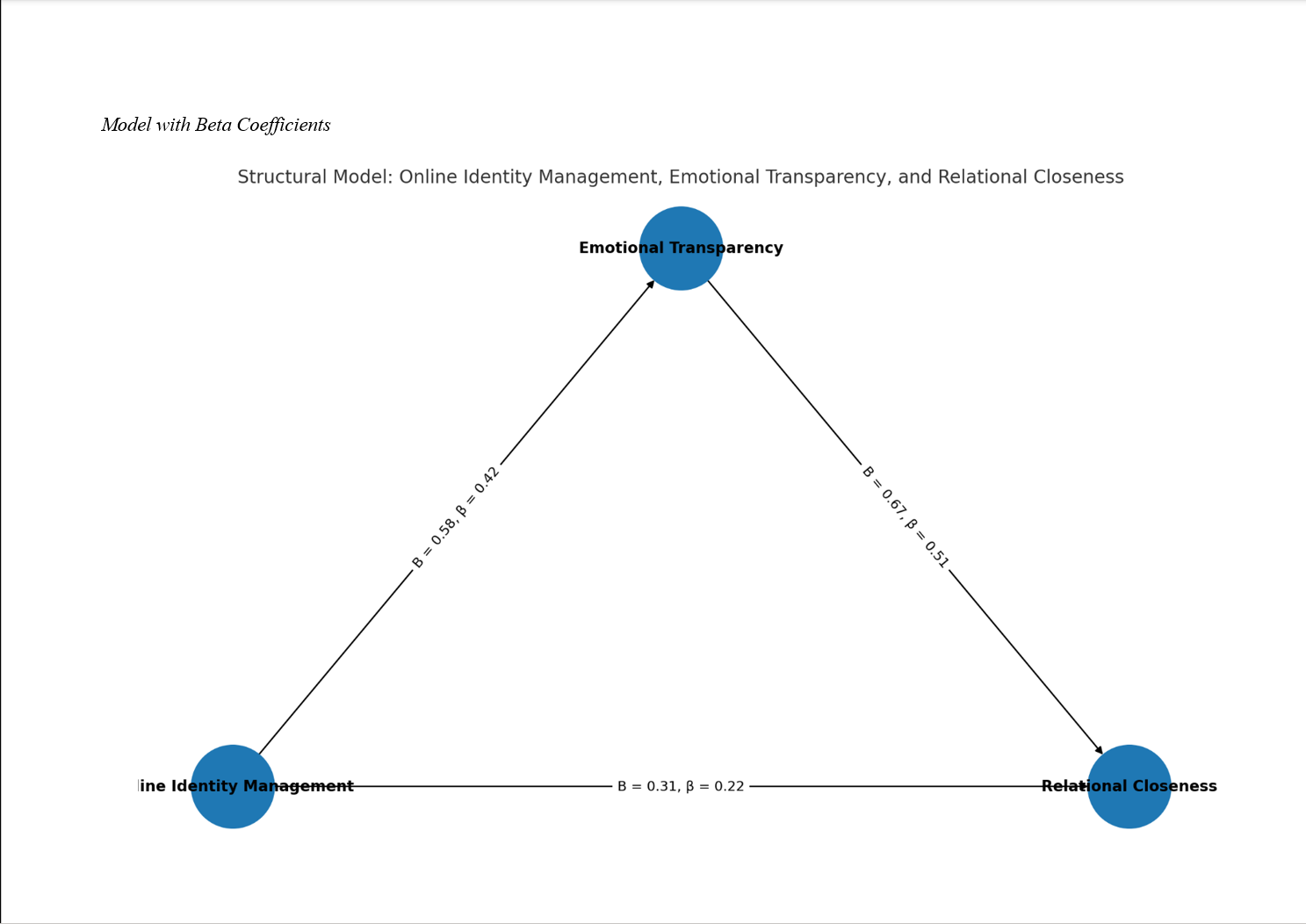
Findings: Online identity management correlated positively with both emotional transparency (r = .42, p < .001) and relational closeness (r = .37, p < .001). Emotional transparency was strongly associated with relational closeness (r = .56, p < .001). The SEM analysis showed an excellent model fit, χ²(73) = 143.62, χ²/df = 1.97, GFI = .93, AGFI = .90, CFI = .96, TLI = .95, RMSEA = .049. Online identity management significantly predicted emotional transparency (β = .42, p < .001) and relational closeness directly (β = .22, p = .002). Emotional transparency strongly predicted relational closeness (β = .51, p < .001) and mediated the relationship between online identity management and closeness (indirect β = .21, p < .001). The total effect of online identity management on relational closeness was moderate to strong (β = .43, p < .001).
Conclusion: Findings demonstrate that while strategic online identity management helps build closeness, its impact is significantly strengthened by emotional transparency. By openly sharing genuine emotions, individuals transform managed digital personas into meaningful and intimate connections.
Downloads
References
Apriyanti, E., Sari, S., & Dianthi, M. H. (2024). Self Disclosure Pada Komunikasi Generasi Z. Profesional Jurnal Komunikasi Dan Administrasi Publik, 11(1). https://doi.org/10.37676/professional.v11i1.6386
Aranda, V., Ayala, M. d. L. C., Esquivel, C., Ossandón, N., & Quinteros, C. (2024). Self-Concealment and Emotional Intimacy in Chilean Adults in a Couple Relationship. Ijp&pp, 1(2), 119-140. https://doi.org/10.56754/2810-6598.2024.0012
Bellis, P., Buganza, T., & Verganti, R. (2023). What Kind of Intimacy Is Meaningful to You? How Intimate Interactions Foster Individuals' Sensemaking of Innovation. Creativity and Innovation Management, 32(3), 407-424. https://doi.org/10.1111/caim.12568
Bradbury, A. E., Schertz, S., & Wiebe, E. (2022). How Does Virtual Reality Compare? The Effects of Avatar Appearance and Medium on Self-Disclosure. Proceedings of the Human Factors and Ergonomics Society Annual Meeting, 66(1), 2036-2040. https://doi.org/10.1177/1071181322661123
Brown, G., Curtis, V., & Pollet, T. V. (2021). Gender, Self-Disclosure and Emotional Closeness in Friendships: An Egocentric Social Network Study. https://doi.org/10.31234/osf.io/wexn9
Cho, E. (2022). Alexa as an Active Listener: How Backchanneling Can Elicit Self-Disclosure and Promote User Experience. https://doi.org/10.48550/arxiv.2204.10191
Cho, Y., & Kim, S. (2024). The Effects of Supervisees' Fear of Negative Evaluation on Self-Disclosure: The Dual Mediating Effects of Perceived Supervisor Authenticity &Amp; Emotional Connection. Korean Association for Learner-Centered Curriculum and Instruction, 24(18), 579-594. https://doi.org/10.22251/jlcci.2024.24.18.579
Croes, E., Antheunis, M. L., Lee, C. v. d., & Wit, J. d. (2024). Digital Confessions: The Willingness to Disclose Intimate Information to a Chatbot and Its Impact on Emotional Well-Being. Interacting with Computers, 36(5), 279-292. https://doi.org/10.1093/iwc/iwae016
Fauzi, D. P., Arifiana, I. Y., & Efendy, M. (2024). Membangun Kepercayaan: Intimasi Pertemanan Dan Self-Disclosure Pada Mahasiswa Baru. Jiwa, 2(03). https://doi.org/10.30996/jiwa.v2i03.11718
Gu, J. (2021). Nüzhubo and Her “Brothers”: Streaming Life and Mediating Intimacy at Scale. Aoir Selected Papers of Internet Research. https://doi.org/10.5210/spir.v2021i0.11928
Jalali, G. H., Soltani, A., & Tabrizi, A. R. (2022). The Association of Social Anxiety and Self-Disclosure With Social Intimacy، Mediated by Perceived Responseiveness. Jarac, 4(2), 47-65. https://doi.org/10.61838/kman.jarac.4.2.4
Kondori, F. M., Zarin, S. A., & Aghayousefi, A. (2022). Modeling Marital Conflict Based on Self Differentiation and Familism Through the Mediation of Intimacy and Emotional Maturity in the Family. Aftj, 3(2), 394-417. https://doi.org/10.61838/kman.aftj.3.2.20
Leite, F. P., & Baptista, P. d. P. (2021). Influencers' Intimate Self-Disclosure and Its Impact on Consumers' Self-Brand Connections: Scale Development, Validation, and Application. Journal of Research in Interactive Marketing, 16(3), 420-437. https://doi.org/10.1108/jrim-05-2020-0111
Li, D., & Zhang, Y. (2025). A Statistical Framework for Modeling Behavioral Engagement via Topic and Psycholinguistic Features: Evidence From High-Dimensional Text Data. Mathematics, 13(15), 2374. https://doi.org/10.3390/math13152374
Lin, Y. H., & My, G. C. (2021). Online Communication Self-Disclosure and Intimacy Development on Facebook: The Perspective of Uses and Gratifications Theory. Online Information Review, 45(6), 1167-1187. https://doi.org/10.1108/oir-08-2020-0329
Lu, L. (2025). Intimacy Reduces Withdrawal After Conflict in Cohabiting Couples. Journal of Social and Personal Relationships, 42(10), 2953-2977. https://doi.org/10.1177/02654075251355074
Martinez, L., & Aesthetika, N. M. (2024). Self Disclosure Between Community Members Connect Group via Whatsapp Media. Indonesian Journal of Cultural and Community Development, 15(2). https://doi.org/10.21070/ijccd.v16i1.1174
Muñoz, K. E. (2022). Predicting Travel Intentions Using Self-Disclosure, Trust and Intimacy: The case of Tinder Users During COVID-19. Journal of Tourism Futures. https://doi.org/10.1108/jtf-09-2021-0232
Park, G., Chung, J., & Lee, S. (2022). Effect of AI Chatbot Emotional Disclosure on User Satisfaction and Reuse Intention for Mental Health Counseling: A Serial Mediation Model. Current Psychology, 42(32), 28663-28673. https://doi.org/10.1007/s12144-022-03932-z
Pratiwi, N. A., & Mukhoyyaroh, T. (2024). Love and Distance: Unveiling the Influence of Self-Disclosure, Gratitude, and Marital Satisfaction Among Military Wives. Jurnal Psikologi Terapan (Jpt), 7(1), 13-18. https://doi.org/10.29103/jpt.v7i1.14864
Roring, T. A. (2025). Sleep Calls and Emotional Intimacy in Non-Long-Distance Romantic Relationships: A Qualitative Exploration of Virtual Communication Practices. Inject (Interdisciplinary Journal of Communication), 10(2), 391-418. https://doi.org/10.18326/inject.v10i2.4885
Saeed, I., Batool, I., & Noreen, S. (2024). Mediating Role of Self Esteem in Gullibility (Unsuspecting) and Emotional Self Disclosure (Anxiety and Fear) Among Institutionalized Orphans. J. Asian Dev. Studies, 13(4), 414-426. https://doi.org/10.62345/jads.2024.13.4.34
Swol, L. M. V., Bloomfield, E. F., Chang, C.-T., & Willes, S. (2021). Fostering Climate Change Consensus: The Role of Intimacy in Group Discussions. Public Understanding of Science, 31(1), 103-118. https://doi.org/10.1177/09636625211020661
Tian, L., Zhai, R., Dai, P., & Cui, J. (2022). How Different Online Self-Presentations Relate to Life Satisfaction Differently in College Students: The Role of Positive Online Feedback and Self-Esteem. Current Psychology, 42(29), 25460-25475. https://doi.org/10.1007/s12144-022-03444-w
Wu, R. (2024). Does Artificial Intelligence Also Bare Its Heart: Self-Disclosure of Artificial Intelligence in Human-Computer Interaction. Academic Journal of Science and Technology, 10(3), 172-177. https://doi.org/10.54097/4wbgvg24
Wu, T., & Zheng, Y. (2021). Effect of Sexual Esteem and Sexual Communication on the Relationship Between Body Image and Sexual Function in Chinese Heterosexual Women. Journal of Sexual Medicine, 18(3), 474-486. https://doi.org/10.1016/j.jsxm.2020.12.006
Xie, B., Xu, Y., & Ouyang, Y.-Q. (2024). Effects of Parental Intimacy and Self-Disclosure on Dyadic Coping in Parents of Children With Autism Spectrum Disorder Entering School. https://doi.org/10.21203/rs.3.rs-3844754/v1
Yeo, G., & Tong, E. M. W. (2024). Trajectories of Emotional Disclosure With Parents During the College Transition Among Asian First-Year Students. Developmental Psychology, 60(10), 1935-1947. https://doi.org/10.1037/dev0001781
Zhang, S., Zhao, X., Nan, D., & Kim, J. H. (2024). Beyond Learning With Cold Machine: Interpersonal Communication Skills as Anthropomorphic Cue of AI Instructor. International Journal of Educational Technology in Higher Education, 21(1). https://doi.org/10.1186/s41239-024-00465-2
Zhu, Y. (2025). Anonymous Intimacy in the Digital Age: Psychological Mechanisms, Risks, and Potential. Icarss, 2(1), 11-29. https://doi.org/10.33422/icarss.v2i1.1056
Downloads
Additional Files
Publication Timeline
- Submitted
- Revised
- Accepted
Issue
Section
License

This work is licensed under a Creative Commons Attribution-NonCommercial 4.0 International License.