Attachment Avoidance and Intimacy Decline: The Mediating Role of Expressive Suppression
DOI:
https://doi.org/10.61838/kman.aftj.6.3.18Keywords:
attachment avoidance, expressive suppression, intimacy decline, emotion regulationAbstract
Objective: This study aimed to examine the association between attachment avoidance and intimacy decline in romantic relationships and to test whether expressive suppression mediates this relationship among adults in Kenya.
Methods and Materials: A descriptive correlational design was adopted with a sample of 391 adults recruited from different counties in Kenya, determined using the Morgan and Krejcie sample size table. Participants completed standardized self-report instruments: the Experiences in Close Relationships–Revised (ECR-R) for attachment avoidance, the Emotion Regulation Questionnaire (ERQ) for expressive suppression, and the Personal Assessment of Intimacy in Relationships (PAIR) Inventory for intimacy decline. Data analysis was conducted in two stages: bivariate relationships were tested using Pearson’s product–moment correlation coefficients in SPSS-27, and the hypothesized mediational model was examined using Structural Equation Modeling (SEM) with AMOS-21. Model fit was evaluated with multiple indices (χ²/df, GFI, AGFI, CFI, TLI, RMSEA).
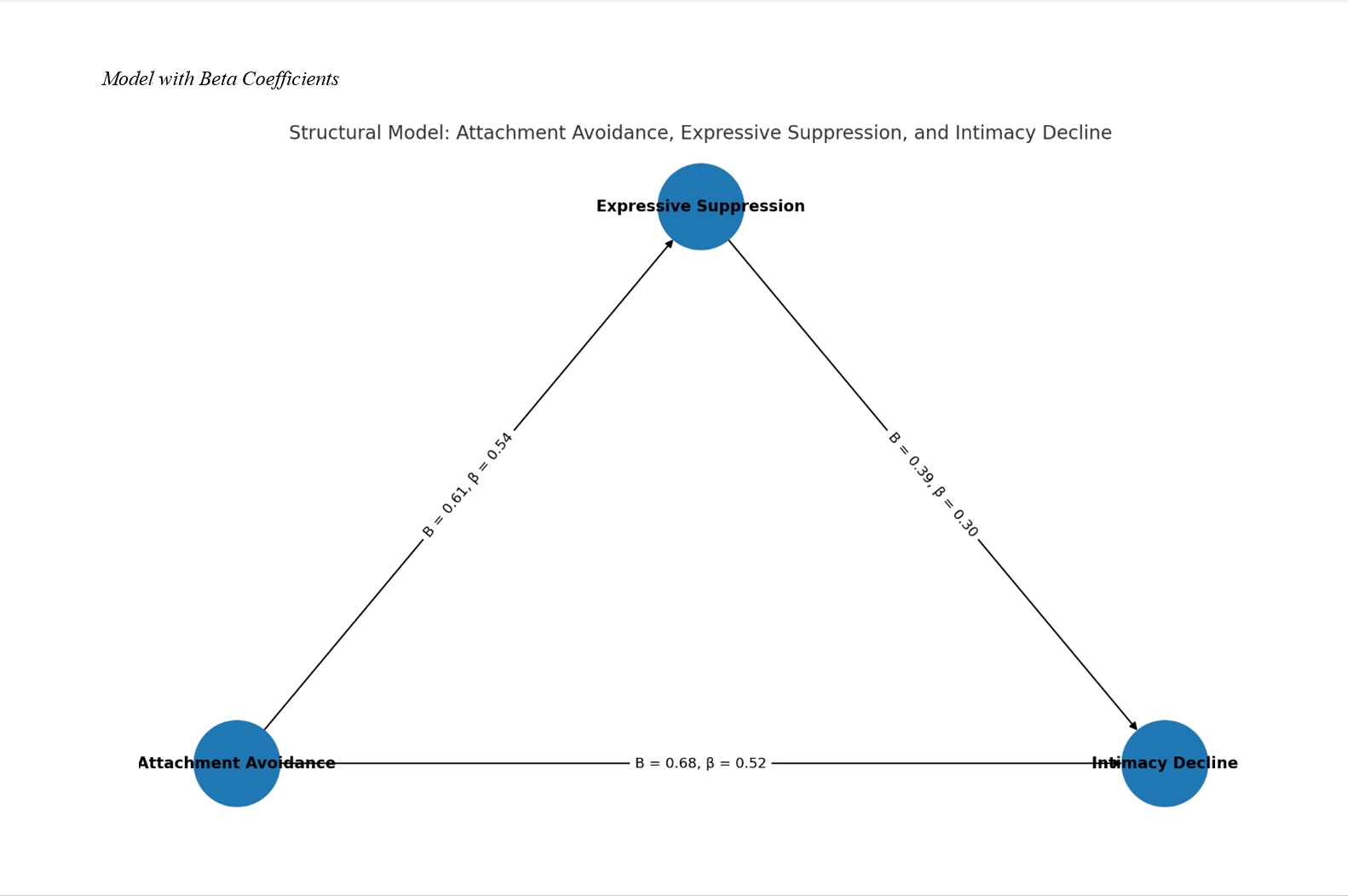
Findings: Attachment avoidance was strongly and positively associated with intimacy decline (r = .61, p < .001) and with expressive suppression (r = .54, p < .001). Expressive suppression was moderately correlated with intimacy decline (r = .48, p < .001). The SEM analysis showed excellent model fit (χ² = 112.47, df = 48, χ²/df = 2.34, CFI = .97, TLI = .96, GFI = .95, RMSEA = .058). Attachment avoidance had a significant direct effect on intimacy decline (β = .52, p < .001) and an additional indirect effect through expressive suppression (β = .16, p < .001), yielding a substantial total effect (β = .68, p < .001).
Conclusion: These findings support attachment theory by confirming that expressive suppression functions as a key process linking avoidant relational orientations to intimacy erosion. The results highlight the importance of targeting emotional inhibition in interventions designed to maintain closeness and relational health across cultures.
Downloads
References
Batthyany, K., & Blasi, C. H. (2025). Rejection Sensitivity and Attachment Avoidance as Predictors of Intimacy Struggles in Romantic Relationships. PWJ, 6(2). https://doi.org/10.61838/kman.pwj.6.2.17
Brassard, A., Vallée-Destrempes, M., Binet, M.-A., Brault‐Labbé, A., Lafontaine, M. F., & Péloquin, K. (2023). Attachment, Sexual Motives, and Sexual Satisfaction Among Couples Expecting Their First Child. Journal of sex & marital therapy, 49(7), 755-771. https://doi.org/10.1080/0092623x.2023.2193190
Chahal, J. (2025). The Relational Consequences of Childhood Trauma: Attachment Patterns in Adults’ Life. https://doi.org/10.21203/rs.3.rs-7261046/v1
Farahmand, E., Nor, M. M., Abbas, G. B., & Danaee, M. (2021). The Role of Intimacy, Belonging, Self-Esteem Inthe Association Between Anxious, Avoidant Attachment and Forgiveness Among Married Iranian Women. International Journal of Education Psychology and Counseling, 6(40), 74-92. https://doi.org/10.35631/ijepc.640006
Finzi‐Dottan, R., & Abadi, H. Z. M. (2024). From Emotional Abuse to a Fear of Intimacy: A Preliminary Study of the Mediating Role of Attachment Styles and Rejection Sensitivity. International journal of environmental research and public health, 21(12), 1679. https://doi.org/10.3390/ijerph21121679
Gauvin, S. E. M., Maxwell, J. A., Impett, E. A., & MacDonald, G. (2024). Love Lost in Translation: Avoidant Individuals Inaccurately Perceive Their Partners’ Positive Emotions During Love Conversations. Personality and Social Psychology Bulletin. https://doi.org/10.1177/01461672241258391
Ghasemi, Y. (2023). The Relationship Between Attachment Symbols, Attachment Styles and Self-Differentiation With Marital Intimacy. Obstetrics Gynecology and Reproductive Sciences, 7(4), 01-08. https://doi.org/10.31579/2578-8965/168
Guzmán‐González, M., Gómez, F., Bahamondes, J., Barrientos, J., Garrido-Rojas, L., Espinoza-Tapia, R., & Casu, G. (2023). Internalized Homonegativity Moderates the Association Between Attachment Avoidance and Emotional Intimacy Among Same-Sex Male Couples. Frontiers in psychology, 14. https://doi.org/10.3389/fpsyg.2023.1148005
Kharazi, M. A., & Ramezani, M. A. (2022). Investigating the Relationship Between Sexual Intimacy, Emotion Regulation and Attachment Styles. Jayps, 3(2), 41-56. https://doi.org/10.61838/kman.jayps.3.2.4
Lankveld, J. v., Dewitte, M., Thewissen, V., Jacobs, N., & Verboon, P. (2021). Predicting Sexual Desire in Daily Life From an Attachment Perspective: An Experience Sampling Study. Journal of sex & marital therapy, 47(4), 311-324. https://doi.org/10.1080/0092623x.2020.1871141
Lankveld, J. v., Dewitte, M., Verboon, P., & Susan, A. H. v. H. (2021). Associations of Intimacy, Partner Responsiveness, and Attachment-Related Emotional Needs With Sexual Desire. Frontiers in psychology, 12. https://doi.org/10.3389/fpsyg.2021.665967
Mu, X. (2025). The Avoidant Attachment Style: A Multidimensional Analysis of Its Origins, Manifestations, and the Path Toward Earned Security. Integration of Industry and Education Journal, 4(2), 91-98. https://doi.org/10.6914/iiej.040210
Naor‐Ziv, R. (2024). Insecure Attachment Styles in Adolescents at Risk for Eating Disorders. Clinical Child Psychology and Psychiatry, 30(1), 116-126. https://doi.org/10.1177/13591045241293167
Park, C., & Harris, V. W. (2022). The Impact of Attachment Styles on Attitudes Toward Marriage: The Mediating Role of Emotional Intimacy. The Family Journal, 31(2), 269-277. https://doi.org/10.1177/10664807221124271
Pei, Y. P. (2025). A Dual-Process Model of Attachment: How System 1 and System 2 Shape Relationship Patterns. https://doi.org/10.31219/osf.io/z7yd6_v2
Persram, R. J., & Konishi, C. (2022). Differential Effects of Maternal‐ and Paternal‐adolescent Attachments on Friendship Security and Intimacy. British Journal of Developmental Psychology, 41(1), 66-78. https://doi.org/10.1111/bjdp.12433
Pohorila, O. M., & Vinogradov, A. G. (2024). Ukrainian-Language Adaptation of the Experiences in Close Relationships Revised (Ecr-R) Questionnaire. Ukrainian Psychological Journal(2 (22)), 97-112. https://doi.org/10.17721/upj.2024.2(22).6
Pouya, F. H., Gharamaleki, N. S., & Mirzahosseini, H. (2025). The Structural Model for Predicting Marital Burnout Based on Attachment Styles With the Mediating Role of Marital Self-Regulation and Marital Intimacy in Married Individuals. Aftj, 6(1), 29-36. https://doi.org/10.61838/kman.aftj.6.1.4
Rigby, R. A., & Cobb, R. J. (2022). Positive Illusions About Dyadic Perspective-Taking as a Moderator of the Association Between Attachment Insecurity and Marital Satisfaction. Journal of Social and Personal Relationships, 40(4), 1223-1249. https://doi.org/10.1177/02654075221127241
Rodrigues, J. C., Soares, T., & Ribeiro, L. M. (2024). Do Attachment Styles Influence the Sexual Function of an Individual? European Psychiatry, 67(S1), S767-S768. https://doi.org/10.1192/j.eurpsy.2024.1597
Shrestha, P. S., Shaver, S. R., Perlman, T. T., & Walsham, W. (2023). Emotional Dimensions of Infidelity: An Analysis of Psychological and Emotional Factors Affecting Relationship Infidelity. Sosateris, 11(2), 88-103. https://doi.org/10.35335/85rbw180
Tkalych, M., & Hrechanyk, M. (2025). Psychological Peculiarities of Attachment Across Gays and Lesbians. Psychological Journal, 11(1), 34-44. https://doi.org/10.31108/1.2025.11.1.3
Wang, H. J. (2025). The Drivers of Intimacy Toward Social Media-Based Brand Communities: Perspective of Attachment Theory. Internet Research. https://doi.org/10.1108/intr-01-2024-0066
Wang, Y., Zheng, Z., Wang, X., & Li, Y. (2022). Unraveling the Effect of Ambivalence Over Emotional Expression on Subjective Wellbeing in Chinese College Students in Romantic Relationships: A Multiple Mediation Model. Frontiers in Psychiatry, 13. https://doi.org/10.3389/fpsyt.2022.982406
Waqas, M., Hussain, Z., Ibrahimi, I., & Ali, M. (2024). Investigating How Childhood Bonding Patterns Influence Adult Behavior and Intimacy. Review of Applied Management and Social Sciences, 7(4), 959-972. https://doi.org/10.47067/ramss.v7i4.425
Wendołowska, A., Czyżowska, N., & Czyżowska, D. (2022). The Role of Attachment and Dyadic Coping in Shaping Relational Intimacy: Actor–Partner Interdependence Model. International journal of environmental research and public health, 19(23), 16211. https://doi.org/10.3390/ijerph192316211
Wood, V. M., Tam‐Seto, L., MacDonald, T. K., & Urban, S. (2022). Adult Attachment and Spousal Reports of Conflict and Quality of Partner Interactions During a Post-Deployment Reunion. Journal of Military Veteran and Family Health, 8(3), 72-83. https://doi.org/10.3138/jmvfh-2021-0108
Yu-wen, P. (2023). The Relationship Between Attachment and Intimacy. Lecture Notes in Education Psychology and Public Media, 16(1), 207-212. https://doi.org/10.54254/2753-7048/16/20231154
Downloads
Additional Files
Publication Timeline
- Submitted
- Revised
- Accepted
Issue
Section
License

This work is licensed under a Creative Commons Attribution-NonCommercial 4.0 International License.