Family Resilience and Adolescent Academic Achievement: The Mediating Role of Self-Efficacy Beliefs
DOI:
https://doi.org/10.61838/kman.aftj.4512Keywords:
Family resilience, Self-efficacy beliefs, Academic achievement, Adolescents, Structural equation modeling, EgyptAbstract
Objective: This study aimed to investigate the predictive relationship between family resilience and adolescent academic achievement, with a specific focus on the mediating role of self-efficacy beliefs.
Methods and Materials: The study employed a descriptive correlational design with a sample of 400 secondary school students from Egypt, selected according to the Morgan and Krejcie sample size table. Data on family resilience, self-efficacy beliefs, and academic achievement (GPA) were collected using validated scales and institutional records. Data analysis was conducted using SPSS-27 and AMOS-21. Pearson correlation coefficients were computed to examine bivariate relationships, and Structural Equation Modeling (SEM) was performed to test the mediating role of self-efficacy. Model fit indices, including χ²/df, GFI, AGFI, CFI, TLI, and RMSEA, were used to evaluate the adequacy of the structural model.
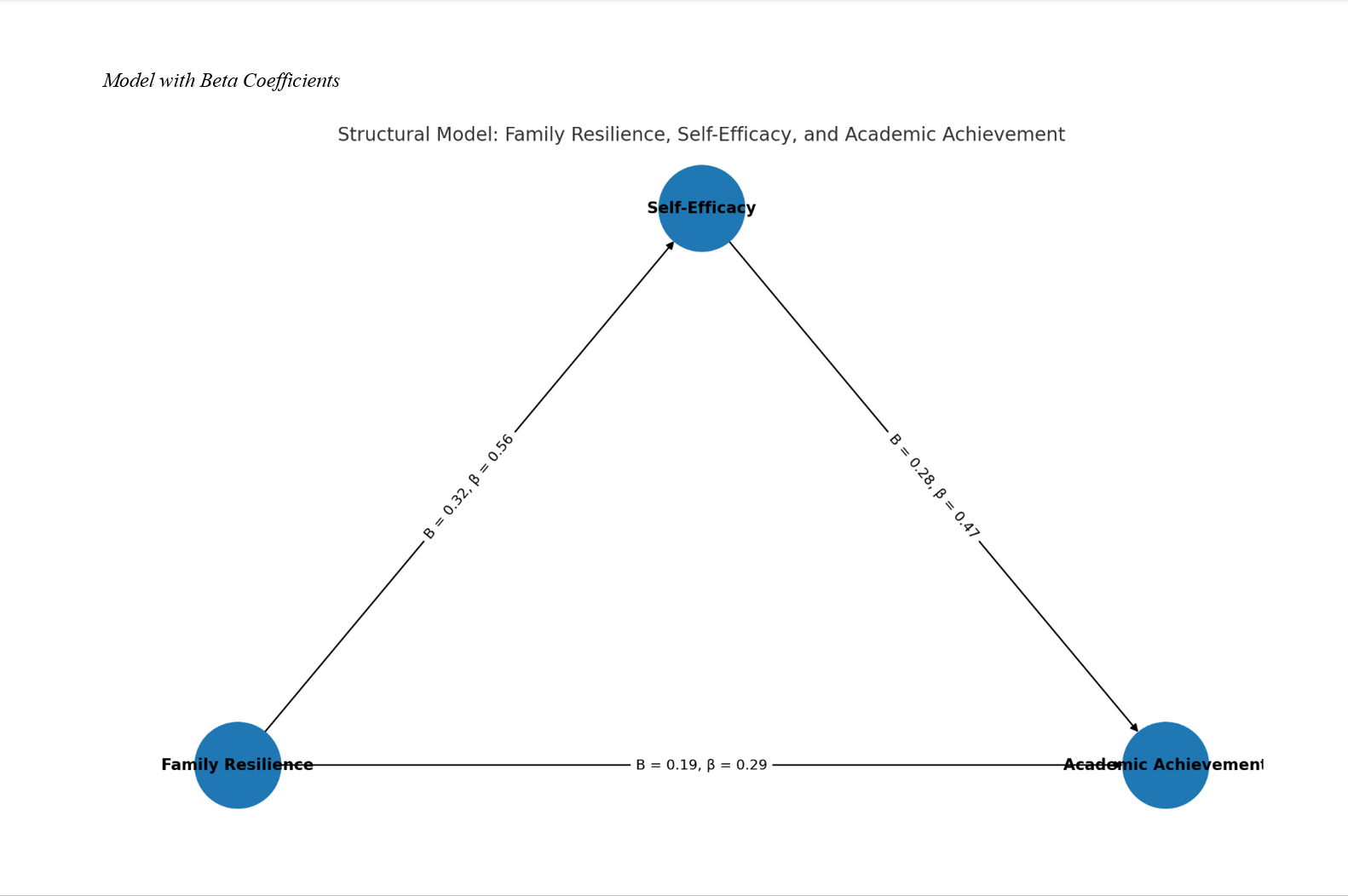
Findings: Results revealed significant positive correlations between family resilience, self-efficacy beliefs, and academic achievement (r = .41–.56, all p < .01). The SEM demonstrated acceptable fit indices (χ²/df = 2.05, GFI = 0.93, AGFI = 0.90, CFI = 0.96, TLI = 0.95, RMSEA = 0.051). Family resilience significantly predicted self-efficacy (B = 0.32, β = 0.56, p < .001), while self-efficacy positively influenced academic achievement (B = 0.28, β = 0.47, p = .002). The direct path from family resilience to academic achievement was also significant (B = 0.19, β = 0.29, p = .004). Moreover, the indirect effect of family resilience on academic achievement through self-efficacy was significant (B = 0.09, β = 0.18, p = .006), confirming the mediating role of self-efficacy.
Conclusion: The findings highlight that family resilience contributes to adolescent academic achievement both directly and indirectly through self-efficacy beliefs. Strengthening family resilience and fostering adolescents’ self-efficacy may serve as key strategies for enhancing academic outcomes.
Downloads
References
Alogiliy, M. A. (2024). The Impact of Self-Efficacy on Academic Achievement Mediated by Learning Motivation and Moderated by Socioeconomic Status Among Jordanian EFL Students. Theory and Practice in Language Studies, 14(12), 3871-3879. https://doi.org/10.17507/tpls.1412.22
Atak, N. T., & Bebiş, H. (2024). Risk Factors Affecting the Psychological Resilience of Adolescents in Institutional Care: A Systematic Review. Psychiatry and Clinical Psychopharmacology, 34(3), 252-264. https://doi.org/10.5152/pcp.2024.23782
Bağatarhan, T. (2025). Investigating the Mediating Effect of Resilience in the Relationship Between Self-Efficacy, happiness, Social Support, and Internet Addiction in Adolescents. Current Psychology. https://doi.org/10.1007/s12144-025-07931-8
Chen, X., & Yeung, W. J. J. (2024). COVID‐19 Experiences and Family Resilience: A Latent Class Analysis. Journal of marriage and family, 87(1), 280-299. https://doi.org/10.1111/jomf.13031
Lin, H., Chen, H., Liu, Q., Xu, J., & Li, S. (2024). A Meta-Analysis of the Relationship Between Social Support and Physical Activity in Adolescents: The Mediating Role of Self-Efficacy. Frontiers in psychology, 14. https://doi.org/10.3389/fpsyg.2023.1305425
Liu, X. (2024). Childhood Socioeconomic Status and Its Impact on College Students' Career Adaptability: The Mediating Role of Self-Efficacy. 1(3), 87-93. https://doi.org/10.62381/e244315
Ma, L., Jiao, Y., Xiao, L., & Liu, J. (2023). The Association Between Socioeconomic Status and Chinese Secondary Students’ English Achievement: Mediation of Self-Efficacy and Moderation of Gender. Iral - International Review of Applied Linguistics in Language Teaching, 63(2), 1223-1248. https://doi.org/10.1515/iral-2023-0112
Maurer, J., Meyrose, A. K., Kaman, A., Mauz, E., Ravens‐Sieberer, U., & Reiß, F. (2023). Socioeconomic Status, Protective Factors, and Mental Health Problems in Transition From Adolescence to Emerging Adulthood: Results of the Longitudinal BELLA Study. Child Psychiatry & Human Development, 56(3), 649-660. https://doi.org/10.1007/s10578-023-01582-1
Moreno, A. G., & María del Mar Molero, J. (2023). Prosocial Behaviours and Resilience in School Coexistence: Implications of Creative Self-Efficacy and Stress in Adolescents. Behavioral Sciences, 13(12), 988. https://doi.org/10.3390/bs13120988
Murniasih, F., & Irvan, M. (2023). Promoting Resilience in Adolescents From Divorced Family: The Role of Social Support and Self-Efficacy. Journal an-Nafs Kajian Penelitian Psikologi, 8(2), 278-293. https://doi.org/10.33367/psi.v8i2.4346
Musabelliu, G., Wiener, J., & Rogers, M. (2022). Parental Involvement in Education and Academic Achievement in Adolescents With Attention Deficit Hyperactivity Disorder. Canadian Journal of School Psychology, 37(3), 237-256. https://doi.org/10.1177/08295735221092959
Ndyareeba, E., Biirah, J., & Kibedi, H. (2024). Achievement of Goal Orientation and Academic Engagement Among Adolescents in Southwestern Uganda. East African Journal of Education Studies, 7(2), 1-18. https://doi.org/10.37284/eajes.7.2.1848
Qian, M., Jin, R., Lu, C., & Zhao, M. (2024). Parental Emotional Support, Self-Efficacy, and Mental Health Problems Among Adolescents in Hong Kong: A Moderated Mediation Approach. Frontiers in Psychiatry, 15. https://doi.org/10.3389/fpsyt.2024.1458275
Rajendran, A. J., Gurushanthappa, Y., & Akkineni, S. (2022). Life Satisfaction in the Caregivers of Schizophrenia and Factors Associated With It: A Cross Sectional Study From South India. Eureka Health Sciences(3), 27-36. https://doi.org/10.21303/2504-5679.2022.002471
Shu, Z., Chen, S., Chen, H., Chen, X., Tang, H., Zhou, J., Tian, Y., Xiao-ping, W., & Zhou, J.-S. (2024). The Effects of Subjective Family Status and Subjective School Status on Depression and Suicidal Ideation Among Adolescents: The Role of Anxiety and Psychological Resilience. Peerj, 12, e18225. https://doi.org/10.7717/peerj.18225
Tang, Y., Liu, T., Wang, Y., & Zhang, J. (2024). Child Abuse and Resilience Influence Belief in a Just World: A Moderated Mediation Model. Social Behavior and Personality an International Journal, 52(5), 13125E-13134E. https://doi.org/10.2224/sbp.13125
Uygur, S., Asıcı, E., & Koçer, M. A. T. (2023). Prediction of Academic Resilience in Adolescents Through Academic, Social and Emotional Self-Efficacy and Gender. Research in Pedagogy, 13(1), 251-266. https://doi.org/10.5937/istrped2301251u
Wang, Q., & Liu, X. (2022). Child Abuse and Non-Suicidal Self-Injury Among Chinese Migrant Adolescents: The Moderating Roles of Beliefs About Adversity and Family Socioeconomic Status. Journal of interpersonal violence, 38(3-4), 3165-3190. https://doi.org/10.1177/08862605221104537
Xiao, B., & Song, G. (2022). The Impact of Family Socioeconomic Status on Learning Conformity Among Chinese University Students: Self-Efficacy as Mediating Factor. Sustainability, 14(16), 9845. https://doi.org/10.3390/su14169845
Xu, Y., Yang, G., Yan, C., Li, J., & Zhang, J. (2022). Predictive Effect of Resilience on Self-Efficacy During the COVID-19 Pandemic: The Moderating Role of Creativity. Frontiers in Psychiatry, 13. https://doi.org/10.3389/fpsyt.2022.1066759
Yang, J., Xu, J., & Zhang, H. (2022). Resiliency and Academic Engagement: A Moderated Mediation Model. Psychology in the Schools, 59(5), 900-914. https://doi.org/10.1002/pits.22654
Yu, M. (2024). The Relation Between Family Socioeconomic Status and Academic Performance in Chinese Adolescents. Tssehr, 8, 22-33. https://doi.org/10.62051/jh2c9886
Downloads
Additional Files
Publication Timeline
- Submitted
- Revised
- Accepted
Issue
Section
License

This work is licensed under a Creative Commons Attribution-NonCommercial 4.0 International License.