Identifying Patterns of Role Negotiation in Blended Families and Their Effects on Cohesion and Identity
DOI:
https://doi.org/10.61838/kman.aftj.4510Keywords:
Blended families, role negotiation, cohesion, family identity, stepfamily adaptation, Iraq, qualitative researchAbstract
Objective: This study aimed to explore the patterns of role negotiation in blended families and examine their influence on family cohesion and identity formation.
Methods and Materials: A qualitative research design was employed using semi-structured interviews with 26 participants from blended families in Iraq, including parents, step-parents, and children. Participants were selected purposively to ensure diversity in age, gender, and family role, with inclusion criteria requiring at least two years of experience in a blended family. Data collection continued until theoretical saturation was reached. All interviews were audio-recorded, transcribed verbatim, and analyzed thematically with the aid of NVivo 14 software. Credibility was enhanced through member checking and audit trails, while thick descriptions ensured transferability.
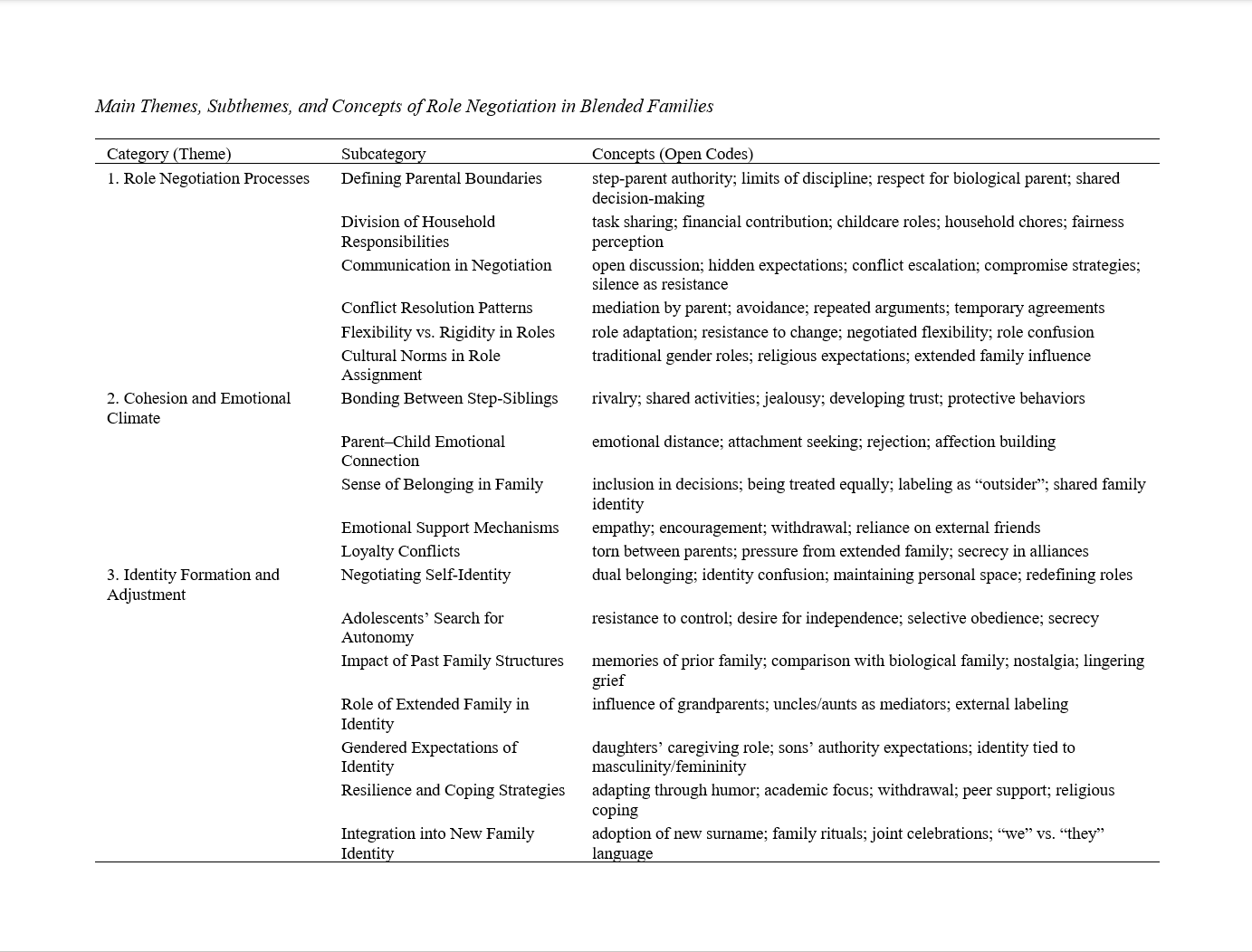
Findings: Analysis revealed three overarching themes: (1) Role Negotiation Processes, encompassing parental boundaries, household responsibilities, communication patterns, and cultural influences; (2) Cohesion and Emotional Climate, including bonding among step-siblings, emotional connections between parents and children, feelings of belonging, and loyalty conflicts; and (3) Identity Formation and Adjustment, covering dual belonging, adolescent autonomy, the influence of past family structures, and resilience strategies. Participant narratives highlighted frequent conflicts around fairness, authority, and inclusion, with cultural norms and extended kin networks shaping both tensions and adaptation. Successful negotiation fostered cohesion and strengthened shared identity, while unresolved conflicts generated exclusion and fragmented identities.
Conclusion: The findings underscore that role negotiation is a central process in determining the stability, cohesion, and identity development of blended families. Effective communication, cultural sensitivity, and shared rituals emerged as key facilitators of integration. Interventions should focus on clarifying roles, managing loyalty conflicts, and promoting adaptive coping strategies to strengthen resilience and family cohesion in blended family contexts.
Downloads
References
Bray, J. H. (2019). Remarriage and Stepfamilies. 707-724. https://doi.org/10.1037/0000099-039
Deal, R. L., & Olson, D. H. (2015). The Smart Stepfamily Marriage: Keys to Success in the Blended Family. Baker Publishing Group. https://books.google.com/books/about/The_Smart_Stepfamily_Marriage.html?id=s5gQBgAAQBAJ
Erdélyi, G. (2020). Negotiating Widowhood and Female Agency in Seventeenth-Century Hungary. Hungarian Historical Review, 9(4), 595-623. https://doi.org/10.38145/2020.4.595
Faghiharam, B. (2019). The Relationship between Social Health and Social Networks using among Female Student's Parent [Research Article]. Iranian Journal of Educational Sociology, 2(1), 150-160. https://doi.org/10.29252/ijes.2.1.150
Fang, C., Poortman, A. R., & Brons, M. D. (2024). Parents’ Perceptions of Cohesion in Diverse Stepfamilies. Family Relations, 74(1), 80-101. https://doi.org/10.1111/fare.13115
H.Ganong, L., Jensen, T. M., Sanner, C., Russell, L., & Coleman, M. (2019). Stepfathers’ Affinity-Seeking With Stepchildren, Stepfather-Stepchild Relationship Quality, Marital Quality, and Stepfamily Cohesion Among Stepfathers and Mothers. Journal of Family Psychology, 33(5), 521-531. https://doi.org/10.1037/fam0000518
Hu, Y., & To, S. (2017). Family Relations and Remarriage Postdivorce and Postwidowhood in China. Journal of Family Issues, 39(8), 2286-2310. https://doi.org/10.1177/0192513x17748694
Jensen, T. M., & H.Ganong, L. (2022). Associations Between Dyadic Relationship Quality and Stepfamily Functioning: A Common Fate Modeling Approach. Family Process, 62(2), 641-652. https://doi.org/10.1111/famp.12803
Karahan, A. S. (2024). Interventions for Remarried Families. Psikiyatride Guncel Yaklasimlar - Current Approaches in Psychiatry, 16(3), 494-504. https://doi.org/10.18863/pgy.1340773
Kim, H. (2010). Exploratory Study on the Factors Affecting Marital Satisfaction Among Remarried Korean Couples. Families in Society the Journal of Contemporary Social Services, 91(2), 193-200. https://doi.org/10.1606/1044-3894.3977
Kim, Y. (2012). A Practice Model for Strengthening Resilience Among Remarried Families. Journal of Korean Home Management Association, 30(4), 147-161. https://doi.org/10.7466/jkhma.2012.30.4.147
Kumar, K. (2017). The Blended Family Life Cycle. Journal of Divorce & Remarriage, 58(2), 110-125. https://doi.org/10.1080/10502556.2016.1268019
Lawrence, K. C., & Adebowale, T. A. (2023). Adolescence dropout risk predictors: Family structure, mental health, and self-esteem. Journal of Community Psychology, 51(1), 120-136. https://doi.org/10.1002/jcop.22884
Ma, X. (2023). The Impact of Family Structure Towards the Smart Community Construction. The Frontiers of Society Science and Technology, 5(3). https://doi.org/10.25236/fsst.2023.050304
Mo, K. Y., & Chan, T. M. S. (2023). The Challenges of a Stepfamily in Hong Kong Chinese Culture. Appl. Psychol. Res., 2(1), 1355. https://doi.org/10.59400/apr.v2i1.1355
Navabinejad, S., Rostami, M., & Parsakia, K. (2024). Influences of Family Structure and Intimacy on Emotional Divorce: A Cross-Sectional Analysis. JPRFC, 23-30. https://doi.org/10.61838/kman.jprfc.2.1.5
Safikhani, F. (2022). The effectiveness of grammatical mental imagery with cognitive processing on self-efficacy, emotional processing and spirituality in mothers of students with autism spectrum disorder. International Journal of Education and Cognitive Sciences, 3(2), 12-22. https://doi.org/10.22034/injoeas.2022.160609
Sanchez, L., Whisman, M. A., Hughes, J. A., & Gordon, K. C. (2022). Diversity in the prevalence and correlates of extramarital sex in a probability sample of Latino adults. Journal of Family Psychology, 36(4), 555-564. https://doi.org/10.1037/fam0000942
Sanner, C., H.Ganong, L., Coleman, M., & Berkley, S. (2022). Effective Parenting in Stepfamilies: Empirical Evidence of What Works. Family Relations, 71(3), 884-899. https://doi.org/10.1111/fare.12703
Vaezi, S. A., Fayyaz, E., & Sakiani, Z. (2024). Analyzing the Effects of Capitalist Systems on Family Structure and Free Sexual Relationships. Interdisciplinary Civilization Studies of the Islamic Revolution, 2(6), 75-99. https://en.civilica.com/doc/1974693/
Yun, B. M., an, S. R., & Yun, K. J. (2024). A Study of Subject-Related Art Therapy on Self-Esteem and Self-Regulation of a Child From a Remarried Family. Korean Correct Counseling Psychological Assoc, 9(2), 65-103. https://doi.org/10.33614/kccpa.2024.9.2.65
РУДЕНОК, А., Petyak, O., КОМАР, Т., Afanasenko, V., & ХАНЕЦЬКА, Н. (2022). Psycological Adaptation of Children in Remarried Families. Revista Romaneasca pentru Educatie Multidimensionala, 14(1), 521-534. https://doi.org/10.18662/rrem/14.1/533
Downloads
Additional Files
Publication Timeline
- Submitted
- Revised
- Accepted
Issue
Section
License

This work is licensed under a Creative Commons Attribution-NonCommercial 4.0 International License.