Presenting a Model for Predicting Marital Burnout Based on Experiential Avoidance and Relationship Beliefs with the Mediation of Forgiveness in Married Women Referring to Counseling Centers in Tehran
DOI:
https://doi.org/10.61838/kman.aftj.4464Keywords:
Marital burnout, Experiential avoidance, Relationship beliefs, Forgiveness, Structural equation modeling, Married womenAbstract
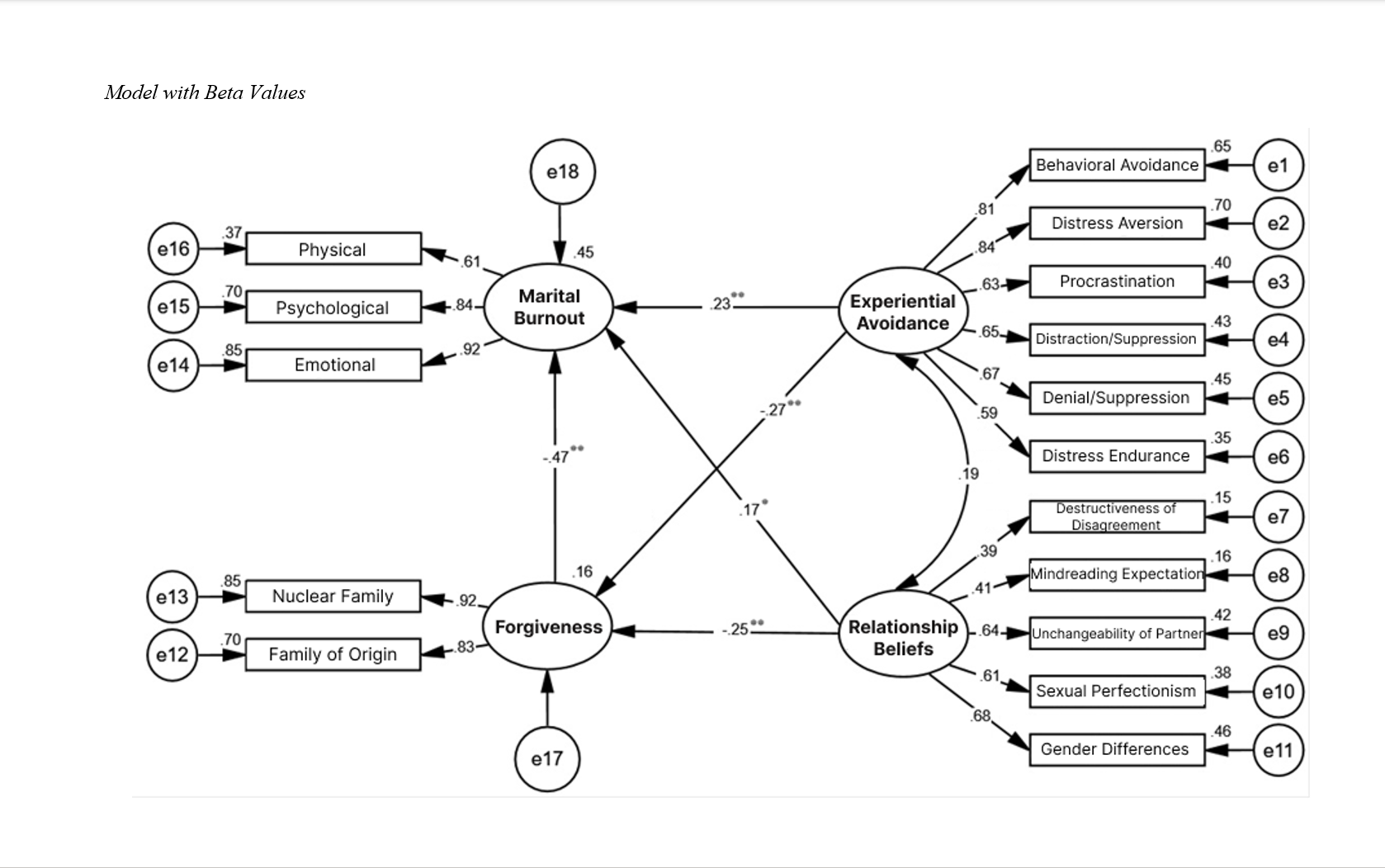
Objective: This study aimed to present a predictive model of marital burnout based on experiential avoidance and relationship beliefs with the mediating role of forgiveness in married women.
Methods and Materials: The research employed a descriptive-correlational design using structural equation modeling (SEM). The statistical population consisted of married women living in Tehran who had been married between 5 and 15 years and referred to counseling centers. A sample of 300 women was selected using available sampling. Data collection instruments included the Couple Burnout Measure (Pines, 1996), the Multidimensional Experiential Avoidance Questionnaire (Gámez et al., 2011), the Relationship Beliefs Inventory (Eidelson & Epstein, 1982), and the Family Forgiveness Scale (Pollard et al., 1998). Reliability and validity of the instruments were confirmed in prior studies. Data analysis was performed using AMOS-24 with maximum likelihood estimation.
Findings: The results indicated that experiential avoidance positively predicted marital burnout (β = 0.364, p < .001). Relationship beliefs also showed a positive and significant effect on marital burnout (β = 0.291, p < .001). Forgiveness had a negative and significant effect on marital burnout (β = -0.478, p < .001). Furthermore, forgiveness mediated the relationship between experiential avoidance and marital burnout (β = 0.129, p < .001), as well as between relationship beliefs and marital burnout (β = 0.118, p < .001). The model demonstrated acceptable fit indices (χ²/df = 2.45, CFI = 0.923, RMSEA = 0.07). Overall, experiential avoidance, relationship beliefs, and forgiveness explained 45% of the variance in marital burnout among participants.
Conclusion: The findings suggest that dysfunctional relationship beliefs and higher levels of experiential avoidance increase the risk of marital burnout, while forgiveness plays a protective role by reducing its intensity. Designing interventions that strengthen forgiveness and restructure irrational relationship beliefs can help reduce marital burnout and promote marital satisfaction.
Downloads
References
Aspara, J., Wittkowski, K., & Luo, X. (2018). Types of intelligence predict likelihood to get married and stay married: Large -scale empirical evidence for evolutionary theory. Personality and individual differences, 122, 1-6. https://doi.org/10.1016/j.paid.2017.09.028
Bardeen, J. R., & Fergus, T. A. (2016). The interactive effect of cognitive fusion and experiential avoidance on anxiety, depression, stress and posttraumatic stress symptoms. Journal of Contextual Behavioral Science, 5(1), 1-6. https://doi.org/10.1016/j.jcbs.2016.02.002
Braithwaite, S. R., Selby, E. A., & Fincham, F. D. (2019). Forgiveness and relationship satisfaction: Mediating mechanisms. Journal of Family Psychology, 4, 551-559. https://doi.org/10.1037/a0024526
Dehghan Abolfazl, G. L. M. M. Y. (2018). The Relationship between Relationship Beliefs and Couple Burnout: The Mediating Role of Mindfulness. Journal of Psychology, 22(3), 344-357. https://doi.org/magiran.com/p1908299
Dollahite, D. C., Marks, L. D., & Wurm, G. J. (2019). Generative devotion: A theory of sacred relational care in families of faith. Journal of Family Theory & Review, 11(3), 429-448. https://doi.org/10.1111/jftr.12339
Elmimanesh, N., & Zhaleh, M. (2018). Effectiveness of positivist psychotherapy on the psychological well-being, forgiveness and marital burnout in the women exposed to divorce. Family Pathology, Counseling & Enrichment, 4(1), 89-102. https://doi.org/http://fpcej.ir/article-1-209-en.html
Fahd, S., & Hanif, R. (2019). Determinants of marital flourishing among married individuals: an asian perspective. Review of Economics and Development Studies, 5(1), 95-108. https://doi.org/10.26710/reads.v5i1.513
Fatehi, N., Gholami Hosnaroudi, M., & Abed, N. (2021). The Mediating Role of Marital Forgiveness and Mental Well-being in the Relationship Between Mindfulness and Sexual Satisfaction in Married Women and Men of Tehran City: A Descriptive Study. J Rafsanjan Univ Med Sci, 20(6), 645-660. https://doi.org/10.52547/jrums.20.6.660
Freedman, S., & Zarifkar, T. (2016). The psychology of interpersonal forgiveness and guidelines for forgiveness therapy: What therapists need to know to help their clients forgive. Spirituality in Clinical Practice, 3(1), 45. https://doi.org/10.1037/scp0000087
Harasymchuk, C., Peetz, J., Fehr, B., & Chowdhury, S. (2021). Worn out relationship? The role of expectations in judgments of relational boredom. Personal Relationships, 28(1), 80-98. https://doi.org/10.1111/pere.12354
Hershenberg, R., Mavandadi, S., Wright, E., & Thase, M. E. (2017). Anhedonia in the daily lives of depressed veterans: A pilot report on experiential avoidance as a moderator of emotional reactivity. Journal of affective disorders, 208, 414-417. https://doi.org/10.1016/j.jad.2016.10.011
Hosseini, S. Z., Esmaeilpour, K., & Heshmati, R. (2024). Prediction of marital burnout based on marital conflicts and communication beliefs in couples applying for divorce. Razi J(84). https://doi.org/10.47176/rjms.31.84
Karimi, J., Homayuni, A., & Homayuni, F. (2019). The Prediction of Health Anxiety based on Experiential Avoidance and Anxiety Sensitivity among Non-Clinical Population. Research in Psychological Health, 12(4), 66-79. https://doi.org/https://sid.ir/paper/134046/en
Kazemian Moghadam, K., Mehrabizadeh, M., Kiamanesh, A., & Hosseinian, S. (2017). The role of differentiation, meaning in life, and forgiveness in predicting marital boredom among married female students. Women's Cultural Psychology, 9(33), 35-50. https://doi.org/https://sanad.iau.ir/Journal/jwc/Article/919996
Kazemian Moghaddam, K., Mehrabizadeh Honarmand, M., Kiamanesh, A., & Hosseiniyan, S. (2021). The role of differentiation, meaningfulness in life and forgiveness in predicting martial satisfaction. Iranian Journal of Family Psychology, 3(2), 71-82. https://doi.org/https://www.ijfpjournal.ir/article_245519.html
Khademi, Z., Yarahmadi, S., & Hamami, R. (2016). Prediction of marital boredom based on forgiveness characteristics in couples of Miandoab city. The Journal Of New Advances In Behavioral Sciences(4), 42-51. https://doi.org/http://ijndibs.com/article-۱-۴۸-fa.html
Li, H., & Lu, J. (2017). The neural association between tendency to forgive and spontaneous brain activity in healthy young adults. Frontiers in human neuroscience, 11, 561. https://doi.org/10.3389/fnhum.2017.00561
Liceaga, M. D. (2021). "You stay, no matter how bad": Women voice the trajectory of marital disaffection
Moradi, A., Yazdanbakhsh, K., & Basati, A. (2017). Prediction of marital conflicts according to schemes attachment styles and impunity. Journal of Psychological Sciences, 15(60), 518-531. https://doi.org/http://psychologicalscience.ir/article-1-169-en.html
Najibzadegan, A., Bahrainian, S. A., & Shahabizadeh, F. (2024). Efficacy of Acceptance and Commitment Therapy on Intimacy, Marital Forgiveness, and Marital Burnout in Women Affected by Extramarital Relationships. Aftj, 5(3), 102-112. https://doi.org/10.61838/kman.aftj.5.3.11
Nazeran, Z., Haghayegh, S. A., Raeisi, Z., & Dehghani, A. (2023). The relationship between marital attributions and marital burnout the mediating role of couple forgiveness. Rooyesh, 12(1), 187-196. https://doi.org/20.1001.1.2383353.1402.12.1.17.1
Neal, A. M., & Lemay, E. P. (2019). The wandering eye perceives more threats: Projection of attraction to alternative partners predicts anger and negative behavior in romantic relationships. Journal of Social and Personal Relationships, 36(2), 450-468. https://doi.org/10.1177/0265407517734398
Nemati, S., Ghobari Bonab, B., & Pourhossein, R. (2015). Psychological consequences of forgiveness from the perspective of Iranian's mothers of children with intellectual disabilities. Journal of Psychological Science., 14(54), 180-192. https://doi.org/http://psychologicalscience.ir/article-1-238-en.html
Piri, M., & Shirazi, P. D. M. (2018). The Role of Marital Offence-Specific Forgiveness and Semantic Differential of Sex Roles in Marital Satisfaction of Married Teachers in Zahedan. 15(2), 109-128. https://doi.org/20.1001.1.26766728.1397.15.2.6.6
Pouya, F. H., Gharamaleki, N. S., & Mirzahosseini, H. (2025). The Structural Model for Predicting Marital Burnout Based on Attachment Styles With the Mediating Role of Marital Self-Regulation and Marital Intimacy in Married Individuals. Aftj, 6(1), 29-36. https://doi.org/10.61838/kman.aftj.6.1.4
Ragabi, G., Harizavi, M., & Taghipour, M. (2017). Evaluating the model of the relationship between self-compassion, marital empathy, and depression with mediating marital forgiveness in Female. Biannual Journal of Applied Counseling, 6(2), 1-22. https://doi.org/10.22055/jac.2017.21290.1422
Roush, J. F., Brown, S. L., Mitchell, S. M., & Cukrowicz, K. C. (2019). Experiential Avoidance, Cognitive Fusion, and Suicide Ideation among Psychiatric Inpatients: The Role of Thwarted Interpersonal Needs. Psychotherapy Research, 29(4), 514-523. https://doi.org/10.1080/10503307.2017.1395923
Sadati, S. E., Mehrabizadeh Honarmand, M., & Soodani, M. (2015). The Causal Relationship Of Differentiation, Neuroticism, And Forgiveness With Marital Disaffection Through Mediation Of Marital Conflict. Family Psychology, 1(2), 55-68. https://doi.org/https://sid.ir/paper/250062/en
Seçer, İ., & Ulaş, S. (2021). An Investigation of the Effect of COVID-19 on OCD in Youth in the Context of Emotional Reactivity, Experiential Avoidance, Depression and Anxiety. Int J Ment Health Addiction, 19, 2306-2319. https://doi.org/10.1007/s11469-020-00322-z
Sharifi, B., Raeisi, F., & Haji Hassani, M. (2024). The relationship between self-compassion and forgiveness with marital burnout: The mediating role of self-criticism in married individuals. Rooyesh-e-Ravanshenasi Journal (Psychology Rising), 13(9), 21-30. https://frooyesh.ir/article-1-5199-en.html
Sultanali Zadeh, M., Nemati, N., & Montazeri, M. (2019). Predicting marital boredom based on rumination and acceptance and action (experiential avoidance) in infertile women. Proceedings of the 2nd International Conference on Psychology, Counseling, and Educational Sciences. https://doi.org/RIPTW01_035
Vahedinia, M., Akbari Daghi, H., & Gharib, H. (2019). The relationship between irrational thoughts and communication beliefs with marital boredom among teacher (Master's Married teachers in Gonbad County, Master's thesis, Gonbad, Iran.
Walsh, C. M. (2019). Emotional capital and the benefits for personal well -being: how positive moments with you might help me too
Yaghoutian, M., Soleimanian, A. A., & Mohammadzadeh Ebrahimi, A. (2015). Prediction of marital burnout based on couples' communication beliefs. Proceedings of the 2nd International Conference on Psychology, Educational Sciences. https://doi.org/ICPE02_099
Yousefi, H., Sheibani, H., & Majdabadi, Z. (2018). Examining the relationship between emotional dysregulation and experiential avoidance with marital boredom among couples on the verge of divorce in Qaen Ganj Irandoc].
Zali, Z., Ahmadi, S., & Sarami Foroshani, G. (2019). The mediating role of marital forgiveness in the relationship between psychological hardiness and marital burnout. 5(1), 107-124. https://doi.org/20.1001.1.24234869.1398.5.1.1.8
Downloads
Additional Files
Publication Timeline
- Submitted
- Revised
- Accepted
Issue
Section
License
Copyright (c) 2025 Hourieh Masoumi Rad (Author); Pantea Jahangir (Corresponding Author); Simindokht Rezakhani (Author)

This work is licensed under a Creative Commons Attribution-NonCommercial 4.0 International License.