Humor in Families and Stress Reduction: The Mediating Role of Positive Affect
DOI:
https://doi.org/10.61838/kman.aftj.4446Keywords:
Humor, Stress, Positive Affect, Family Functioning, Structural Equation, South AfricaAbstract
Objective: This study aimed to investigate the relationship between humor and stress in families, with positive affect as a mediating variable.
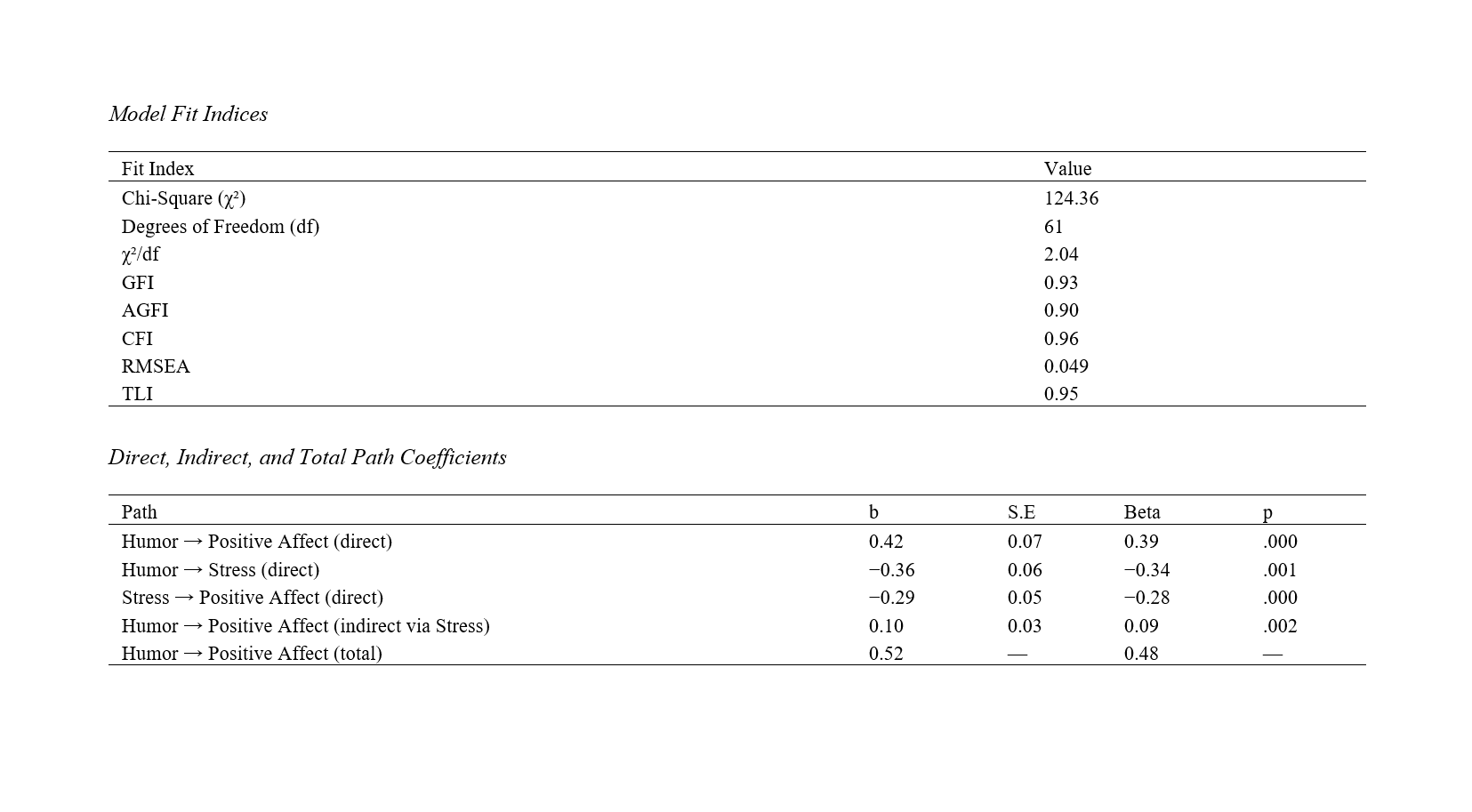
Methods and Materials: The study employed a descriptive correlational design with 409 participants selected from families in South Africa, based on the Morgan and Krejcie sample size table. Data were collected through standardized questionnaires measuring humor, stress, and positive affect. Pearson correlation analysis was conducted using SPSS-27 to explore bivariate associations among variables. Structural Equation Modeling (SEM) was performed in AMOS-21 to test the hypothesized mediation model. Model fit was evaluated using multiple indices, including χ², df, χ²/df, GFI, AGFI, CFI, TLI, and RMSEA.
Findings: The results revealed significant correlations between the study variables. Humor was positively correlated with positive affect (r = 0.53, p < .001) and negatively correlated with stress (r = −0.41, p = .001). Stress showed a significant negative correlation with positive affect (r = −0.47, p < .001). The structural model demonstrated acceptable fit (χ²(61) = 124.36, χ²/df = 2.04, GFI = 0.93, AGFI = 0.90, CFI = 0.96, TLI = 0.95, RMSEA = 0.049). Path analysis confirmed that humor had a direct positive effect on positive affect (β = 0.39, p < .001) and a negative effect on stress (β = −0.34, p = .001). Stress negatively influenced positive affect (β = −0.28, p < .001). Positive affect mediated the relationship between humor and stress, with a significant indirect effect (β = 0.09, p = .002).
Conclusion: The findings highlight the protective role of humor in family contexts, showing that it reduces stress both directly and through the mediating role of positive affect. Integrating humor into family-based interventions may enhance resilience and emotional well-being.
Downloads
References
Bartzik, M., Bentrup, A., Hill, S., Bley, M., Hirschhausen, E. v., Krause, G., Ahaus, P., Dahl-Dichmann, A., & Peifer, C. (2021). Care for Joy: Evaluation of a Humor Intervention and Its Effects on Stress, Flow Experience, Work Enjoyment, and Meaningfulness of Work. Frontiers in Public Health, 9. https://doi.org/10.3389/fpubh.2021.667821
Emery, L., Libera, A., Lehman, E., & Levi, B. H. (2024). Humor in Parenting: Does It Have a Role? PLoS One, 19(7), e0306311. https://doi.org/10.1371/journal.pone.0306311
Fritz, H. L. (2021). Caregiving in Quarantine: Humor Styles, Reframing, and Psychological Well-Being Among Parents of Children With Disabilities. Journal of Social and Personal Relationships, 39(3), 615-639. https://doi.org/10.1177/02654075211043515
Fritz, H. L. (2025). Humor Styles and Well-Being of Women With Endometriosis During the COVID-19 Pandemic. Humor - International Journal of Humor Research. https://doi.org/10.1515/humor-2024-0040
Froehlich, E., Madipakkam, A. R., Craffonara, B., Bolte, C., Muth, A.-K., & Park, S. Q. (2021). A Short Humorous Intervention Protects Against Subsequent Psychological Stress and Attenuates Cortisol Levels Without Affecting Attention. Scientific reports, 11(1). https://doi.org/10.1038/s41598-021-86527-1
Gültekin, D. D., & Ulutaş, İ. (2022). “Less Stress More Learning”. 64-78. https://doi.org/10.4018/978-1-6684-4313-2.ch004
Hampes, W. P. (2013). A Pilot Study of the Relation Between Humor Styles and the Past-Positive and Past-Negative Time Perspectives. Psychological Reports, 113(1), 345-351. https://doi.org/10.2466/16.10.pr0.113x17z9
Hartley, S. L., Papp, L. M., & Bolt, D. M. (2016). Spillover of Marital Interactions and Parenting Stress in Families of Children With Autism Spectrum Disorder. Journal of Clinical Child & Adolescent Psychology, 47(sup1), S88-S99. https://doi.org/10.1080/15374416.2016.1152552
Hoicka, E., Telli, B. S., Prouten, E., Leckie, G., Browne, W. J., Mireault, G. C., & Fox, C. L. (2021). The Early Humor Survey (EHS): A Reliable Parent-Report Measure of Humor Development for 1- To 47-Month-Olds. Behavior Research Methods, 54(4), 1928-1953. https://doi.org/10.3758/s13428-021-01704-4
Jacquin, L., Blottière, L., Haussy, C., Perret, S., & Gasparini, J. (2012). Prenatal and Postnatal Parental Effects on Immunity and Growth in ‘Lactating’ Pigeons. Functional Ecology, 26(4), 866-875. https://doi.org/10.1111/j.1365-2435.2012.01988.x
Joshi, P., Yadav, B. P., Jain, V., & Sharma, S. (2022). Knowledge, Stress and Adopted Coping Strategies of Parents of Children Having Congenital Adrenal Hyperplasia: An Exploratory Survey. Indian Journal of Child Health, 4(2), 127-132. https://doi.org/10.32677/ijch.2017.v04.i02.005
Kırca, K., Güner, C. K., Öztürk, E., & Ersoy, M. (2023). Determination of Perceived Stress Levels and Coping With Humor in Cancer Patients Receiving Chemotherapy. Gobeklitepe Saglik Bilimleri Dergisi, 6(12), 49-58. https://doi.org/10.55433/gsbd/143
Leter, T. L. M., Ellis‐Davies, K., Rubio, B., Vecho, O., Bos, H., Lamb, M. E., & Loes Van Rijn – Van, G. (2024). Parental Positive Affect and Negative Affect in Same- And Different-Sex Parent Families: No Associations With Parental Gender and Caregiving Role. Frontiers in psychology, 15. https://doi.org/10.3389/fpsyg.2024.1332758
Lindwall, J., Russell, K., Huang, Q., Zhang, H., Vannatta, K., Barrera, M., Alderfer, M. A., & Phipps, S. (2014). Adjustment in Parents of Children Undergoing Stem Cell Transplantation. Biology of Blood and Marrow Transplantation, 20(4), 543-548. https://doi.org/10.1016/j.bbmt.2014.01.007
Mireault, G. C., Crockenberg, S., Sparrow, J. E., Cousineau, K., Pettinato, C. A., & Woodard, K. C. (2015). Laughing Matters: Infant Humor in the Context of Parental Affect. Journal of Experimental Child Psychology, 136, 30-41. https://doi.org/10.1016/j.jecp.2015.03.012
Nahm, E. Y., & Park, S. (2017). Mother-Child Interactions in a Stressful Situation by Mother’s Emotional Regulation Level. Korean Journal of Child Studies, 38(1), 251-262. https://doi.org/10.5723/kjcs.2017.38.1.251
Oh, Y. K., & Hwang, H. S. (2019). The Effects of Parents’ Humor Styles on Children’s Emotional Regulation Competence -The Mediating Effect of Warm Parenting Behavior. Korean Journal of Child Studies, 40(1), 27-37. https://doi.org/10.5723/kjcs.2019.40.1.27
Romero, E. J., & Arendt, L. A. (2011). Variable Effects of Humor Styles on Organizational Outcomes. Psychological Reports, 108(2), 649-659. https://doi.org/10.2466/07.17.20.21.pr0.108.2.649-659
Rong, W., Chan, D. K., Goh, Y. W., Penfold, M., Harper, T., & Weltewitz, T. (2017). Humor and Workplace Stress: A Longitudinal Comparison Between Australian and Chinese Employees. Asia Pacific Journal of Human Resources, 56(2), 175-195. https://doi.org/10.1111/1744-7941.12157
Sharma, H., Disawala, H., & Suyog, G. (2024). Parental Humors Importance in Supporting Families With Disabled Children. Multidisciplinary Science Journal, 6, 2024ss0521. https://doi.org/10.31893/multiscience.2024ss0521
Theisen, J. C., Ogolsky, B. G., Simpson, J. A., & Rholes, W. S. (2019). Dyad to Triad: A Longitudinal Analysis of Humor and Pregnancy Intention During the Transition to Parenthood. Journal of Social and Personal Relationships, 36(11-12), 3611-3630. https://doi.org/10.1177/0265407519831076
Vera, E., Vacek, K., Blackmon, S. k., Coyle, L. D., Gomez, K. L., Jorgenson, K. C., Luginbuhl, P. J., Moallem, I., & Steele, J. C. (2011). Subjective Well-Being in Urban, Ethnically Diverse Adolescents the Role of Stress and Coping. Youth & Society, 44(3), 331-347. https://doi.org/10.1177/0044118x11401432
Villalba, A., Stanley, J. T., Vale, M. T., Turner, J. R., & Houston, M. L. (2023). Age Differences in Using Humor to Cope During a Pandemic. Humor - International Journal of Humor Research, 36(1), 51-74. https://doi.org/10.1515/humor-2021-0137
Walsh, J. (2021). Using Humor in Practice Relationships. 231-251. https://doi.org/10.1093/oso/9780197517956.003.0013
Wang, H., Liu, S., Xu, J., Hu, X., & Han, Z. R. (2023). Daily Experiences and Well-Being of Chinese Parents of Children With Autism. Autism, 27(6), 1560-1574. https://doi.org/10.1177/13623613221144191
Xu, J., & Zheng, Y. (2022). Parent- And Child-Driven Daily Family Stress Processes Between Daily Stress, Parental Warmth, and Adolescent Adjustment. Journal of youth and adolescence, 52(3), 490-505. https://doi.org/10.1007/s10964-022-01691-5
Yu, M., & Kim, K. M. (2015). A Structural Equation Model for Parenting Stress in Mothers of Premature Infants. Journal of Child and Family Studies, 25(4), 1334-1344. https://doi.org/10.1007/s10826-015-0297-1
Yustia, F. A., Lubis, H., & Putri, E. T. (2021). Sense of Humor Dengan Subjective Well-Being Pada Remaja Dengan Orangtua Yang Bercerai. Psikoborneo Jurnal Ilmiah Psikologi, 9(3), 566. https://doi.org/10.30872/psikoborneo.v9i3.6500
Μαλλιαρού, Μ., Karadonta, A., Mitroulas, S., Παραλίκας, Θ., Kotrotsiou, S., Nikolentzos, A., & Sarafis, P. (2021). Preterm Parents' Stress and Coping Strategies in a Neonatal Intensive Care Unit in a University Hospital of Central Greece. Materia Socio Medica, 33(4), 244. https://doi.org/10.5455/msm.2021.33.244-249
Downloads
Additional Files
Publication Timeline
- Submitted
- Revised
- Accepted
Issue
Section
License

This work is licensed under a Creative Commons Attribution-NonCommercial 4.0 International License.