Hidden Grief, Visible Grades: Components of Academic Functioning after Friendship Loss in Adolescents
Keywords:
Adolescence, Friendship loss, Academic functioning, Emotional adjustment, ResilienceAbstract
Objective: This study aimed to explore the emotional and academic consequences of friendship loss among adolescents, identifying the components of academic functioning most affected by the hidden grief of relational dissolution.
Methods and Materials: A qualitative research design was employed, drawing on semi-structured interviews with 24 adolescents (ages 13–18) from Argentina who had experienced the loss of a significant friendship within the past two years. Participants were recruited through purposive sampling to ensure diversity in gender, school type, and academic performance levels. Interviews were conducted in Spanish, audio-recorded, transcribed verbatim, and analyzed using NVivo 14 software. Data collection continued until theoretical saturation was achieved. Thematic analysis, combining inductive and deductive strategies, was used to identify patterns across participants’ narratives. Credibility was enhanced through independent coding, constant comparison, and reflexive memoing.
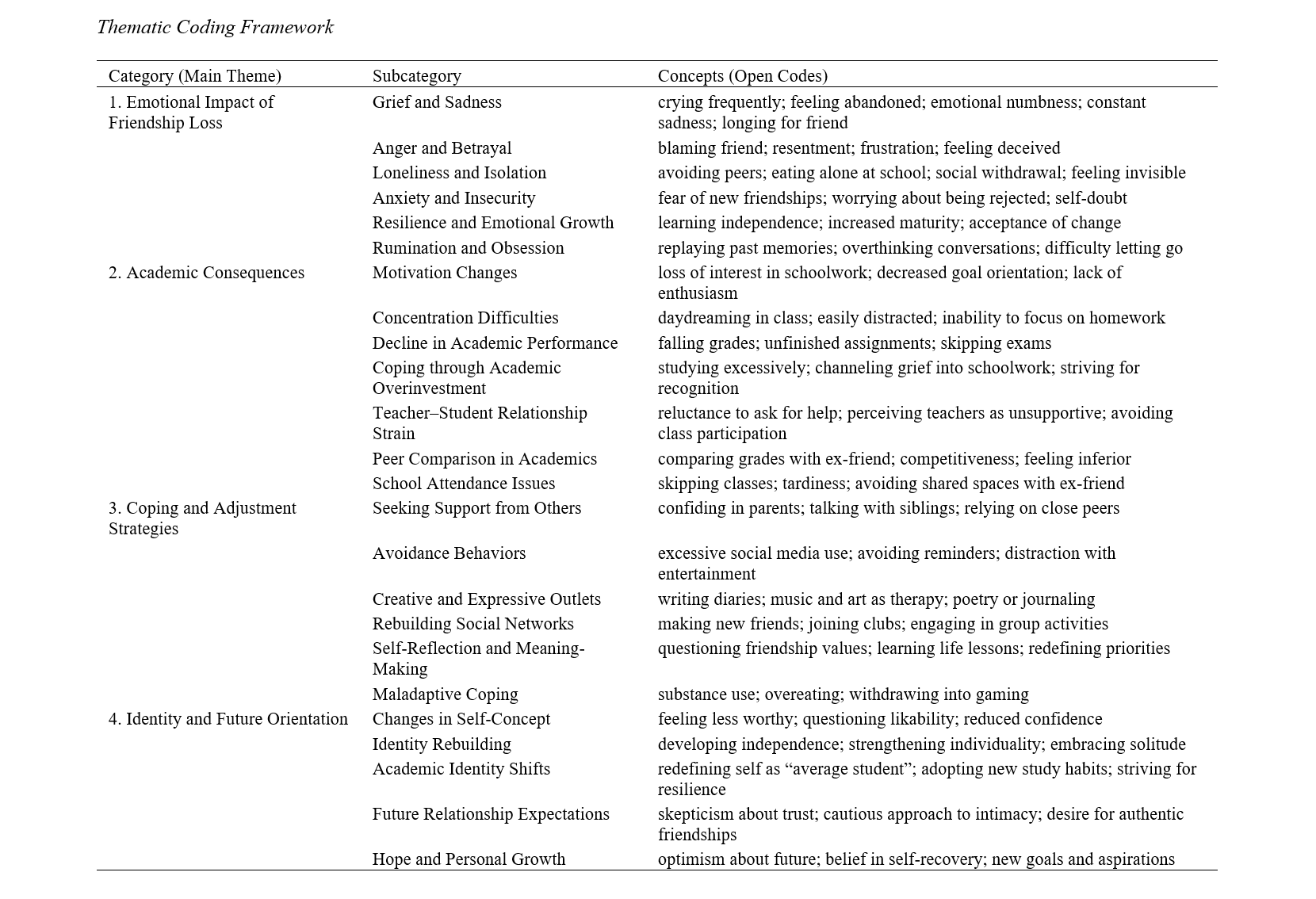
Findings: Four overarching themes emerged: (1) Emotional impact of friendship loss, encompassing grief, sadness, anger, loneliness, insecurity, and rumination; (2) Academic consequences, including declines in motivation, concentration, and performance, as well as paradoxical overinvestment in schoolwork; (3) Coping and adjustment strategies, ranging from seeking support and creative expression to maladaptive behaviors such as avoidance and substance use; and (4) Identity and future orientation, reflecting disrupted self-concept, cautiousness in future friendships, and eventual processes of resilience and growth.
Conclusion: The study demonstrates that friendship loss in adolescence is a profound relational rupture with both emotional and academic consequences. Recognizing academic decline as a potential indicator of hidden grief may inform educational and counseling practices. Supporting adolescents in coping with friendship loss through adaptive strategies can foster both resilience and academic recovery.
Downloads
References
Annisa, N. I., Lutfianawati, D., & Putri, A. M. (2025). The Role of Gender and Friendship Quality on Happiness Among Adolescents in Bandar Lampung. Seurune Jurnal Psikologi Unsyiah, 8(1), 42-48. https://doi.org/10.24815/s-jpu.v8i1.41016
Bohnert, A. M., Lieb, R., & Arola, N. T. (2016). More Than Leisure: Organized Activity Participation and Socio-Emotional Adjustment Among Adolescents With Autism Spectrum Disorder. Journal of Autism and Developmental Disorders, 49(7), 2637-2652. https://doi.org/10.1007/s10803-016-2783-8
Fan, T., & Bellmore, A. (2023). Connecting Feelings of School Belonging to High School Students’ Friendship Quality Profiles. Journal of Social and Personal Relationships, 40(8), 2488-2511. https://doi.org/10.1177/02654075231151952
Gallardo, L. O., Barrasa, Á., & Guevara-Viejó, F. (2016). Positive Peer Relationships and Academic Achievement Across Early and Midadolescence. Social Behavior and Personality an International Journal, 44(10), 1637-1648. https://doi.org/10.2224/sbp.2016.44.10.1637
Harmelen, A. L. v., Blakemore, S. J., Goodyer, I., & Kievit, R. (2019). The Interplay Between Adolescent Friendships and Resilience Following Childhood Adversity. https://doi.org/10.31219/osf.io/tgrc9
Harmelen, A. L. v., Blakemore, S. J., Goodyer, I., & Kievit, R. (2020). The Interplay Between Adolescent Friendship Quality and Resilient Functioning Following Childhood and Adolescent Adversity. Adversity and Resilience Science, 2(1), 37-50. https://doi.org/10.1007/s42844-020-00027-1
Hoffman, A. J., Pullés, S. A., Medina, M., Pinetta, B. J., Rivas‐Drake, D., Schaefer, D. R., & Jagers, R. J. (2021). Considering Multiple Levels of Influence on Adjustment in School: Ethnic–racial Public Regard, Peer Socialization, and Social‐emotional Learning Practices. Social Development, 30(3), 806-832. https://doi.org/10.1111/sode.12501
Kim, Y., & Kim, Y. M. (2024). Adolescents’ Positive Friendship and Academic Engagement: The Mediating Effect of Academic Helplessness and the Moderated Mediating Effect of Fandom Activities. Korean Association for Learner-Centered Curriculum and Instruction, 24(22), 103-116. https://doi.org/10.22251/jlcci.2024.24.22.103
Koele, I. J., Blankenstein, N. E., Schreuders, E., Anna, C. K. v. D., & Güroğlu, B. (2023). Adolescents’ Friendship Quality, Internalizing Problems, and Academic Achievement During the COVID-19 Pandemic: A Longitudinal Study. https://doi.org/10.21203/rs.3.rs-2653418/v1
Lan, X. (2020). Grit and Peer Relationships in Early Adolescence: A Person-Centered Approach. Journal of Social and Personal Relationships, 37(7), 2250-2269. https://doi.org/10.1177/0265407520921557
Laninga‐Wijnen, L., Gremmen, M., Dijkstra, J. K., Veenstra, R., Vollebergh, W., & Harakeh, Z. (2019). The Role of Academic Status Norms in Friendship Selection and Influence Processes Related to Academic Achievement. Developmental Psychology, 55(2), 337-350. https://doi.org/10.1037/dev0000611
Lessard, L. M., & Juvonen, J. (2018). Losing and Gaining Friends: Does Friendship Instability Compromise Academic Functioning in Middle School? Journal of School Psychology, 69, 143-153. https://doi.org/10.1016/j.jsp.2018.05.003
Neprily, K., Climie, E. A., McCrimmon, A. W., & Makarenko, E. (2025). Why Can't We Be Friends? A Narrative Review of the Challenges of Making and Keeping Friends for Children and Adolescents With Attention-Deficit/Hyperactivity Disorder. Frontiers in Developmental Psychology, 2. https://doi.org/10.3389/fdpys.2024.1390791
ÖZtÜRk, N., & Sumbas, E. (2023). How Do Adolescent Friendships End and How Do Adolescents Experience and Interpret This Development? Kastamonu Eğitim Dergisi, 31(1), 12-21. https://doi.org/10.24106/kefdergi.1243309
Park, D., Tsukayama, E., & Galla, B. M. (2022). Friends Know You: Peer Nomination of Self‐control Predict Changes in Academic Achievement and Friendship Among Adolescents. Journal of adolescence, 94(3), 477-487. https://doi.org/10.1002/jad.12041
Poulin, F., & Denault, A. S. (2013). Friendships With Co-Participants in Organized Activities: Prevalence, Quality, Friends' Characteristics, and Associations With Adolescents' Adjustment. New directions for child and adolescent development, 2013(140), 19-35. https://doi.org/10.1002/cad.20035
Rambaran, A., Hopmeyer, A., Schwartz, D., Steglich, C., Badaly, D., & Veenstra, R. (2016). Academic Functioning and Peer Influences: A Short‐Term Longitudinal Study of Network–Behavior Dynamics in Middle Adolescence. Child development, 88(2), 523-543. https://doi.org/10.1111/cdev.12611
Reinke, A. L., Stiles, K., & Lee, S. S. (2023). Childhood ADHD With and Without Co-Occurring Internalizing/Externalizing Problems: Prospective Predictions of Change in Adolescent Academic and Social Functioning. Journal of Attention Disorders, 27(13), 1520-1531. https://doi.org/10.1177/10870547231187146
Rieffe, C., Broekhof, E., Eichengreen, A., Kouwenberg, M., Veiga, G., Brenda, M. S. d. S., Laan, A. v. d., & Frijns, J. H. M. (2018). Friendship and Emotion Control in Pre-Adolescents With or Without Hearing Loss. The Journal of Deaf Studies and Deaf Education, 23(3), 209-218. https://doi.org/10.1093/deafed/eny012
Robert, P.-O., Kuipers, M. A. G., Rathmann, K., Moor, I., Kinnunen, J. M., Rimpelä, A., Perelman, J., Federico, B., Richter, M., Kunst, A. E., & Lorant, V. (2018). Academic Performance and Adolescent Smoking in 6 European Cities: The Role of Friendship Ties. International Journal of Adolescence and Youth, 24(1), 125-135. https://doi.org/10.1080/02673843.2018.1475288
Robertz, A.-C., Kantzer, A. K., Nilsson, S., Törnhage, C.-J., & Nyman, V. (2024). Friendship Matters—An Interview Study With Adolescents With Attention Deficit Hyperactivity Disorder. PLOS Ment Health, 1(1), e0000023. https://doi.org/10.1371/journal.pmen.0000023
Schwartz, D., Kelly, B. M., Mali, L. V., & Duong, M. T. (2016). Exposure to Violence in the Community Predicts Friendships With Academically Disengaged Peers During Middle Adolescence. Journal of youth and adolescence, 45(9), 1786-1799. https://doi.org/10.1007/s10964-016-0485-3
Shen, M., & French, D. C. (2023). Peer Relationships and Chinese Adolescents’ Academic Achievement: Selection and Influence. American Educational Research Journal, 61(1), 177-207. https://doi.org/10.3102/00028312231208675
Wicaksono, B., & Adiyanti, M. G. (2019). Understanding the Dynamics of Friendship Formation Among High School Adolescent: Indigenous Psychology Approach. Psychological Research and Intervention, 2(1), 28-35. https://doi.org/10.21831/pri.v2i1.28048
Zhao, X., & Gao, M. (2014). “No Time for Friendship”. Journal of Adolescent Research, 29(5), 587-615. https://doi.org/10.1177/0743558413520225
Downloads
Additional Files
Publication Timeline
- Submitted
- Revised
- Accepted
Issue
Section
License

This work is licensed under a Creative Commons Attribution-NonCommercial 4.0 International License.