Exploring the Role of Narrative Reframing in Families Experiencing Trauma
DOI:
https://doi.org/10.61838/kman.aftj.4409Keywords:
Narrative reframing, trauma, families, coping, posttraumatic growth, Taiwan, qualitative researchAbstract
Objective: This study aimed to explore how narrative reframing functions as a coping and meaning-making mechanism among Taiwanese families experiencing trauma.
Methods and Materials: A qualitative research design was adopted using purposive sampling to recruit 26 participants from Taiwan who had directly experienced family trauma, including bereavement, illness, or sudden life disruptions. Semi-structured interviews were conducted until theoretical saturation was reached. Each interview lasted 60–90 minutes, was audio-recorded, and transcribed verbatim. Data were analyzed using thematic analysis facilitated by NVivo 14 software. An inductive coding approach was applied to identify open codes, subcategories, and overarching themes, with constant comparison used to refine findings. Research rigor was ensured through reflexive memo-writing, triangulation of coding among team members, and maintaining an audit trail.
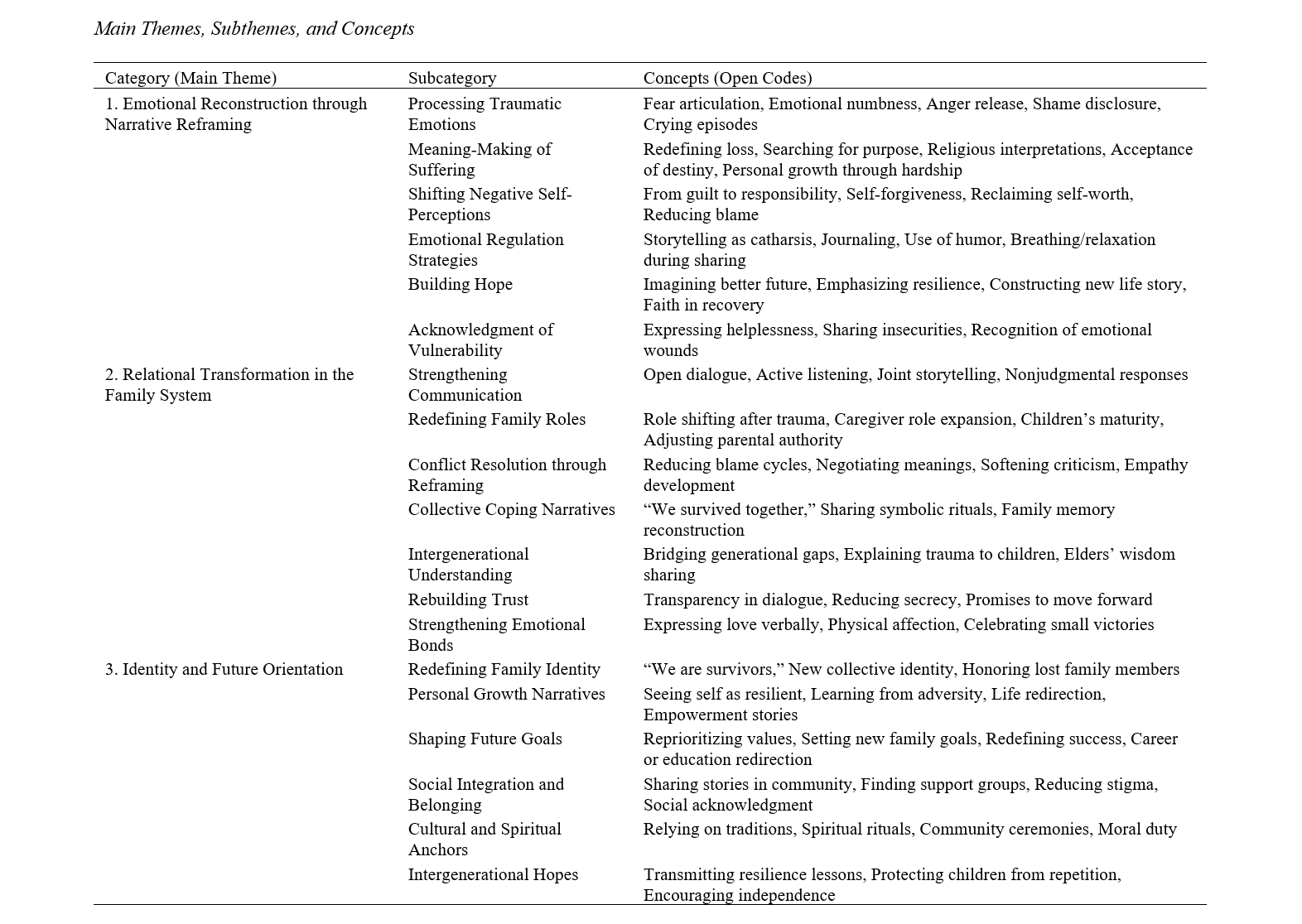
Findings: Analysis yielded three overarching themes: (1) Emotional reconstruction through narrative reframing, where participants processed trauma-related emotions, reduced guilt and shame, regulated distress, and cultivated hope; (2) Relational transformation within the family system, including improved communication, redefined roles, conflict resolution, trust rebuilding, and strengthened intergenerational understanding; and (3) Identity and future orientation, where families reframed themselves as survivors, emphasized personal growth, redefined goals and values, and expressed aspirations to transmit resilience across generations. Participants highlighted that narrative reframing enabled them to transform suffering into continuity, strengthen bonds, and situate trauma within cultural and spiritual frameworks that emphasized endurance and meaning.
Conclusion: The findings demonstrate that narrative reframing is a powerful coping process in families experiencing trauma, allowing for emotional healing, relational adaptation, and the construction of resilient family identities. This study underscores the importance of integrating narrative approaches into therapeutic interventions to support families in navigating trauma, rebuilding trust, and envisioning hopeful futures.
Downloads
References
Acuna, M. A., & Kataoka, S. H. (2017). Family Communication Styles and Resilience Among Adolescents. Social Work, 62(3), 261-269. https://doi.org/10.1093/sw/swx017
Arënliu, A., Shala-Kastrati, F., Avdiu, V. B., & Landsman, M. (2017). Posttraumatic Growth Among Family Members With Missing Persons From War in Kosovo: Association With Social Support and Community Involvement. OMEGA - Journal of Death and Dying, 80(1), 35-48. https://doi.org/10.1177/0030222817725679
Barakat, L. P., Madden, R., Vega, G., Askins, M. A., & Kazak, A. E. (2021). Longitudinal Predictors of Caregiver Resilience Outcomes at the End of Childhood Cancer Treatment. Psycho-Oncology, 30(5), 747-755. https://doi.org/10.1002/pon.5625
Beck, C. T., & Casavant, S. G. (2019). Vicarious Posttraumatic Growth in NICU Nurses. Advances in Neonatal Care, 20(4), 324-332. https://doi.org/10.1097/anc.0000000000000689
Beck, C. T., & Twomey, T. M. (2023). Posttraumatic Growth After Postpartum Psychosis. MCN the American Journal of Maternal/Child Nursing, 48(6), 303-311. https://doi.org/10.1097/nmc.0000000000000954
Bunkers, S. S., Flinn, E., Letcher, D. C., Reding, N., Damgaard, G., Young, L., Klein, L., & Knitig, K. (2022). Storytelling and the Humanbecoming Family Model. Nursing Science Quarterly, 35(2), 184-190. https://doi.org/10.1177/08943184211070594
Choi, S. O. (2014). Posttraumatic Growth in Family Caregivers of Patients With Cancer. The Korean Journal of Hospice and Palliative Care, 17(1), 1-9. https://doi.org/10.14475/kjhpc.2014.17.1.1
Cong, Z., Nejat, A., & Liang, D. (2016). The Effect of Emotional Closeness and Exchanges of Support Among Family Members on Residents’ Positive and Negative Psychological Responses After Hurricane Sandy. Plos Currents. https://doi.org/10.1371/currents.dis.5eebc1ace65be41d0c9816c93d16383b
Donohue, E. (2024). Family Coping With COVID-19: Unexpected Parental Loss and Surviving Parent Coping, Grief and Posttraumatic Growth Outcomes Based on Child Age. OMEGA - Journal of Death and Dying. https://doi.org/10.1177/00302228241272566
Ferrari, M., & Munroe, M. (2024). Coping Personally and Politically With World Crises. 127-142. https://doi.org/10.1093/oso/9780197751756.003.0008
Khatimah, K., & Pudjiati, S. R. R. (2022). Posttraumatic Growth: The Role of Trauma Exposure and Family Hardiness Against Pasigala Liquefaction Survivors. Analitika, 14(2), 132-142. https://doi.org/10.31289/analitika.v14i2.8123
Lee, M., Kim, K., Lim, C., & Kim, J. (2017). Posttraumatic Growth in Breast Cancer Survivors and Their Husbands Based on the Actor‐partner Interdependence Model. Psycho-Oncology, 26(10), 1586-1592. https://doi.org/10.1002/pon.4343
Liao, Y., Xuelan, L., Wu, X., Li, C., & Li, Y. (2024). Social Isolation Profiles and Conditional Process Analysis Among Postoperative Enterostomy Patients With Colorectal Cancer. BMC psychology, 12(1). https://doi.org/10.1186/s40359-024-02304-5
Macaulay, C., & Angus, L. (2019). The Narrative-Emotion Process Model: An Integrative Approach to Working With Complex Posttraumatic Stress. Journal of Psychotherapy Integration, 29(1), 42-53. https://doi.org/10.1037/int0000118
Ochu, A. C., Davis, E. B., Magyar‐Russell, G., O’Grady, K. A., & Aten, J. D. (2018). Religious Coping, Dispositional Forgiveness, and Posttraumatic Outcomes in Adult Survivors of the Liberian Civil War. Spirituality in Clinical Practice, 5(2), 104-119. https://doi.org/10.1037/scp0000163
Ogińska-Bulik, N. (2016). Ruminations and Effects of Trauma in Women Experiencing Domestic Violence. Roczniki Psychologiczne, 19(4), 643-658. https://doi.org/10.18290/rpsych.2016.19.4-1en
Pérez-San-Gregorio, M. Á., Rodríguez, A. M., María de las Mercedes Borda, M., Navarro, M. L. A., Pérez-Bernal, J., & Bravo, M. Á. G. (2017). Coping Strategies in Liver Transplant Recipients and Caregivers According to Patient Posttraumatic Growth. Frontiers in psychology, 8. https://doi.org/10.3389/fpsyg.2017.00018
Ramos, C., & Leal, I. (2013). Posttraumatic Growth in the Aftermath of Trauma: A Literature Review About Related Factors and Application Contexts. Psychology Community & Health, 2(1), 43-54. https://doi.org/10.5964/pch.v2i1.39
Roebuck, B. S., Sattler, P., & Clayton, A. K. (2023). Violence and Posttraumatic Change (PTC). Psychological Trauma Theory Research Practice and Policy, 15(1), 18-26. https://doi.org/10.1037/tra0001222
Rolbiecki, A. J., Washington, K., & Bitsicas, K. (2019). Digital Storytelling as an Intervention for Bereaved Family Members. OMEGA - Journal of Death and Dying, 82(4), 570-586. https://doi.org/10.1177/0030222819825513
Sharpe, S., Passmore, T., Thomas, A., & Winston, J. (2023). Operation Growth: The Impact of Heroes on the Water Kayak Fishing on Posttraumatic Growth in U.S. Military Veterans. Therapeutic Recreation Journal, 57(4). https://doi.org/10.18666/trj-2023-v57-i4-11974
Stephenson, E., DeLongis, A., Steele, R., Cadell, S., Andrews, G., & Siden, H. (2016). Siblings of Children With a Complex Chronic Health Condition: Maternal Posttraumatic Growth as a Predictor of Changes in Child Behavior Problems. Journal of Pediatric Psychology, jsw053. https://doi.org/10.1093/jpepsy/jsw053
Tahory, H., Mohammadian, R., Rahmani, A., Seyedrasooli, A., Lackdezajy, S., & Heidarzadeh, M. (2016). Viewpoints of Family Caregivers About Posttraumatic Growth in Cancer Patients. Asian Pacific Journal of Cancer Prevention, 17(2), 755-758. https://doi.org/10.7314/apjcp.2016.17.2.755
Wendlandt, B., Chen, Y. T., Lin, F. C., Toles, M., Gaynes, B. N., Hanson, L. C., & Carson, S. S. (2021). Posttraumatic Stress Disorder Symptom Trajectories in ICU Family Caregivers. Critical Care Explorations, 3(4), e0409. https://doi.org/10.1097/cce.0000000000000409
Weststrate, N. M., Greteman, A. J., Morris, K. A., & Moore, L. L. (2024). Pathways to Queer Thriving in an LGBTQ+ Intergenerational Community. American psychologist, 79(8), 1185-1201. https://doi.org/10.1037/amp0001338
Wilson, J. Z., Marin, D., Maxwell, K. E., Cumming, J., Berger, R. P., Saini, S., Ferguson, W. S., & Chibnall, J. T. (2016). Association of Posttraumatic Growth and Illness‐Related Burden With Psychosocial Factors of Patient, Family, and Provider in Pediatric Cancer Survivors. Journal of Traumatic Stress, 29(5), 448-456. https://doi.org/10.1002/jts.22123
Yoo, S., Komura, K., Matsui, Y., & Maruyama, S. (2017). The Stress Symptoms and Posttraumatic Growth of Dispatched Firefighters Following the Great East Japan Earthquake. The Japanese Journal of Psychology, 87(6), 644-650. https://doi.org/10.4992/jjpsy.87.15309
Záhorcová, L., & Prielomková, A. (2020). Posttraumatic Growth After the Loss of a Loved One in Relation to Ruminations and Core Beliefs. Human Affairs, 30(3), 399-412. https://doi.org/10.1515/humaff-2020-0034
Zebrack, B., Kwak, M., Salsman, J. M., Cousino, M. K., Meeske, K., Aguilar, C., Embry, L., Block, R., Hayes‐Lattin, B., & Cole, S. W. (2014). The Relationship Between Posttraumatic Stress and Posttraumatic Growth Among Adolescent and Young Adult (AYA) Cancer Patients. Psycho-Oncology, 24(2), 162-168. https://doi.org/10.1002/pon.3585
Downloads
Additional Files
Publication Timeline
- Submitted
- Revised
- Accepted
Issue
Section
License

This work is licensed under a Creative Commons Attribution-NonCommercial 4.0 International License.