Investigating the Effect of Narcissistic Tendencies on Marital Relationship Stability and the Mediating Role of Emotional Maturity in Couples
DOI:
https://doi.org/10.61838/kman.aftj.4148Keywords:
Narcissistic tendencies, Marital relationship stability, Emotional maturity, Structural equation modelingAbstract
Objective: The present study aimed to investigate the effect of narcissistic tendencies on marital relationship stability and examine the mediating role of emotional maturity in couples.
Methods and Materials: This study employed a descriptive-correlational design and was conducted among married couples residing in Chaharmahal and Bakhtiari Province, Iran. A total of 384 couples were selected using multistage cluster sampling. Inclusion criteria included at least two years of marital experience and no history of severe psychological disorders. Data were collected using three standardized instruments: the Marital Instability Index (MII), the Narcissistic Personality Inventory (NPI), and the Emotional Maturity Scale (EMS). The psychometric properties of these tools were confirmed through Cronbach’s alpha and split-half reliability. Data were analyzed using descriptive statistics, Pearson correlation, and structural equation modeling (SEM) via SPSS and AMOS software. Bootstrapping was also employed to test the mediating effect.
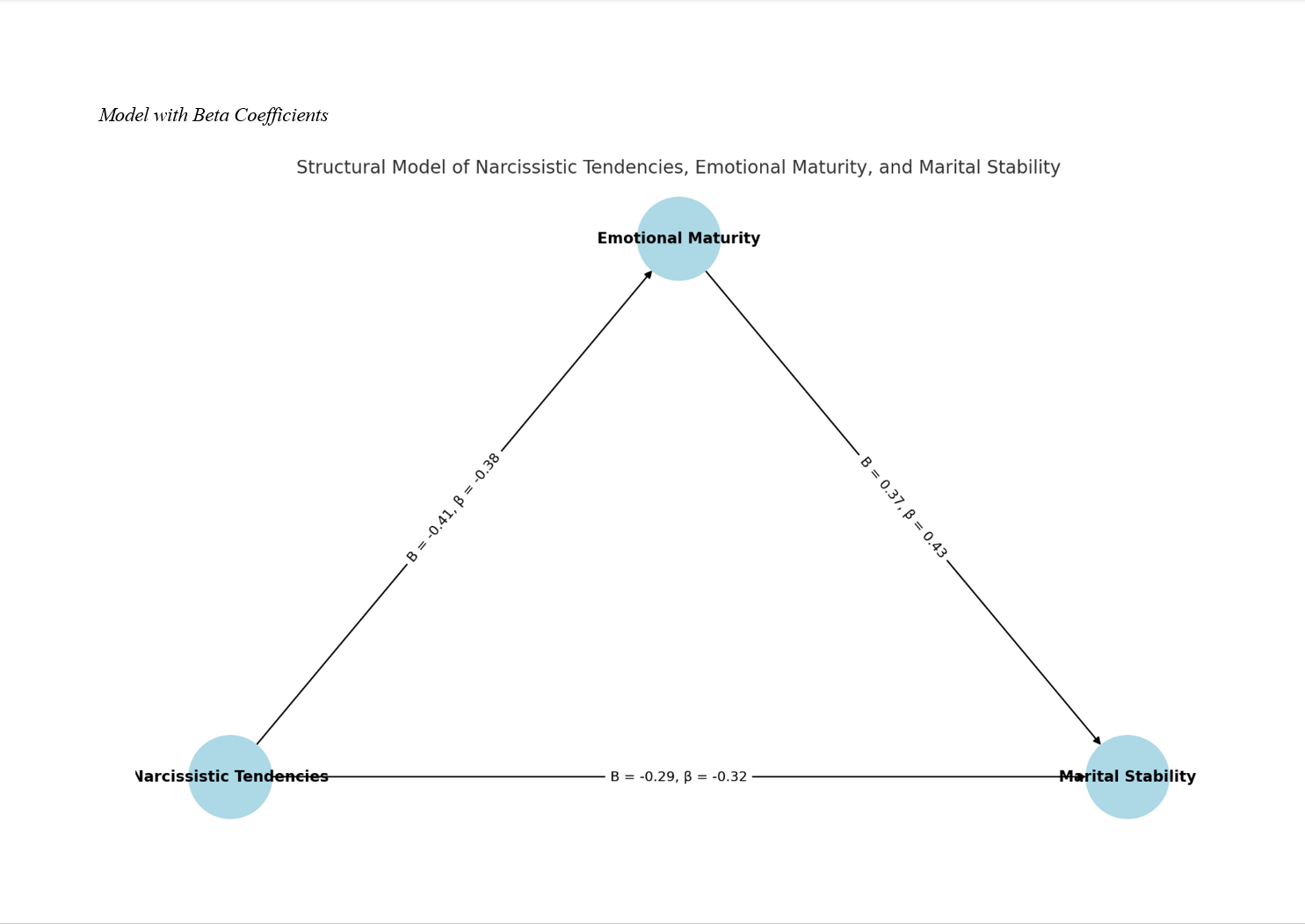
Findings: The results revealed that narcissistic tendencies were significantly and negatively associated with marital relationship stability (β = -0.32, p < .001). Emotional maturity was found to have a significant positive effect on marital stability (β = 0.43, p < .001) and a significant negative relationship with narcissistic tendencies (β = -0.38, p < .001). Importantly, emotional maturity partially mediated the relationship between narcissistic tendencies and marital stability (indirect effect β = -0.16, p < .01), and the total effect of narcissism on marital instability was substantial (β = -0.48, p < .001). The proposed model demonstrated a good fit to the data with acceptable fit indices.
Conclusion: The findings suggest that narcissistic traits undermine marital stability directly and indirectly by reducing emotional maturity. Emotional maturity serves as a protective factor that enhances relational resilience. These results highlight the importance of addressing emotional development and personality traits in marital counseling and relationship education.
Downloads
References
Abreu-Afonso, J., Ramos, M. M., Queiroz-Garcia, I., & Leal, I. (2022). How couple's relationship lasts over time? A model for marital satisfaction. Psychological Reports, 125(3), 1601-1627. https://doi.org/10.1177/00332941211000651
Agu, S. A., & Nwankwo, B. E. (2019). Influence of religious commitment, intentionality in marriage, and forgiveness on marital satisfaction among married couples. IFE Psychologia: An International Journal, 27(2), 121-133. https://journals.co.za/doi/abs/10.10520/EJC-19190fbde4
Ahmadi, F., & Mohammadi, S. (2019). Designing a model of marital relationship stability based on narcissistic tendencies. Iranian Journal of Social Psychology, 14(2), 45-65. https://elmnet.ir/article/10791899-7561
Alizadeh, F., & Azami, Y. (2022). Predicting Marital Adjustment Based on Basic Psychological Needs and Narcissism. Journal of Royesh-e Ravanshenasi, 11(10), 172-180. https://frooyesh.ir/article-1-4114-en.html
Bahrami, R., & Sadeghi, K. (2022). Analysis of the mediating role of emotional maturity in marital relationship stability. Journal of Educational Psychology, 16(2), 83-98. https://civilica.com/doc/1754882/
Bharath, A., Nethravathi, R., & KP, M. P. (2020). Influence of marital status on emotional maturity among female young adults. International Journal of Indian Psychology, 8(4). https://ijip.co.in/index.php/ijip/article/view/2553
Chi, P., Wu, Q., Cao, H., Zhou, N., & Lin, X. (2020). Relationship-oriented values and marital and life satisfaction among Chinese couples. Journal of Social and Personal Relationships, 37(8-9), 2578-2596. https://doi.org/10.1177/0265407520928588
Ferreira, M., Antunes, L., Duarte, J., & Chaves, C. (2015). Influence of Infertility and Fertility Adjustment on Marital Satisfaction. Procedia - Social and Behavioral Sciences, 171, 96-103. https://doi.org/10.1016/j.sbspro.2015.01.094
Finzi‐Dottan, R., Riff, A. R., & Dagan, G. (2025). Mirror, Mirror on the Wall, Who Loves You Above All: Navigating Vulnerable Narcissism, Intimacy, and Marital &Amp; Sexual Satisfaction. The Family Journal. https://doi.org/10.1177/10664807251321510
Fu, L., Zheng, H., Zhou, Y., Cheng, J., Zhou, T., & Yi, C. (2023). Intergenerational Family Boundaries and Adult Children's Marital Satisfaction. Journal of Child and Family Studies, 1-9. https://doi.org/10.1007/s10826-023-02672-3
Ghasemi Verniab, B., Rahmani, A., Zarbakhsh Bahri, M. R., & Abolghasemi, S. (2020). Presenting a structural model of marital commitment based on emotional maturity with the mediation of intimacy and interpersonal cognitive distortions. https://www.noormags.ir/view/en/articlepage/1822247
Gholami, Z., Sanai, B., Kiamanesh, A., & Zahrakar, K. (2020). Predicting marital satisfaction based on emotional maturity and attitude to marriage between men and women with early and normal age marriage. Family Counseling and Psychotherapy, 10(1), 151-178. https://doi.org/10.22034/fcp.2020.61741
Hosseini, M., & Rezaei, A. (2020). Investigating the role of marital attractions in marital relationship stability. Quarterly Journal of Educational Sciences and Psychology, 21(3), 72-88. https://pzk.journals.miu.ac.ir/article_4721.html?lang=fa
Kakolian, S., Mashayekh, M., Davaei, M., & Khosravi Babadi, A. A. (2024). Modeling marital satisfaction based on marital expectations, emotional maturity, and aspects of love with the mediation of marital conflicts of married women. Shenakht Journal of Psychology and Psychiatry, 11(3), 1-5. https://doi.org/10.32598/shenakht.11.3.1
Karney, B. R., & Bradbury, T. N. (2020). Research on marital satisfaction and stability in the 2010s: Challenging conventional wisdom. Journal of marriage and family, 82(1), 100-116. https://doi.org/10.1111/jomf.12635
Lavner, J. A., Lamkin, J., Miller, J. D., Campbell, W. K., & Karney, B. R. (2016). Narcissism and Newlywed Marriage: Partner Characteristics and Marital Trajectories. Personality Disorders: Theory, Research, and Treatment, 7(2), 169. https://doi.org/10.1037/per0000137
Mahdavian, A., & Shahinvarnosfaderani, Z. (2023). Predicting Marital Adjustment Based on Spirituality and Narcissism Components in Couples Living in Tehran. Research Journal on Religion and Health, 9(1), 123-133. https://journals.sbmu.ac.ir/jrrh/article/view/34204
McNulty, J. K., & Widman, L. (2013). The Implications of Sexual Narcissism for Sexual and Marital Satisfaction. Archives of Sexual Behavior, 42(6), 1021-1032. https://doi.org/10.1007/s10508-012-0041-5
Mirzaei, F., Abdi Zarin, Sohrab, Aghayousefi, Alireza. (2022). Modeling marital conflict based on self differentiation and familism through the mediation of intimacy and emotional maturity in the family. Journal of Applied Family Therapy, 3(2), 394-417. https://doi.org/10.22034/aftj.2022.312890.1239
Mosavi, S. E., & Iravani, M. R. (2012). A Study on Relationship Between Emotional Maturity and Marital Satisfaction. Management Science Letters, 2(3), 927-932. https://doi.org/10.5267/j.msl.2011.10.012
Mousavi, F., & Heidari, S. (2018). Emotional maturity as a mediator between marital attractions and relationship stability. Journal of Psychological Studies, 12(4), 101-120.
Nameni, E., Abasi, F., & Zarei, A. Z. (2016). Predicting Marital Commitment on the Basis of Love Style and Relationship Beliefs [orginal]. Social Welfare, 16(60), 87-107. http://refahj.uswr.ac.ir/article-1-2477-en.html
Norouzi, H., & Karimi, M. (2020). The effect of narcissistic tendencies on marital relationship stability in couples applying for divorce. Journal of Mental Health and Marriage, 5(3), 58-74.
Shamsi, M. F., Asad, Sara. (2021). Emotional Maturity, forgiveness, and marital satisfaction among dual earner couples. Bahria Journal of Professional Psychology, 20(1), 1-13. https://www.bjpp.bahria.edu.pk/index.php/BJPP/article/view/309
Sinha, K. B. (2021). Social Freedom, Emotional Maturity and Marital Adjustment of Working and Non-working Women. Journal of Advanced Research in English & Education, 4(4), 15-19. https://doi.org/10.24321/2456.4370.201911
Downloads
Additional Files
Publication Timeline
- Submitted
- Revised
- Accepted
Issue
Section
License
Copyright (c) 2025 Ahmad Raisi Sheykhvisi (Author); Seyed Faizullah Afrazizadeh (Corresponding Author); Ali Reza Maredpour (Author)

This work is licensed under a Creative Commons Attribution-NonCommercial 4.0 International License.