The Effectiveness of Emotionally Focused Couple Therapy on Self-Differentiation and Intolerance of Uncertainty in Couples Seeking Divorce
DOI:
https://doi.org/10.61838/kman.aftj.4048Keywords:
Couples therapy, Indecision, IntoleranceAbstract
Objective: This study aimed to investigate the effectiveness of Emotionally Focused Couple Therapy (EFCT) on differentiation of self and the reduction of intolerance of uncertainty in couples seeking divorce.
Methods: The research method was quasi-experimental with a pretest–posttest control group design. The statistical population consisted of couples seeking divorce in Tehran, from which 30 couples were selected through convenience sampling and randomly assigned to experimental and control groups. The experimental group underwent a 10-session EFCT intervention, each session lasting 90 minutes, while the control group did not receive any intervention.
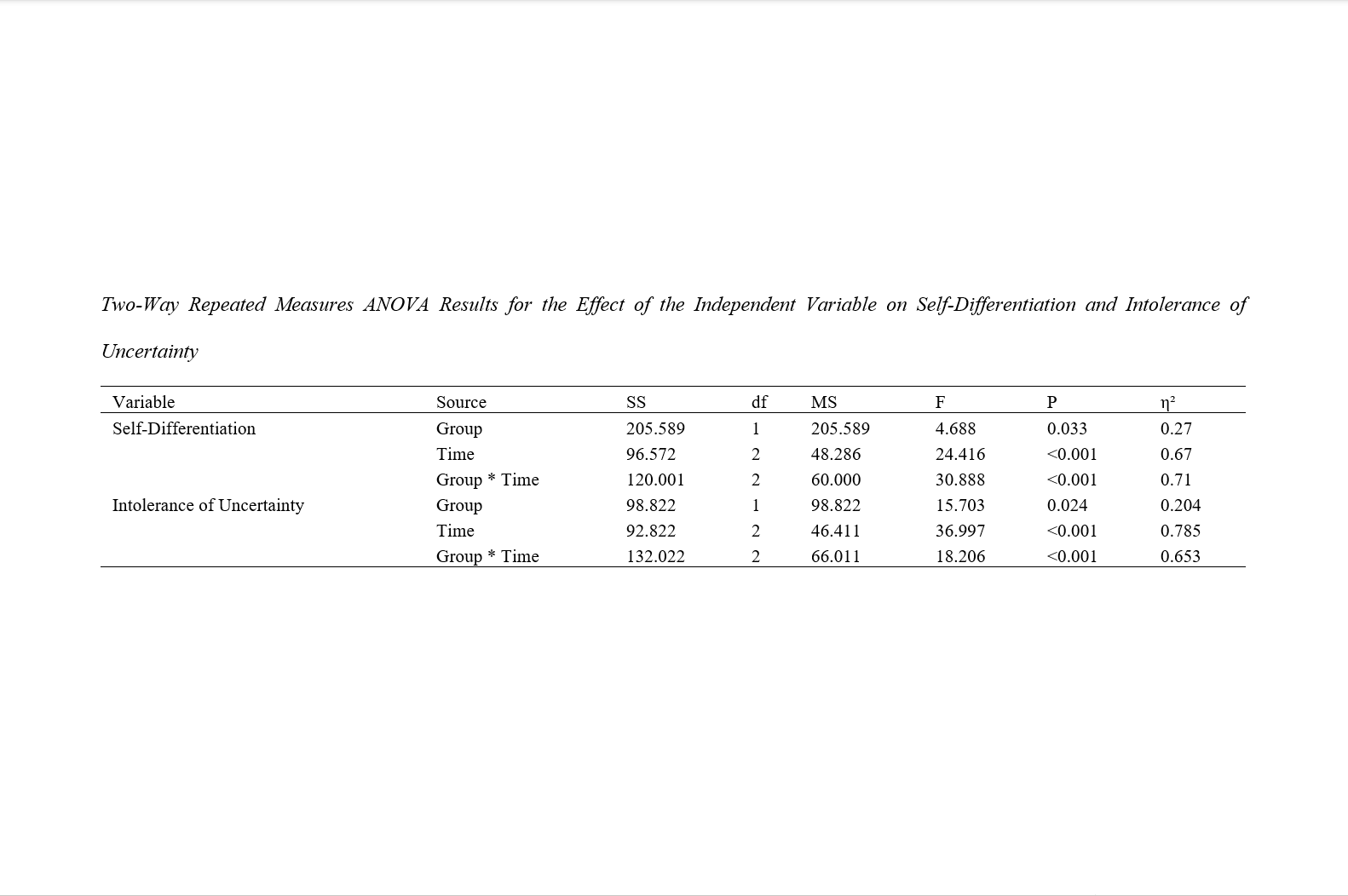
Findings: Findings showed that Emotionally Focused Couple Therapy significantly increased differentiation of self and reduced intolerance of uncertainty in couples seeking divorce.
Conclusion: These results suggest that by focusing on core emotions and emotional interactions, it is possible to improve interpersonal relationships and facilitate more informed decision-making in marital relationships. Accordingly, the use of EFCT is recommended in psychological interventions related to divorce crises.
Downloads
References
Al-Dmour, S. M., & halim Arabiyat, A. A. (2024). The Predictive Ability of Marital distress in Emotional Divorce among married teachers in Karak Governorate. Jordanian Educational Journal, 9(2), 343-368. https://doi.org/10.46515/jaes.v9i2.710
Asayesh, M., Taran, M., & Eftekhari, M. (2024). Consequences of Emotional Divorce from the Perspective of Men: A Phenomenological Study. Psychology Growth, 13(1), 41-52. http://frooyesh.ir/article-1-4175-fa.html
Bottesi, G., Noventa, S., Freeston, M. H., & Ghisi, M. (2019). Seeking certainty about Intolerance of Uncertainty: Addressing old and new issues through the Intolerance of Uncertainty Scale-Revised. PLoS One, 14(2), e0211929. https://doi.org/10.1371/journal.pone.0211929
Brown, G., & Medcalf-Bell, R. (2022). Phoning it in: social anxiety, intolerance of uncertainty, and anxiety reduction motivations predict phone use in social situations. Human Behavior and Emerging Technologies, 2022(1), 6153053. https://doi.org/10.1155/2022/6153053
Burnette, J. L., Taylor, K. W., Worthington, E. L., & Forsyth, D. R. (2007). Attachment and trait forgivingness: The mediating role of angry rumination. Personality and individual differences, 42(8), 1585-1596. https://doi.org/10.1016/j.paid.2006.10.033
Carleton, R. N., Collimore, K. C., & Asmundson, G. J. (2010). "It's not just the judgments-It's that I don't know": Intolerance of uncertainty as a predictor of social anxiety. Journal of anxiety disorders, 24(2), 189-195. https://doi.org/10.1016/j.janxdis.2009.10.007
Carleton, R. N., Mulvogue, K. M., Thibodeau, M. A., McCabe, R. E., Antony, M. M., & Asmundson, G. J. (2012). Increasingly certain about uncertainty: Intolerance of uncertainty across anxiety and depression. Journal of anxiety disorders, 26(3), 468-479. https://doi.org/10.1016/j.janxdis.2012.01.011
Carleton, R. N., Norton, M. P. J., & Asmundson, G. J. (2007). Fearing the unknown: A short version of the Intolerance of Uncertainty Scale. Journal of anxiety disorders, 21(1), 105-117. https://doi.org/10.1016/j.janxdis.2006.03.014
Carnahan, N. D., Carter, M. M., & Sbrocco, T. (2022). Intolerance of uncertainty, looming cognitive style, and avoidant coping as predictors of anxiety and depression during COVID-19: a longitudinal study. International Journal of Cognitive Therapy, 15(1), 1-19. https://doi.org/10.1007/s41811-021-00125-7
Dalgleish, T. L. (2013). Examining predictors of change in emotionally focused couples therapy. University of Ottawa (Canada). https://search.proquest.com/openview/7c6cc5979c8f822fad3384b8ead9138f/1.pdf?pq-origsite=gscholar&cbl=18750
Denton, W. H., Wittenborn, A. K., & Golden, R. N. (2012). Augmenting antidepressant medication treatment of depressed women with emotionally focused therapy for couples: A randomized pilot study. Journal of marital and family therapy, 38, 23-38. https://doi.org/10.1111/j.1752-0606.2012.00291.x
Dugas, M. J., Schwartz, A., & Francis, K. (2004). Brief report: Intolerance of uncertainty, worry, and depression. Cognitive therapy and research, 28, 835-842. https://doi.org/10.1007/s10608-004-0669-0
Freeston, M. H., Rhéaume, J., Letarte, H., Dugas, M. J., & Ladouceur, R. (1994). Why do people worry? Personality and individual differences, 17(6), 791-802. https://doi.org/10.1016/0191-8869(94)90048-5
Frenkel-Brunswik, E. (1949). Intolerance of ambiguity as an emotional and perceptual personality variable. Journal of personality, 18(1). https://doi.org/10.1111/j.1467-6494.1949.tb01236.x
Golrokh, N., Sheykhan, R., & Sajjadi, M. (2024). The relationship between parental emotional divorce and identity crisis, emotional resilience, and social adjustment in adolescents. Health Psychology Journal: Research and Applications, 1(1), 26-39. https://rpp.araku.ac.ir/article_713529.html?lang=en
Imanirad, A., Golmohammadian, M., Moradi, A., & Goodarzi, M. (2021). Effectiveness of Emotionally Focused Couples Therapy on forgiveness and relationship beliefs in couples involved in marital infidelity. Psychological Science Research Journal, 20(100), 653-665. http://psychologicalscience.ir/browse.php?a_id=966&sid=1&slc_lang=fa
Jahanbakhshie, Z., Soltanian, S., & Pourshahriar Koleshtri, H. (2025). Prediction of Emotional Divorce based on Marital Commitment and Family Power Structure with the mediator role of Intimacy. Journal of Applied Psychological Research. https://doi.org/10.22059/japr.2025.372580.644895
Karadoğan, F. M., & Tagay, O. (2022). Predictive Role of Attachment Styles and Emotion Regulation on Forgiveness in Married People. Psikiyatride Güncel Yaklaşımlar, 14(Ek 1), 128-136. https://doi.org/10.18863/pgy.1117537
Karukivi, M., Tolvanen, M., Karlsson, L., & Karlsson, H. (2014). Is alexithymia linked with marital satisfaction or attachment to the partner? A study in a pregnancy cohort of parents-to-be. Comprehensive Psychiatry, 55(5), 1252-1257. https://doi.org/10.1016/j.comppsych.2014.03.019
Kermanshahi, F., Navabi Nezhad, S., & Ahmadi Noudeh, K. (2023). Comparing the effectiveness of Emotion Focused, acceptance and commitment and positive interventions on marital boredom and Alexithymia in women affected by infidelity. medical journal of mashhad university of medical sciences, 66(5). https://mjms.mums.ac.ir/m/article_23845.html?lang=en
Koerner, N., Mejia, T., & Kusec, A. (2017). What's in a name? Intolerance of uncertainty, other uncertainty-relevant constructs, and their differential relations to worry and generalized anxiety disorder. Cognitive behaviour therapy, 46(2), 141-161. https://doi.org/10.1080/16506073.2016.1211172
Kupferberg, A., & Hasler, G. (2023). The social cost of depression: Investigating the impact of impaired social emotion regulation, social cognition, and interpersonal behavior on social functioning. Journal of Affective Disorders Reports, 100631. https://doi.org/10.1016/j.jadr.2023.100631
Ladouceur, R., Gosselin, P., & Dugas, M. J. (2000). Experimental manipulation of intolerance of uncertainty: A study of a theoretical model of worry. Behaviour Research and Therapy, 38(9), 933-941. https://doi.org/10.1016/S0005-7967(99)00133-3
McEvoy, P. M., & Mahoney, A. E. (2012). To be sure, to be sure: Intolerance of uncertainty mediates symptoms of various anxiety disorders and depression. Behavior therapy, 43(3), 533-545. https://doi.org/10.1016/j.beth.2011.02.007
Namani, E., Mohammadi Hosseini, A., Jamalian, M., & Mazhab Yusofi, A. (2024). The effect of self-differentiation on academic self-efficacy in elementary exceptional students: The mediating role of academic achievement motivation and goal orientation. Journal of Modern Thoughts in Education, 20(1), 91-108. https://jontoe.alzahra.ac.ir/jufile?ar_sfile=220726
Rastgar, A., Yousefi, E., & Khajepoor, L. (2025). Comparing the Effectiveness of Emotional Efficacy Therapy and Integrated Transdiagnostic Treatment on Psychological Fatigue in Women Involved in Emotional Divorce with Early Marriage. Iranian Journal of Educational Research, 4(1), 195-214. https://ijer.hormozgan.ac.ir/article-1-217-fa.html
Sahib, A., Chen, J., Cárdenas, D., & Calear, A. (2023). Intolerance of uncertainty and emotion regulation: A meta-analytic and systematic review. Clinical psychology review, 102270. https://doi.org/10.1016/j.cpr.2023.102270
Tahmasebizadeh, F. (2024). The effectiveness of schema therapy on schemas and self-differentiation in individuals committing infidelity in marriage. Jarac, 6(1), 15-25. https://doi.org/10.61838/kman.jarac.6.1.2
Tanbakouchian, R., Zanganeh, F., & Bayat, M. R. (2021). Compare the Effectiveness of Emotion-Focused and Schema Therapy Approaches on Ambiguity Resilience, and Self-Control of Women with Marital Burnout. mui-jbs, 19(1), 1-12. https://doi.org/10.52547/rbs.19.1.1
Tanbakouchian, R., Zangeneh Motlagh, F., & Bayat, M. (2021). Comparison of the effectiveness of emotion-focused therapy and schema therapy on ambiguity tolerance and self-control in women experiencing marital burnout. Behavioral Science Research Journal, 19(1), 3-16. https://doi.org/10.52547/rbs.19.1.1
Tang, J., Xiang, X., Wang, J., & Schänzel, H. (2024). Mechanism Underlying the Influence of Family Travel On Adolescent Self‐Differentiation: A Social Learning Theory Perspective. International Journal of Tourism Research, 26(5). https://doi.org/10.1002/jtr.2766
Vaghee, S., Salarhaji, A., Rezaei Ardani, A., Mazlom, S., & Alizadeh, F. (2017). The relationship of Self-Differentiation with Stress-Coping Strategies and Suicide in Patients with Mood Disorders [Research]. Journal title, 5(1), 17-25. http://jms.thums.ac.ir/article-1-392-en.html
Vahidi, S., Aghausefi, A., & Namvar, H. (2022). Prediction of Happiness upon Neuroticism, Self-descrimination with Mediating Body Image, and Optimism in obese women and men Adjustment of Couples. Journal of Applied Family Therapy, 3(3), 237-262. https://doi.org/10.22034/aftj.2022.330697.1415
Wiebe, S. A., & Johnson, S. M. (2016). A review of the research in emotionally focused therapy for couples. Family Process, 55(3), 390-407. https://doi.org/10.1111/famp.12229
Zarei, S. (2019). The Mediating Role of Self-Differentiation in the Relationship Between Resiliency and Marital Burnout in Married Women. Shenakht Journal of Psychology and Psychiatry, 6(2), 62-73. https://doi.org/10.29252/shenakht.6.2.62
Downloads
Additional Files
Publication Timeline
- Submitted
- Revised
- Accepted
Issue
Section
License
Copyright (c) 2025 Sahar Saniei, Hosein Hasanzadeh, Shima Hosseinzadeh (Author); Narjes Eslami (Corresponding Author); Maryam Nasri, Kamran Pourmohammadghouchani (Author)

This work is licensed under a Creative Commons Attribution-NonCommercial 4.0 International License.