Parental Overcontrol and Adolescent Social Withdrawal: The Mediating Role of Fear of Evaluation
DOI:
https://doi.org/10.61838/kman.aftj.6.1.20Keywords:
Parental overcontrol, adolescent social withdrawal, fear of negative evaluation, fear of positive evaluationAbstract
Objective: This study aimed to investigate the relationship between parental overcontrol and adolescent social withdrawal, with fear of negative and positive evaluation as potential mediating variables.
Methods: The research employed a descriptive correlational design and included a sample of 551 Nigerian adolescents selected based on the Morgan and Krejcie table. Data were collected using standardized self-report instruments: the Psychological Control Scale–Youth Self-Report (PCS-YSR) for parental overcontrol, the Brief Fear of Negative Evaluation Scale (BFNE), the Fear of Positive Evaluation Scale (FPES), and the Withdrawn/Depressed subscale of the Youth Self-Report (YSR). Descriptive statistics and Pearson correlation coefficients were calculated using SPSS-27, and Structural Equation Modeling (SEM) was conducted via AMOS-21 to examine direct and indirect pathways among the variables.
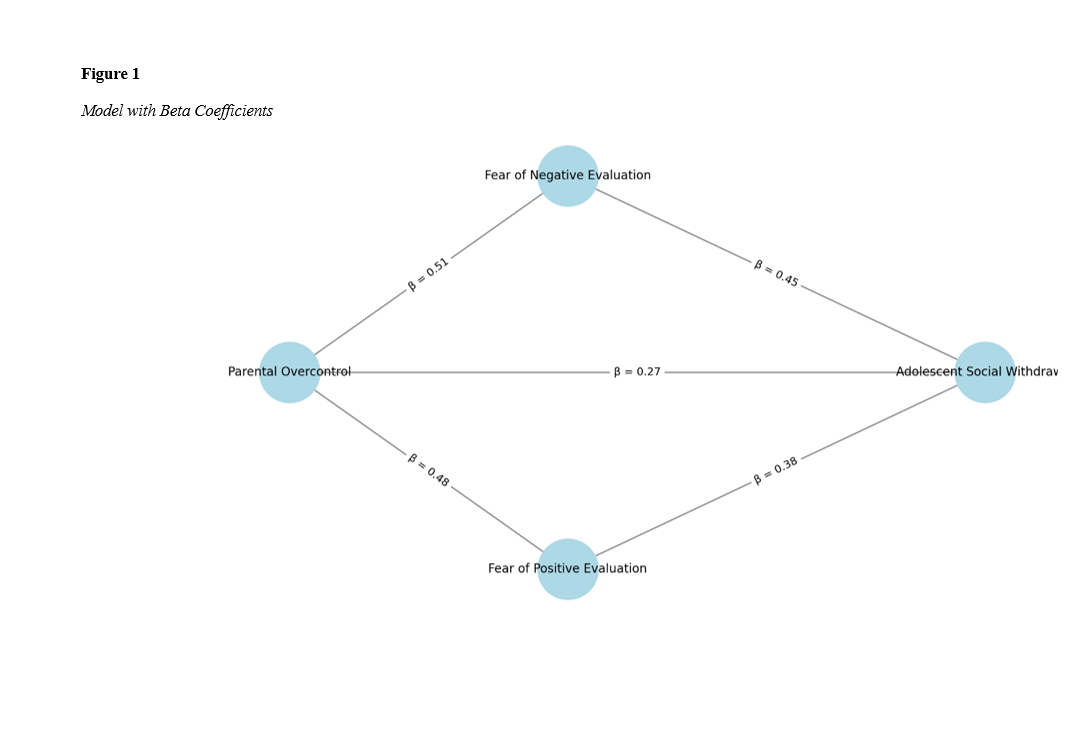
Findings: Pearson correlation analysis showed that parental overcontrol was significantly associated with fear of negative evaluation (r = .51, p < .001), fear of positive evaluation (r = .47, p < .001), and social withdrawal (r = .42, p < .001). SEM results confirmed that the structural model had good fit indices (χ² = 146.23, df = 84, χ²/df = 1.74, CFI = 0.97, RMSEA = 0.041). Parental overcontrol had significant direct effects on fear of negative evaluation (β = .51, p < .001), fear of positive evaluation (β = .48, p < .001), and social withdrawal (β = .27, p < .001). Both fears significantly predicted social withdrawal (FNE: β = .45, p < .001; FPE: β = .38, p < .001). Indirect effects of parental overcontrol on social withdrawal via FNE (B = 0.19, p < .001) and FPE (B = 0.14, p < .001) were also significant.
Conclusion: These findings highlight that fear of evaluation—both negative and positive—serves as a psychological mechanism linking parental overcontrol to social withdrawal in adolescents, emphasizing the importance of addressing cognitive-affective vulnerabilities in preventive and therapeutic interventions.
Downloads
References
Ahn, J., & Choi, Y. (2023). A Study on the Measurement of Fear of Crime: Fear of Crime as Emotional and Cognitive Evaluation. Korean Criminological Review, 34(1), 105-140. https://doi.org/10.36889/kcr.2023.3.31.1.105
Auliannisa, S. H., Firdaus, F., & Fakhri, N. F. (2024). The Effect of Self-Esteem on Fear of Negative Evaluation in Students. Journal of Correctional Issues, 7(1), 51-60. https://doi.org/10.52472/jci.v7i1.388
Cartagena, N. L. (2020). Christ's Propassion of Fear: A Re‐Evaluation. The Heythrop Journal, 63(6), 1055-1070. https://doi.org/10.1111/heyj.13799
Cook, S. I., Moore, S., Bryant, C., & Phillips, L. (2022). The Role of Fear of Positive Evaluation in Social Anxiety: A Systematic Review and Meta-Analysis. Clinical Psychology Science and Practice, 29(4), 352-369. https://doi.org/10.1037/cps0000082
Dismuke, A. (2021). Social Anxiety and Its Relationship to Fear of Positive Evaluation and Fear of Negative Evaluation: A Meta-Analysis. https://doi.org/10.17605/osf.io/u24dr
Fredrick, J. W., & Luebbe, A. M. (2022). Prospective Associations Between Fears of Negative Evaluation, Fears of Positive Evaluation, and Social Anxiety Symptoms in Adolescence. Child Psychiatry & Human Development, 55(1), 195-205. https://doi.org/10.1007/s10578-022-01396-7
Hofmann, S. G. (2025). Fear of Positive Evaluation and the Bivalent Fear of Evaluation Model of Social Anxiety: An Integration. Journal of anxiety disorders, 111, 102986. https://doi.org/10.1016/j.janxdis.2025.102986
Iannattone, S., Miscioscia, M., Raffagnato, A., & Gatta, M. (2021). The Role of Alexithymia in Social Withdrawal During Adolescence: A Case–Control Study. Children, 8(2), 165. https://doi.org/10.3390/children8020165
Iqbal, A., & Ajmal, A. (2019). Fear of Negative Evaluation and Social Anxiety in Young Adults. Peshawar Journal of Psychology and Behavioral Sciences (Pjpbs), 4(1), 45-53. https://doi.org/10.32879/picp.2018.4.1.45
Jeon, S., & Park, K.-H. (2023). The Relationship Between Internalized Shame and Self-Concealment: The Mediating Effects of Fear of Negative/Positive Evaluation and Self-Compassion. Korean Association for Learner-Centered Curriculum and Instruction, 23(23), 507-520. https://doi.org/10.22251/jlcci.2023.23.23.507
Johnson, A. R., Bank, S. R., Summers, M. W., Hyett, M. P., Erceg‐Hurn, D. M., Kyron, M. J., & McEvoy, P. M. (2020). A Longitudinal Assessment of the Bivalent Fear of Evaluation Model With Social Interaction Anxiety in Social Anxiety Disorder. Depression and Anxiety, 37(12), 1253-1260. https://doi.org/10.1002/da.23099
Kim, S., & Seo, E. H. (2024). Does Fear of Negative Evaluation Itself Cause Academic Procrastination?: Focusing on the Moderating Effect of Social Anxiety. The New Educational Review, 77(3), 11-21. https://doi.org/10.15804/tner.2024.77.3.01
Kocijan, L., & Harris, L. (2016). Fear of Positive Evaluation and Social Anxiety. Behaviour Change, 33(1), 15-26. https://doi.org/10.1017/bec.2015.17
Lipp, O. V., Luck, C. C., & Muir, A. C. (2019). Evaluative Conditioning Affects the Subsequent Acquisition of Differential Fear Conditioning as Indexed by Electrodermal Responding and Stimulus Evaluations. Psychophysiology, 57(3). https://doi.org/10.1111/psyp.13505
McVarnock, A., & Closson, L. M. (2022). Motivations for Social Withdrawal and Academic Adjustment in Emerging Adulthood. British Journal of Developmental Psychology, 40(2), 352-367. https://doi.org/10.1111/bjdp.12411
Neitzel, C., & Stright, A. D. (2004). Parenting behaviours during child problem solving: The roles of child temperament, mother education and personality, and the problem-solving context. International Journal of Behavioral Development, 28(2), 166-179. https://doi.org/10.1080/01650250344000370
Rahmat, N. H., Mohanda, E. S., Razlan, Z., Arepin, M., Hassan, A. F. A., & Taib, S. A. (2022). Oral Presentation: Is There a Relationship Between Fear of Negative Evaluation and Cause of Fear? International Journal of Academic Research in Business and Social Sciences, 12(7). https://doi.org/10.6007/ijarbss/v12-i7/14254
Reichenberger, J., Smyth, J. M., & Blechert, J. (2017). Fear of Evaluation Unpacked: Day-to-Day Correlates of Fear of Negative and Positive Evaluation. Anxiety Stress & Coping, 31(2), 159-174. https://doi.org/10.1080/10615806.2017.1396826
Rondon, A. T., Hilton, D. C., Jarrett, M. A., & Ollendick, T. H. (2020). Sleep, internalizing problems, and social withdrawal: Unique associations in clinic-referred youth with elevated sluggish cognitive tempo symptoms. Journal of Attention Disorders, 24(4), 524-534. https://doi.org/10.1177/1087054718756197
Shahul, A., M, S. K., Thomas, S. S., Thaha, V. K., & John, J. M. (2022). Fear of Negative Evaluation and Emotional / Social Loneliness In Young Adults. International Journal of Engineering Technology and Management Sciences, 6(5), 505-509. https://doi.org/10.46647/ijetms.2022.v06i05.078
Shin, J., & Rodebaugh, T. L. (2023). The Role of Fear of Evaluation in Group Perception. Journal of anxiety disorders, 100, 102791. https://doi.org/10.1016/j.janxdis.2023.102791
Trompeter, N., Austen, E., Bussey, K., Reilly, E. E., Cunningham, M. L., Mond, J., Lonergan, A., Tame, J., & Mitchison, D. (2023). Examination of Bidirectional Relationships Between Fear of Negative Evaluation and Weight/Shape Concerns Over 3 years: A Longitudinal Cohort Study of Australian Adolescents. International Journal of Eating Disorders, 56(3), 646-653. https://doi.org/10.1002/eat.23881
Tsarpalis-Fragkoulidis, A., Eickels, R. L. v., & Zemp, M. (2022). Please Don’t Compliment Me! Fear of Positive Evaluation and Emotion Regulation—Implications for Adolescents’ Social Anxiety. Journal of clinical medicine, 11(20), 5979. https://doi.org/10.3390/jcm11205979
Uluman, M., & Tunç, E. B. (2023). The Mediating Role of Academic Self-Efficacy Between the Answer-Copying Tendency and the Fear of Negative Evaluation. International Journal of Assessment Tools in Education, 10(3), 594-612. https://doi.org/10.21449/ijate.1335260
Weinbrecht, A., Roepke, S., & Renneberg, B. (2020). Fear of Positive Evaluation in Borderline Personality Disorder. PLoS One, 15(8), e0237944. https://doi.org/10.1371/journal.pone.0237944
Wilson, G. A., Cassin, S. E., & Antony, M. M. (2023). Fear of Evaluation Scale. https://doi.org/10.1037/t90996-000
Zeng, R., & Zhu, D. (2021). Fear of Evaluation and Online Self-Disclosure on WeChat: Moderating Effects of Protective Face Orientation. Frontiers in psychology, 12. https://doi.org/10.3389/fpsyg.2021.530722
Zhang, H. (2025). The Relationship Between Childhood Trauma and Social Anxiety in College Students: The Mediating Role of Evaluation Fear. BMC psychiatry, 25(1). https://doi.org/10.1186/s12888-025-06668-9
Гордеева, Т. О., Nechaeva, D. M., & Сычев, О. А. (2024). Factors Influencing Students’ Motivation and Academic Performance: The Role of Parental Control and Autonomy Support. Moscow University Psychology Bulletin, 47(3), 33-55. https://doi.org/10.11621/lpj-24-28
Downloads
Additional Files
Publication Timeline
- Submitted
- Revised
- Accepted
Issue
Section
License

This work is licensed under a Creative Commons Attribution-NonCommercial 4.0 International License.