Strategies and Consequences of Non-Marriage among Men: A Grounded Theory Study
DOI:
https://doi.org/10.61838/kman.aftj.3982Keywords:
Non-marriage, , Marriage, Men, Single, Strategies, Consequences, Grounded TheoryAbstract
Objective: The aim of this study is to examine the strategies and consequences of non-marriage among single men.
Methods and Materials: The study was carried out using a qualitative approach and grounded theory methodology. The study population consisted of men whose age ranged between 33 and 45 years, considering the average age of marriage for men in the city of Kazerun in 2023 was 30.9 years. All participants were residents of Kazerun County in Fars Province. Sampling was conducted using purposive sampling based on inclusion/exclusion criteria until theoretical saturation was reached (15 participants). Data were collected through semi-structured interviews and analyzed using Strauss and Corbin's (1998) grounded theory approach, including open, axial, and selective coding.
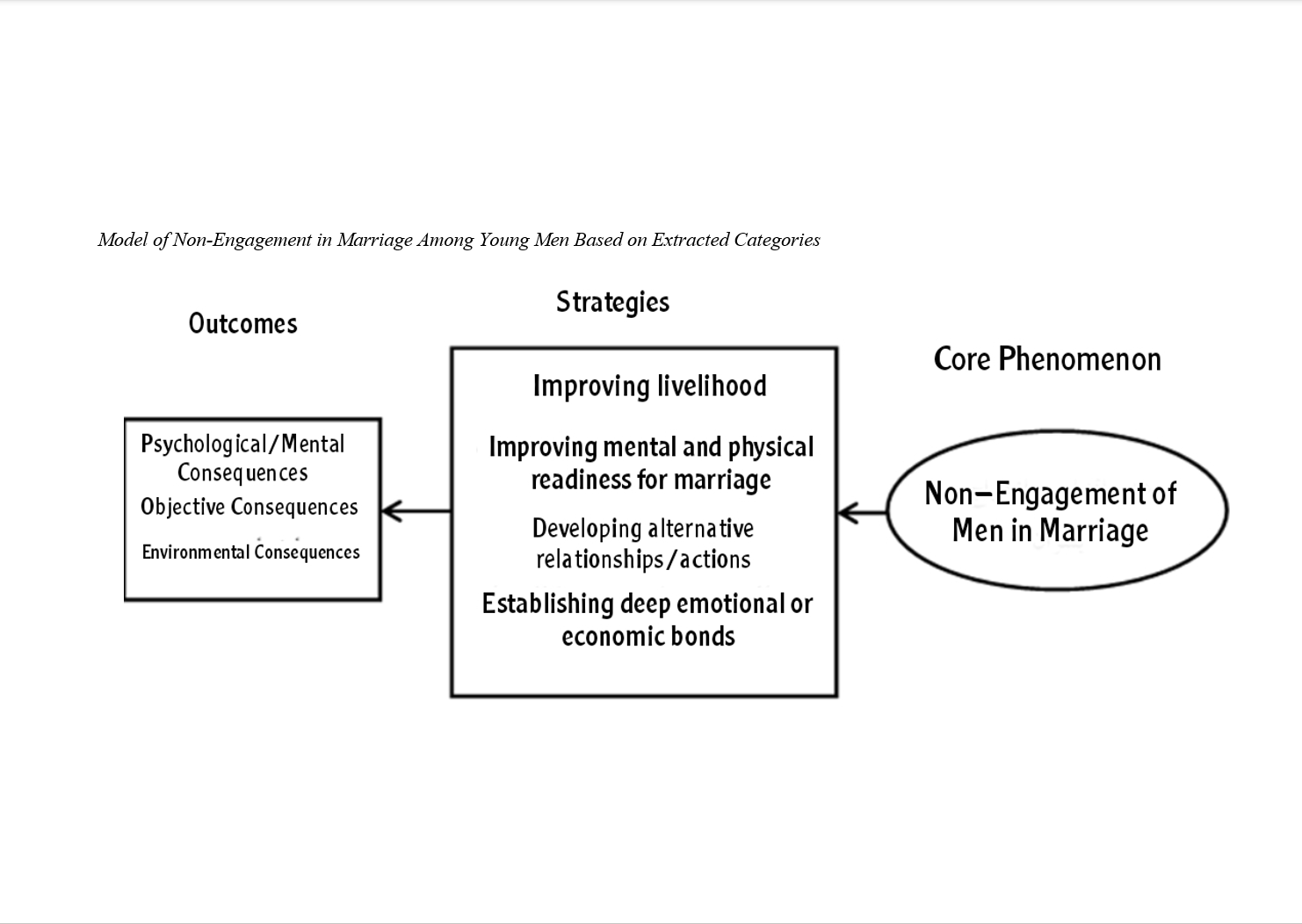
Findings: In the open coding phase, out of 232 identified codes, 33 open codes related to strategies and 56 open codes related to consequences were extracted. These codes were categorized into different concepts during axial coding. Finally, in the selective coding phase, the main categories and related outcomes of non-marriage were identified. The most significant strategies for not pursuing marriage included improving economic conditions, enhancing mental and physical well-being, developing alternative relationships, and seeking emotional or financial bonds. On the other hand, mental and psychological consequences, objective consequences, and environmental consequences were among the major outcomes associated with prolonged singlehood in men. These included negative emotions such as depression, isolation, wasted time and energy, and economic and social problems.
Conclusion: This study revealed that the decision not to marry among men is the result of a combination of psychological, social, cultural, and economic factors that influence individual choices. Based on the findings, it is recommended that social and cultural policies aimed at supporting youth and facilitating marriage are essential. Moreover, identifying and thoroughly examining cultural and social barriers to marriage could help reduce the rate of singlehood and increase the willingness to marry among young people.
Downloads
References
Allison, R. (2023). "Why wait?": Early marriage among Southern college students. Journal of marriage and family, 85(4), 923-940. https://doi.org/10.1111/jomf.12910
Apostolou, M., Papadopoulou, I., & Georgiadou, P. (2019). Are people single by choice? Involuntary singlehood in an evolutionary perspective. Evolutionary Psychological Science, 5(1), 98-103. https://doi.org/10.1007/s40806-018-0169-1
Ashirbayeva, F. M., Smagambet, B. Z., & Tlespayeva, A. (2025). Impact of Infertility on the Institution of Marriage in Modern Society. Revista de Cercetare si Interventie Sociala(88), 169-186. https://doi.org/10.33788/rcis.88.11
Barry, K. (2023). Moving in the Shadows: The Reasons Why Men Purchase Commercial Sexual Services and the Connection to Strain Theory. The Mid-Southern Journal of Criminal Justice, 22(1), 2. https://mds.marshall.edu/msjcj/vol22/iss1/2
Chae, S., Agadjanian, V., & Hayford, S. R. (2021). Bridewealth marriage in the 21st century: A case study from rural Mozambique. Journal of marriage and family, 83(2), 409-427. https://doi.org/10.1111/jomf.12725
Darussamin, Z., Armansyah, A., & Zikri, A. (2023). The Urgency of Maturity to Get Married and Its Relevance to Family Life Goals. Al-Istinbath: Jurnal Hukum Islam, 8(1 May), 215-236. https://doi.org/10.29240/jhi.v8i1.5324
Diekmann, A. (2022). Rational choice sociology: Heuristic potential, applications, and limitations. In Handbook of sociological science (pp. 100-119). Edward Elgar Publishing. https://doi.org/10.4337/9781789909432.00013
Foroutan, Y. (2021). Urban-Rural Convergence Related to Demographic Approaches in Iran. Contemporary Sociological Research, 10(18), 243-268. https://csr.basu.ac.ir/article_4280.html?lang=en
Ghiyasvand, A. (2022). The Concept of Marriage Among Iranian Youth: Types and Challenges. Strategic Studies on Sports and Youth, 22(62), 479-506. https://faslname.msy.gov.ir/article_993.html?lang=en
Javanmard, K., Zeini Hasanvand, N., & Seif, H. (2022). Analyzing the Consequences of Friendly Relationships Between Female and Male Students Using Qualitative and Grounded Theory Methods (Case Study: Students of Ayatollah Borujerdi University). Social Psychology Research, 12(47), 1-32. https://www.socialpsychology.ir/article_164024.html?lang=en
Koçyiğit, M., & Uzun, M. (2025). Emotion Regulation and Couple Burnout in Marriage: A Moderated Moderation Model of Authenticity, Sex of Parents and Having Children. Current Psychology. https://doi.org/10.1007/s12144-024-07253-1
Krstić, M. (2022). Rational choice theory-alternatives and criticisms. Socijalna Ekologija, 31(1), 9-27. https://doi.org/10.17234/SocEkol.31.1.1
Malik, H. A., & Malik, F. A. (2022). Emile Durkheim contributions to sociology. Sociology, 6(2), 7-10. https://www.researchgate.net/profile/Fizana-Malik-2/publication/358928658_Emile_Durkheim_Contributions_to_Sociology/links/621e262b9947d339eb73a611/Emile-Durkheim-Contributions-to-Sociology.pdf
Naebi, H., Moeidfar, S., Serajzadeh, S. H., & Feyzi, I. (2017). Durkheim and Merton's Anomie Theory: Similarities, Differences, and Methods of Measurement. Social Welfare, 17(66), 52-59. https://refahj.uswr.ac.ir/browse.php?a_code=A-10-198-2&sid=1&slc_lang=en
Purnomo, T., & Suprihandari, M. D. (2025). Social dynamics of marriage (divorce) in banyuwangi city: economic and cultural perspectives in banyuwangi. Jurnal Bina Bangsa Ekonomika, 18(1), 480-489. https://jbbe.lppmbinabangsa.id/index.php/jbbe/article/view/720
Rocheleau, G. C., Olson, J. T., & Vito, A. G. (2023). Victimization, negative emotions, and substance use: Variability in general strain theory processes by marriage and relationship quality. Criminology & Criminal Justice. https://doi.org/10.1177/17488958231158469
Tayyebnia, M. S., Kardavani, R., & Yaraqi, S. (2023). A Qualitative Typology of Attitudes Toward Marriage Among Single University Students in Isfahan. Applied Sociology, 34(2), 101-122. https://jas.ui.ac.ir/article_27574.html?lang=en
Vaezi, S. A., Fayyaz, E., & Sakiani, Z. (2024). Analyzing the Effects of Capitalist Systems on Family Structure and Free Sexual Relationships. Interdisciplinary Civilization Studies of the Islamic Revolution, 2(6), 75-99. https://en.civilica.com/doc/1974693/
Zeyn al-Dini, Z., & Veysi Sartayereh, G. (2023). Late Marriage: Its Causes, Contributing Factors, and Post-Marriage Issues. Psychology and Educational Sciences in the Third Millennium, 7(3), 630-644. https://www.pejournal.ir/fa/downloadpaper.php?pid=278&rid=26&p=A
Zhao, S. P., & Mansor, S. (2025). The Study on the Discussion of Women’s Marriage Issues Under the Marriage and Family Concepts of the Republic of China. Salud Ciencia Y Tecnología, 5, 1059. https://doi.org/10.56294/saludcyt20251059
Downloads
Additional Files
Publication Timeline
- Submitted
- Revised
- Accepted
Issue
Section
License
Copyright (c) 2025 Sayedeh Zahra Mansourzadeh, Mohsen Nazarifar, Abbas Amanelahi, Alireza Ghasemizad (Author)

This work is licensed under a Creative Commons Attribution-NonCommercial 4.0 International License.