Prediction and Explanation of the Sense of Happiness and Hope for the Future Based on Parental Attachment Styles
DOI:
https://doi.org/10.61838/kman.aftj.6.3.7Keywords:
Happiness, Hope for the Future, Parental Attachment Styles, Secure Attachment, Insecure AttachmentAbstract
Objective: The aim of this study was to predict and explain happiness and hope for the future based on parental attachment styles among female university students.
Methods and Materials: This research was conducted using a descriptive-analytical and correlational design with a predictive approach. The statistical population included all female students of the Islamic Azad University, Garmsar Branch, during the academic year 2022–2023. A total of 274 students were selected using stratified and purposive sampling methods based on specific inclusion and exclusion criteria. Data were collected using the Oxford Happiness Questionnaire, Snyder’s Hope Scale, and Hazan and Shaver’s Adult Attachment Style Questionnaire. After obtaining informed consent, the data were analyzed through Pearson correlation, multiple regression, and path analysis using SPSS and AMOS software. Statistical significance was set at p < .05.
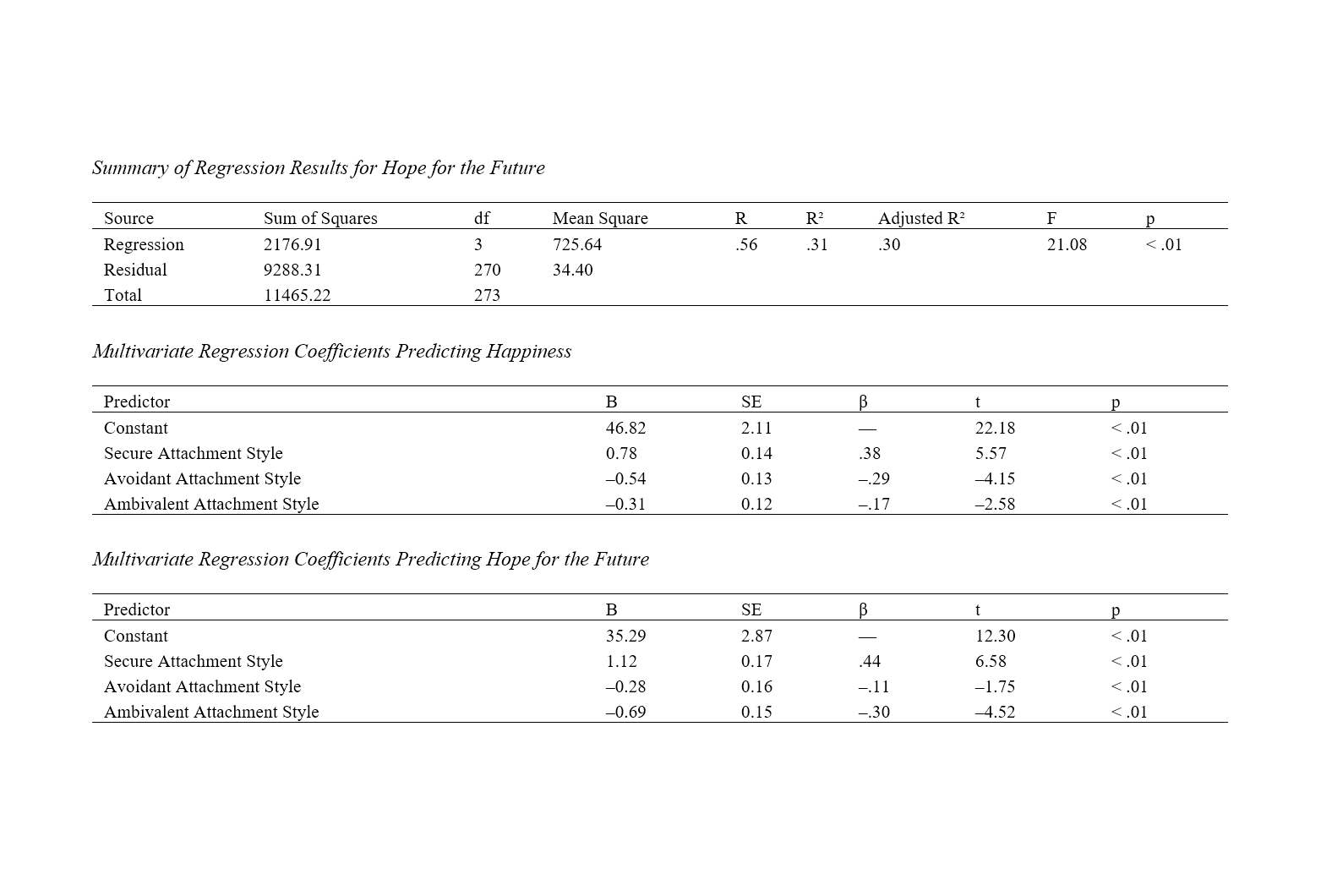
Findings: The results showed that secure attachment style significantly and positively predicted both happiness (β = .38, p < .01; R² = .24) and hope for the future (β = .44, p < .01; R² = .31). Avoidant attachment style was a significant negative predictor of happiness (β = –.29, p < .01) and had a weaker, yet still significant, inverse relationship with hope for the future (β = –.11, p < .01). Ambivalent attachment style negatively and significantly predicted both happiness (β = –.17, p < .01) and hope for the future (β = –.30, p < .01). All regression models met the assumptions of normality, linearity, and independence of residuals.
Conclusion: The findings suggest that parental attachment styles, particularly secure attachment, play a meaningful role in promoting positive psychological outcomes such as happiness and hope in emerging adults. Insecure attachment styles, including avoidant and ambivalent, are associated with diminished emotional well-being.
Downloads
References
Acquaah, G. E. A. (2023). An Examination of the Phenomenon of Cohabitation: A Case Study of the Fante Tribe of Ghana. E-Journal of Religious and Theological Studies, 472-481. https://doi.org/10.38159/erats.2023995
Adesola, A. A., Lawal, J. S., Akoki, D. M., Oyedokun, A., Agboola, O., Babawale, A. A., & Brown, B. J. (2025). Determinants of Marital Decision Despite Sickle Cell Status Awareness: A Mixed Method Study. https://doi.org/10.21203/rs.3.rs-5922377/v1
Al-shahrani, H. F., & Hammad, M. A. (2023). Relationship Between Emotional Divorce and Alexithymia Among Married Women in Saudi Arabia. BMC psychology, 11(1). https://doi.org/10.1186/s40359-023-01236-w
Araya, S., Urrutia, M., Chávez-Castillo, Y., Zañartu, I., & Zapata-Lamana, R. (2024). Impact of Emotional Education Programs in the Development of Emotional Competence in Secondary Students: A Scoping Review. https://doi.org/10.20944/preprints202409.2266.v1
Bahrami Mashouf, R., Ahmadi, S., & Rasouli, M. (2022). The mediating role of emotional expressiveness in the relationship between cognitive emotion regulation strategies and marital satisfaction in female teachers. Women and Family Studies, 10(3), 32-52. https://doi.org/10.22051/jwfs.2022.30614.2374
Basharpour, S., & Estiri, S. (2024). Predicting Marriage Readiness Based on Identity, Intimacy, Desire for Marriage and Optimism Model. Journal of Family Research, 19(76), 553-566. https://www.magiran.com/paper/2696260
Bijani, J., Hashemi, N., & Saadati Shamir, A. (2023). Determining the contribution of attachment styles and coping styles in predicting the instability of married life with the mediating role of resilience in conflicted couples. Journal of Adolescent and Youth Psychological Studies, 4(3), 60-71. https://www.magiran.com/paper/2592832
Diamare, S., D’Anna, E., Glorioso, A., & Furia, R. (2025). A Path of Empowerment Through the Creative Experience of a Work of Art: Evaluation of Psychophysical Effectiveness. Journal of Advanced Health Care, 7(1). https://doi.org/10.36017/jahc202571405
Ghaffar, Z. A., Hameed, M., Abbas, Z., Nawaz, A., Kainaat, M., Sherif, S., Saber, F., Ali, M. A., & Akbar, N. A. (2024). The Perplexing Role of Emotional Intelligence in Driving; Anger and Violence in Medical Students. International Journal of Membrane Science and Technology, 11(1), 48-59. https://doi.org/10.15379/ijmst.v11i1.3529
Gil, M., Kim, D., & Kim, S. S. (2022). Middle-Aged Couples Educational Needs for Psychological Well-Being: A Mixed Method Study. Journal of Korean Academy of Psychiatric and Mental Health Nursing, 31(1), 1-15. https://doi.org/10.12934/jkpmhn.2022.31.1.1
Hadijah, N. (2024). Developing Emotional Intelligence Through Arts Education. Rijre, 4(3), 1-4. https://doi.org/10.59298/rijre/2024/4314
Hashemi, S., Behboodi, M., & Fard, F. D. (2023). Comparison of the Effectiveness of the Premarital Awareness and Interpersonal Choices Program (PICK) and the SYMBIS Premarital Model on Girls' Attitudes Toward Marriage. Jarac, 5(4), 154-163. https://doi.org/10.61838/kman.jarac.5.4.17
Herasymenko, L., & Muravska, S. (2024). Social-Emotional Learning in Foreign Language Classes at Higher Education Institutions: From Theory to Practice. Sciencerise Pedagogical Education(4(61)), 22-28. https://doi.org/10.15587/2519-4984.2024.311511
Hooshmandi, R., & Atapour, N. (2023). Family Dynamics: The Role of Emotional Expressiveness and Social Connectedness in Problem-Solving. JPRFC, 11-18. https://doi.org/10.61838/kman.jprfc.1.4.3
Indellicato, R. (2024). Artificial Intelligence and Social-Emotional Learning: What Relationship? Journal of Modern Science, 60(6), 460-470. https://doi.org/10.13166/jms/196765
Jeong, J., & Kim, J.-H. (2024). Phenomenological Research on Entrepreneurs’ Start-Up Experiences and Implications for Education. Korean Assoc Pract Arts Edu, 37(2), 153-185. https://doi.org/10.24062/kpae.2024.37.2.153
Kashani Kia, F. (2024). The effectiveness of pre-marriage education based on schema modes in the attitude towards marriage and social maturity of 20-30 year old girls Yazd University of Science and Arts. https://ganj.irandoc.ac.ir/#/search?keywords.
Lee, E., Chung, H., & Ko, K.-J. (2023). The Mediating Effect of Emotional Expressiveness on the Relationship Between Marital Attachment and Stability of Married for More Than 20 Years. Korean Association for Learner-Centered Curriculum and Instruction, 23(20), 221-236. https://doi.org/10.22251/jlcci.2023.23.20.221
Melenets, L., Матвійчук, О., Savchenko, S., Сherpak, Y., & Petroshchuk, N. (2022). The Impact of Using Humour on the Improvement of Teachers’ Emotional Intelligence During Advanced Training Courses. Jett, 13(3). https://doi.org/10.47750/jett.2022.13.03.022
Mousavi, S., Valipourkoleti, A., Tabiban, S., Malekrah, A., & Nouri, B. (2023). The Impact of Heart Failure on Sexual Satisfaction of Sexual Partners: A Cross-Sectional Study in Iran. https://doi.org/10.21203/rs.3.rs-2982081/v1
Nazari, R., Sardaripoor, M., Kakavand, A., & Mansobifar, M. (2020). The Relationship between Personality Traits, Marital Stability, and Equality Perception [Original Research Article]. Middle Eastern Journal of Disability Studies, 10(0), 73-73. http://jdisabilstud.org/article-1-1272-en.html
http://jdisabilstud.org/article-1-1272-en.pdf
Niu, X. (2025). The Origin, Application and Prospect of the Expressive Therapy Continuum (ETC). JMSS, 2(1), 36-42. https://doi.org/10.71113/jmss.v2i1.185
Rajabi, G., Abbasi, G., Sudani, M., & Aslāni, K. (2017). Premarital Education Program Based on Premarital Interpersonal Choices and Knowledge Program on Idealistic Marital Expectation in Single Students. Iranian Journal of Psychiatry and Clinical Psychology, 22(3), 212-221. https://doi.org/10.18869/acadpub.ijpcp.22.3.212
Singh, B. (2022). Cognitive Ability of School Students in Relation to Emotional Intelligence in Punjab. BSSS Journal of Education, 11(1), 52-70. https://doi.org/10.51767/je1105
Udechukwu, P. U., Rev. Fr. Dr. Richard, E., & Gichimu, E. W. (2024). Possible Ways of Enhancing Emotional Intelligence Among Women Religious in Country A. International Journal of Research Publication and Reviews, 5(5), 2452-2460. https://doi.org/10.55248/gengpi.5.0524.1207
Zaheer, S., Mehmood, A., Bukhari, N., Saleem, A., Ansar, M., & Usman, F. (2024). Assessing Interpersonal and Intrapersonal Emotional Insights in Undergraduate Medical Students. Pakistan Journal of Health Sciences, 209-214. https://doi.org/10.54393/pjhs.v5i08.1633
Downloads
Additional Files
Publication Timeline
- Submitted
- Revised
- Accepted
Issue
Section
License
Copyright (c) 2025 Seyedeh Fateme Hosseini Harandehi (Author); Mojtaba Sedaghati Fard (Corresponding Author)

This work is licensed under a Creative Commons Attribution-NonCommercial 4.0 International License.