Effectiveness of Schema Therapy and Compassion-Focused Therapy on Emotional Self-Awareness, Hostile Attribution, and Critical Thinking in Adolescents with Binge Eating Disorder
DOI:
https://doi.org/10.61838/kman.aftj.3836Keywords:
Binge Eating Disorder, Critical Thinking, Emotional Self-Awareness, Hostile AttributionAbstract
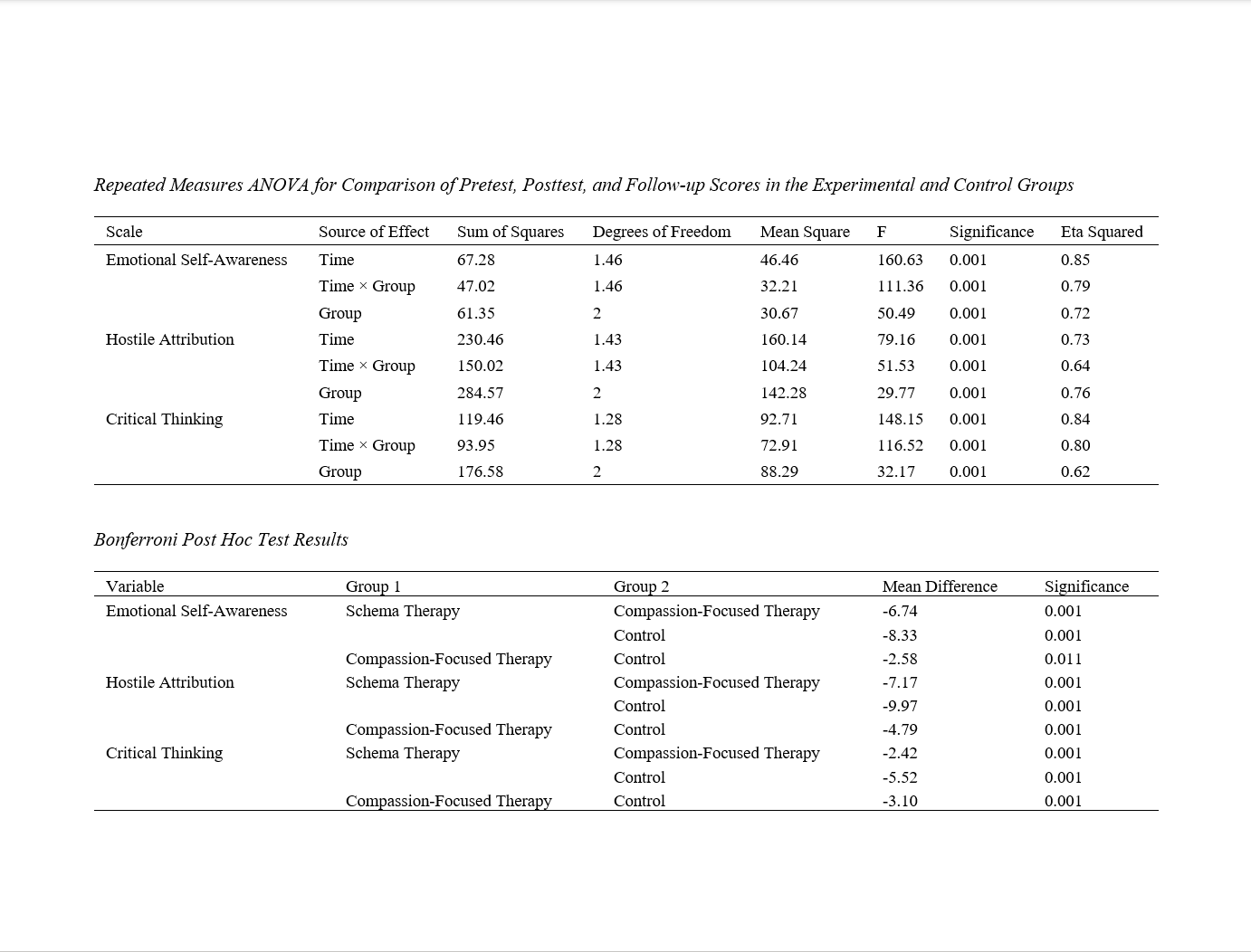
This study compares the effectiveness of schema therapy and compassion-focused therapy on emotional self-awareness, hostile attribution, and critical thinking in adolescents with binge eating disorder. The aim of this research was to evaluate the impact of these two therapies on improving the cognitive and emotional aspects of individuals. The research method was a semi-experimental study with a pretest-posttest and control group. The statistical population consists of adolescents with binge eating disorder in Azarshahr. The samples that were selected as available were randomly divided into two therapy groups (n=15). The first group received schema therapy, while the second group received compassion-focused therapy. To collect data, the Hostile Attribution Questionnaire (Arntz et al., 2003), the Self-Reflection and Insight Scale (Grant et al., 2002), and the Critical Thinking Questionnaire (Ricketts, 2003) were used. The results indicated that both therapies had a significant effect on increasing emotional self-awareness and reducing hostile attribution and critical thinking. However, compassion-focused therapy demonstrated a greater impact on reducing hostile attribution and improving critical thinking. The findings suggested that both approaches can be effective interventions for treating binge eating disorder in adolescents, with compassion-focused therapy being more effective in some aspects.
Downloads
References
Barahmand, U., Shamsina, N., Rojas, K., Geschwind, N., & Iya, F. H. (2023). Mechanisms Linking Perfectionism and Social Anxiety: The Role of Hostility and Disqualification of Positive Social Outcomes. Journal of Psychiatric Practice®, 29(2), 94-103. https://doi.org/10.1097/PRA.0000000000000700
Beaumont, E., Irons, C., Rayner, G., & Dagnall, N. (2016). Does compassion-focused therapy training for health care educators and providers increase self-compassion and reduce self-persecution and self-criticism? Journal of Continuing Education in the Health Professions, 36(1), 4-10. https://doi.org/10.1097/CEH.0000000000000023
Bray, B., Bray, C., Bradley, R., & Zwickey, H. (2022). Mental health aspects of binge eating disorder: A cross-sectional. https://pubmed.ncbi.nlm.nih.gov/36186859/
Colle, L., Hilviu, D., Boggio, M., Toso, A., Longo, P., Abbate-Daga, G., & Fossataro, C. (2023). Abnormal sense of agency. https://www.nature.com/articles/s41598-023-41345-5
Craig, C., Hiskey, S., & Spector, A. (2020). Compassion focused therapy: A systematic review of its effectiveness and acceptability in clinical populations. Expert Review of Neurotherapeutics, 20(4), 385-400. https://doi.org/10.1080/14737175.2020.1746184
Fajrin, R. (2024). THE ROLE of GENERAL PRACTITIONER in PSYCHOTHERAPY of PATIENT BINGE EATING DISORDER. Journal of Psychiatry Psychology and Behavioral Research, 5(1), 34-38. https://doi.org/10.21776/ub.jppbr.2024.005.01.8
Goss, K., & Kelly, A. (2022). The roles of shame, self-criticism, and compassion focused therapy in eating disorders and disordered eating. In (pp. 519-533). Routledge. https://doi.org/10.4324/9781003035879-25
Grabowski, A. (2023). Early maladaptive schemas and the quality of marital bond and communication. Kwartalnik Naukowy Fides et Ratio, 53(1), 9-17. https://doi.org/10.34766/fetr.v53i1.1160
Gul, O., & Koç, B. M. (2025). The Relationship Between Social Media Addiction and Eating Disorders Among Followers of Social Media Influencers. Iranian Journal of Public Health. https://doi.org/10.18502/ijph.v54i2.17909
Hollett, K. B., & Carter, J. C. (2021). Separating binge‐eating disorder stigma and weight stigma: A vignette study. International Journal of Eating Disorders, 54(5), 755-763. https://doi.org/10.1002/eat.23473
Kelly, A. C., & Carter, J. C. (2015). Self‐compassion training for binge eating disorder: A pilot randomized controlled trial. Psychology and Psychotherapy: Theory, Research and Practice, 88(3), 285-303. https://doi.org/10.1111/papt.12044
Khadivizand, E., Ahadi, H., Nejat, H., & Golkar, M. K. (2022). The effectiveness of interpersonal group therapy on depression and emotion regulation in women with bulimia nervosa. Journal of Adolescent and Youth Psychological Studies (JAYPS), 3(2), 255-264. https://doi.org/10.61838/kman.jayps.3.2.19
Khajeh Hasani Rabari, R., Rezaei, M., Mirzaei, M., & Sadeghi, S. (2024). The effectiveness of emotion-focused therapy on fear of intimacy, hostile attributions, and emotional dysregulation in women affected by marital infidelity. Rooesh Psychological Science Journal, 13(1), 233-242. https://frooyesh.ir/browse.php?a_id=4874&sid=1&slc_lang=en
Linardon, J. (2021). 15 Best Eating Disorder Books of All-Time to Improve Your Eating Behaviors Manuscript.
Millard, L. A., Wan, M. W., Smith, D. M., & Wittkowski, A. (2023). The effectiveness of compassion focused therapy with clinical populations: A systematic review and meta-analysis. Journal of affective disorders, 326, 168-192. https://doi.org/10.1016/j.jad.2023.01.010
Mohajan, D., & Mohajan, H. K. (2023). Anorexia Nervosa: A Dreadful Psychosocial Health Complication.
Morvaridi, M., Mashhadi, A., Shamloo, Z. S., & Leahy, R. L. (2019). The effectiveness of group emotional schema therapy on emotional regulation and social anxiety symptoms. International Journal of Cognitive Therapy, 12, 16-24. https://doi.org/10.1007/s41811-018-0037-6
Öcalan, S., Kovancı, M. S., & Hiçdurmaz, D. (2024). 'It is not a mannequin disease': A lived experience narrative of living with bulimia nervosa. Journal of Psychiatric and Mental Health Nursing, 31(2), 174-180. https://doi.org/10.1111/jpm.12973
Pabst, A., Gautier, M., & Maurage, P. (2024). Hostile attributional biases in severe alcohol use disorder: replication, gender specificity, and mechanistic insights. Alcohol and Alcoholism, 59(2), agae010. https://doi.org/10.1093/alcalc/agae010
Petrocchi, N., Ottaviani, C., Cheli, S., Matos, M., Baldi, B., Basran, J. K., & Gilbert, P. (2024). The impact of compassion-focused therapy on positive and negative mental health outcomes: Results of a series of meta-analyses. Clinical Psychology: Science and Practice, 31(2), 230. https://doi.org/10.1037/cps0000193
Pilkington, P. D., Bishop, A., & Younan, R. (2021). Adverse childhood experiences and early maladaptive schemas in adulthood: A systematic review and meta‐analysis. Clinical Psychology & Psychotherapy, 28(3), 569-584. https://doi.org/10.1002/cpp.2533
Prince, T., Mulgrew, K. E., Driver, C., McLoughlin, L. T., Mills, L., Boyes, A., & Hermens, D. F. (2025). The Body Image Related Cyberbullying Picture Series (BRC-PicS): Developed for Use in Research Relating to Cyberbullying, Body Image and Eating Disorders Among Female Adolescents. Current Psychology, 44(4), 2747-2760. https://doi.org/10.1007/s12144-025-07316-x
Rasouli Saravi, S., Hassani, F., Keshavarzi Arshadi, F., Farzad, V., & Sepahmansour, M. (2020). Effectiveness of group schema therapy on eating attitude and self-regulation in overweight adolescent females with binge eating disorder. Avicenna Journal of Neuro Psycho Physiology, 7(1), 20-28. https://doi.org/10.32592/ajnpp.2020.7.1.103
Roshany Golanbar, M., & Smkhani Akbarinejhad, H. (2024). The Efficacy of Compassion-Focused Therapy on Emotional Regulation and Psychological Health in Obese Women. The Neuroscience Journal of Shefaye Khatam, 0-0. https://shefayekhatam.ir/article-1-2464-fa.html
Steffen, P. R., Foxx, J., Cattani, K., Alldredge, C., Austin, T., & Burlingame, G. M. (2021). Impact of a 12-week group-based compassion focused therapy intervention on heart rate variability. Applied Psychophysiology and Biofeedback, 46, 61-68. https://doi.org/10.1007/s10484-020-09487-8
Trentini, C., Tambelli, R., Maiorani, S., & Lauriola, M. (2022). Gender differences in empathy during adolescence: Does. https://journals.sagepub.com/doi/abs/10.1177/0033294120976631
Van Bockstaele, B., van der Molen, M. J., van Nieuwenhuijzen, M., & Salemink, E. (2020). Modification of hostile attribution bias reduces self-reported reactive aggressive behavior in adolescents. Journal of Experimental Child Psychology, 194, 104811. https://doi.org/10.1177/0033294120976631
van der Schans, K. L., Karremans, J. C., & Holland, R. W. (2020). Mindful social inferences: Decentering decreases hostile attributions. European Journal of Social Psychology, 50(5), 1073-1087. https://doi.org/10.1002/ejsp.2657
Vasiliu, O. (2023). An integrative model as a step toward increasing the awareness of eating disorders in the general. https://doi.org/10.3389/fpsyt.2023.1184932
Yang, G., Chen, S., Ma, A., Lu, J., & Wang, T. (2017). Identification of the difference in the pathogenesis in heart failure arising from different etiologies using a microarray dataset. Clinics, 72(10), 600-608. https://doi.org/10.6061/clinics/2017(10)03
Downloads
Additional Files
Publication Timeline
- Submitted
- Revised
- Accepted
Issue
Section
License
Copyright (c) 2025 Firouzeh Sepehrianazar (Corresponding Author); Mahdi Chitsaz (Author)

This work is licensed under a Creative Commons Attribution-NonCommercial 4.0 International License.