Analyzing the Components of Enhancing Dyadic Ego Strength (Facilitating the Transition from "I-ness" to "We-ness" in Marital Relationships) for Married Individuals
DOI:
https://doi.org/10.61838/kman.aftj.6.3.5Keywords:
dyadic ego, we-ness, content analysisAbstract
Objective: The aim of the present study was to analyze the components of enhancing dyadic ego strength (facilitating the transition from "I-ness" to "We-ness" in marital relationships) specifically for married individuals. The research setting included all texts related to the concept of "We-ness."
Methods: The method for selecting texts was purposive sampling from among the aforementioned texts or related constructs within the time frame of 2010 to 2025, based on inclusion and exclusion criteria. The number of texts was determined according to the principle of data saturation. Data collection involved line-by-line analysis of texts based on questions relevant to the concept of "We-ness." The data obtained from the textual analysis were analyzed using the conventional content analysis method proposed by Hsieh and Shannon (2005).
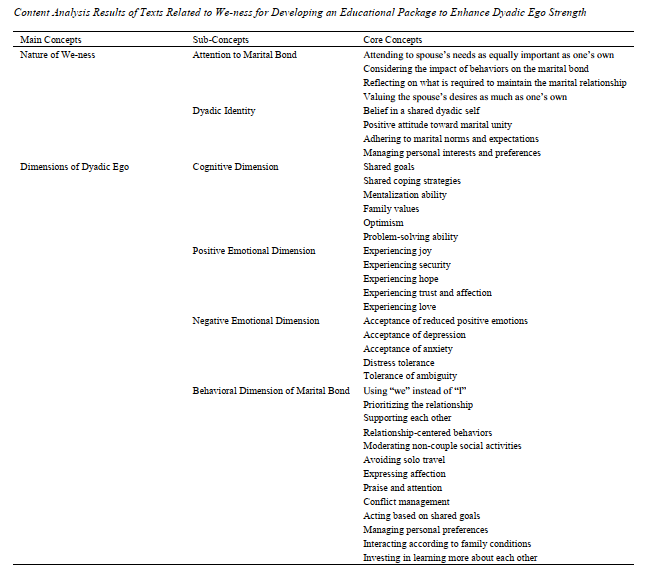
Findings: Content analysis of the texts revealed that dyadic ego consists of four key concepts: (1) essence (with sub-concepts of attention to marital union and dyadic identity); (2) dimensions of dyadic ego (with sub-concepts of cognitive, positive emotional, negative emotional, and behavioral aspects); (3) pathways to achieving dyadic ego (with sub-concepts of generative meaning of the marital bond, family values, and family goals); and (4) obstacles to achieving dyadic ego (with sub-concepts of individualism, lack of self-differentiation, and insecure attachment).
Conclusion: Based on these findings, it can be concluded that dyadic ego is a mechanism that transforms the process of "I-ness" into "We-ness," and for its realization, couples must engage in pathways to attain it and overcome its obstacles.
Downloads
References
Abazari, M., & Barati Ahmadabadi, H. (2017). The mediating role of emotional divorce in the relationship between sexual divorce and psychological divorce in couples on the verge of divorce. Congress of the Iranian Psychological Association,
Abreu-Afonso, J., Ramos, M. M., Queiroz-Garcia, I., & Leal, I. (2022). How a couple's relationship lasts over time? A model for marital satisfaction. Psychological Reports, 125(3), 1601-1627. https://doi.org/10.1177/00332941211000651
Alea, N., Singer, J. A., & Labunko, B. (2015). "We-ness" in relationship-defining memories and marital satisfaction. In Couple resilience: Emerging perspectives (pp. 163-177). https://doi.org/10.1007/978-94-017-9909-6_9
Amorin‐Woods, D., & Imber‐Black, E. (2024). The Ackerman Institute: a journey of culture and diversity over six decades. A conversation with Evan Imber‐Black. Australian and New Zealand Journal of Family Therapy, 45(1), 93-108. https://doi.org/10.1002/anzf.1578
Babasafari, A., H, A. S., & Yousefi, Z. (2022). The effectiveness of integrative systemic-solution-focused couple therapy on marital satisfaction and family relationships of couples. Modern psychological research, 69(18), 35-42. https://en.civilica.com/doc/1722252/
Balali, E., Naghdi, A., & Jafari, R. (2019). Socialization and divorce: Examining the phenomenon of divorce from a process-oriented perspective. Qualitative Research in Health Sciences, 8(1), 44-56. https://sid.ir/paper/215553/fa
Baradari, E., Sheikh Islami, A., Sadri Damirchi, E., & Ghamari Givi, H. (2024). The effectiveness of narrative therapy on family resilience and marital happiness in conflicting couples. Journal title, 18(3), 0-0. https://rph.khu.ac.ir/article-1-4474-en.html
Braverman, L. (2019). Ackerman Institute for the Family. In Encyclopedia of Couple and Family Therapy (pp. 20-23). https://doi.org/10.1007/978-3-319-49425-8_595
Cruwys, T., South, E. I., Halford, W. K., Murray, J. A., & Fladerer, M. P. (2023). Measuring "we-ness" in couple relationships: A social identity approach. Family Process, 62(2), 795-817. https://doi.org/10.1111/famp.12811
Dehghani Sheshdehd, Z., & Yousefi, Z. (2019). Structural equation modeling of divorce tendency based on systemic variables (triangulation, spouse relationship), psychological variables (agreeableness and control methods), and social variables (leisure activities) in mothers in Isfahan. Family Research, 15(1), 155-170. https://jfr.sbu.ac.ir/article_97713.html?lang=en
Ebrahimi, L., & Mohammadi, M. (2021). A systematic review of the underlying factors of consensual divorce among couples in the last decade in Iran (2009-2019). Women and Society Quarterly, 12(46), 16-29. https://jzvj.marvdasht.iau.ir/article_4688.html
Eghbali, A., & Vahedi, H. (2023). Predicting marital satisfaction based on attitude towards spirituality and resilience in the spouses of veterans with post-traumatic stress disorder. https://en.civilica.com/doc/1749660/
Fuchs, N. (2024). From 'I' to 'We'? A Test of the Effect of I-Sharing on We-ness in Couples The University of Vermont and State Agricultural College]. https://scholarworks.uvm.edu/graddis/1839/
Ghafaralahi, E., Etemadi, A., Yousofi, A., & Torkan, Z. (2021). Comparison of the effectiveness of commitment-enhancing counseling and emotion-focused couple therapy on marital burnout and forgiveness in women experiencing virtual infidelity. Behavioral Science Research Journal, 19(2), 342-357. https://doi.org/10.52547/rbs.19.2.342
Ghanvati, M., Johari Fard, R., & Ehtesham Zadeh, P. (2024). Comparison of the effectiveness of emotion-based and attachment-based family therapy on emotional distress tolerance, self-differentiation, and alexithymia in adolescent girls with psychosomatic disorders. Psychological Dynamics in Mood Disorders, 3(4), 132-159. https://doi.org/10.61838/kman.pdmd.3.4.10
Gianèse-Madelaine, C. (2024). Weaving an envelope in psychoanalytic family therapy, on the fabric of the institution. Le Divan familial, 52(1), 153-168. https://doi.org/10.3917/difa.052.0153
Hashemi, S. F., Hamzehgardeshi, Z., Nataj, A. H., & Ganji, J. (2024). Factors Associated With Marital Adjustment in Couples: A Narrative Review. Current Psychosomatic Research, 2(2), 73-86. https://doi.org/10.32598/cpr.2.2.193.1
Hosseini Geravandi, A., Asgari, P., & Yousefi, Z. (2023). An Investigation into Components of Female Attractiveness in Couple Relationships from the Perspective of Expert Family Therapists: A Qualitative Study. Women's Health Bulletin, 10(4), 224-233. https://womenshealthbulletin.sums.ac.ir/article_49627.html
Jelokhanian, M., Atashpour, S. H., & Nadi, M. A. (2022). Effectiveness of an Educational Package Based on an Integrative Self-Analytical Framework to Attachment Styles of Couples with Marital Conflicts. Advances in Nursing and Midwifery, 31(3), 8-15. https://journals.sbmu.ac.ir/anm/article/view/39328
Kazim, S. M., & Rafique, R. (2021). Predictors of marital satisfaction in individualistic and collectivist cultures: A mini review. Journal of Research in Psychology, 3(1), 55-67. https://doi.org/10.31580/jrp.v3i1.1958
Khodaee, S., & Yousefi, Z. (2023). Comparing the effectiveness of attention-seeking adjustment training and commitment-based training on family executive functions and narcissistic tendencies among married women with attention-seeking in Isfahan. Journal of education and health promotion, 12(1), 232. https://doi.org/10.4103/jehp.jehp_74_23
Klausli, J., Gross, C., & Leedom, E. (2025). Processes Linking Shared Spiritual Practices, Spiritual Intimacy, and Sanctification of Marriage to Attachment to Spouse and Relationship Satisfaction. Journal of Psychology and Theology. https://doi.org/10.1177/00916471241310161
Lessard, I., Brassard, A., Gosselin, P., Brault-Labbé, A., Lafontaine, M. F., & Péloquin, K. (2025). Attachment, conflict, and relationship satisfaction of couples transitioning to parenthood: The moderator role of intimacy. Journal of Family Psychology. https://doi.org/10.1037/fam0001321
Mehrabi, S., & Khanjani Vashki, S. (2023). The effectiveness of Bowen family therapy on emotional abuse in married women. Applied Psychology Knowledge and Research, 91(24), 251-260. https://sanad.iau.ir/en/Article/895539?FullText=FullText
Mohamadjani, D., & Fazeli, A. (2024). Factors contributing to the rising divorce rate in society and strategies for strengthening family bonds. Modern Advances in Psychology, Educational Sciences, and Teaching, 77(7), 1-9. https://jonapte.ir/fa/showart-3dfcd69acb3fa2ae22c9a91b75d90ecc
Molazadeh Galeh-Pardasari, Z., & Kanaani, M. A. (2024). Modernization and the tendency towards divorce: A study on married women in Rasht. Sociology of Social Institutions, 11(24), 237-269. https://ssi.journals.umz.ac.ir/article_5351.html?lang=en
Mozas-Alonso, M., Oliver, J., & Berástegui, A. (2022). Differentiation of self and its relationship with marital satisfaction and parenting styles in a Spanish sample of adolescents' parents. PLoS One, 17(3), e0265436. https://doi.org/10.1371/journal.pone.0265436
Nafisah, D., Nasrudin, N., Meidina, A. R., & Zain, M. F. (2024). Comparative analysis of Islamic family law and normative law: Examining the causes of divorce in Purwokerto, Indonesia. Samarah: Jurnal Hukum Keluarga dan Hukum Islam, 8(2), 847-871. https://doi.org/10.22373/sjhk.v8i2.16825
Nasiri, P., Mousavi, S. F., & Mollazadeh, J. (2022). Mediating role of cognitive emotion regulation strategies in the relationship between brain-behavioral system activity and marital satisfaction. Iranian Journal of Psychiatry and Clinical Psychology, 27(4), 474-491. https://doi.org/10.32598/ijpcp.27.4.3506.1
Safari, E., & Golnavazi, P. (2022). Comparison of the causes of divorce from the perspective of men and women seeking consensual divorce. Clinical Psychology Achievements, 8(3), 135-144. https://jacp.scu.ac.ir/article_18407.html?lang=en
Salehi, H., Hoseinian, S., & Yazdi, S. M. (2021). The relationship between successful marriage and self-differentiation: The mediating role of cognitive emotion regulation. Journal of Woman and Family Studies, 9(4), 63-78. https://en.civilica.com/doc/1425357/
Shahriari, M., & Navah, A. (2022). The lived experiences of women seeking divorce from the processes leading to divorce. Iranian Cultural Studies, 15(1), 97-120. https://sid.ir/paper/1051888/fa
Sistani Pour, N., Asghari Ebrahim Abad, M. J., & Ghanbari Hashem Abadi, B. (2024). The effectiveness of group emotional schema therapy on balancing dark personality traits, increasing flourishing, and cognitive flexibility in female heads of households. Clinical Psychology Studies, 14(53), 1-18. https://jcps.atu.ac.ir/article_17013.html
Soltanian, V., Yousefi, Z., & Khayatan, F. (2023). Examining the power dynamics in the family: A sample of qualitative study. Journal of Applied Family Therapy, 4(4), 300-316. https://doi.org/10.61838/kman.aftj.4.4.17
Sotoudeh, N., Ghorbani, R., Darini, A., & Souri, Z. (2022). Examining the factors influencing divorce among divorce applicants in Semnan. Koomesh, 24(3), 327-337. https://sid.ir/paper/1059080/fa
Todorov, E. H., Paradis, A., & Ha, T. (2023). Emotion regulation difficulties and relationship satisfaction in adolescent couples: The role of conflict resolution strategies. Journal of youth and adolescence, 52(8), 1753-1767. https://doi.org/10.1007/s10964-023-01804-8
Young, H. (2022). Strengthening we-ness in working with intercultural couples. New Zealand Journal of Counselling, 42(1), 59-84. https://doi.org/10.24135/nzjc.v42i1.6
Zhang, L. R., & Chen, W. W. (2024). Is it harmful to me or to us? A dyadic analysis of Chinese young adults' dysfunctional individuation and romantic relationship satisfaction. International journal of psychology, 59(2), 279-287. https://doi.org/10.1002/ijop.13092
Downloads
Additional Files
Publication Timeline
- Submitted
- Revised
- Accepted
Issue
Section
License
Copyright (c) 2025 Zahra Sadeghi (Author); Seyed Hamid Atashpour (Corresponding Author); Zahra Yousefi (Author)

This work is licensed under a Creative Commons Attribution-NonCommercial 4.0 International License.