The Effect of Marital Relationships on the Tendency Toward Infidelity Based on Attachment Behavior in Married Women
DOI:
https://doi.org/10.61838/kman.aftj.3728Keywords:
tendency toward infidelity, attachment behavior, marital relationshipsAbstract
Objective: The present study aimed to examine the effect of marital relationships on the tendency toward infidelity based on attachment behavior in married women.
Methods: This study employed a descriptive-correlational design. The statistical population consisted of all married female students at the Islamic Azad University, Central Tehran Branch, during the 2023–2024 academic year. The sampling method was multi-stage cluster random sampling, and a sample of 200 individuals was selected. Data were collected using the Attitudes Toward Infidelity Scale (ATIS) (Whatley, 2008) and the Adult Attachment Style Questionnaire by Collins and Read (1990). Data analysis was conducted using descriptive statistics (mean, median, measures of dispersion including standard deviation, skewness, and kurtosis) and correlation tests.
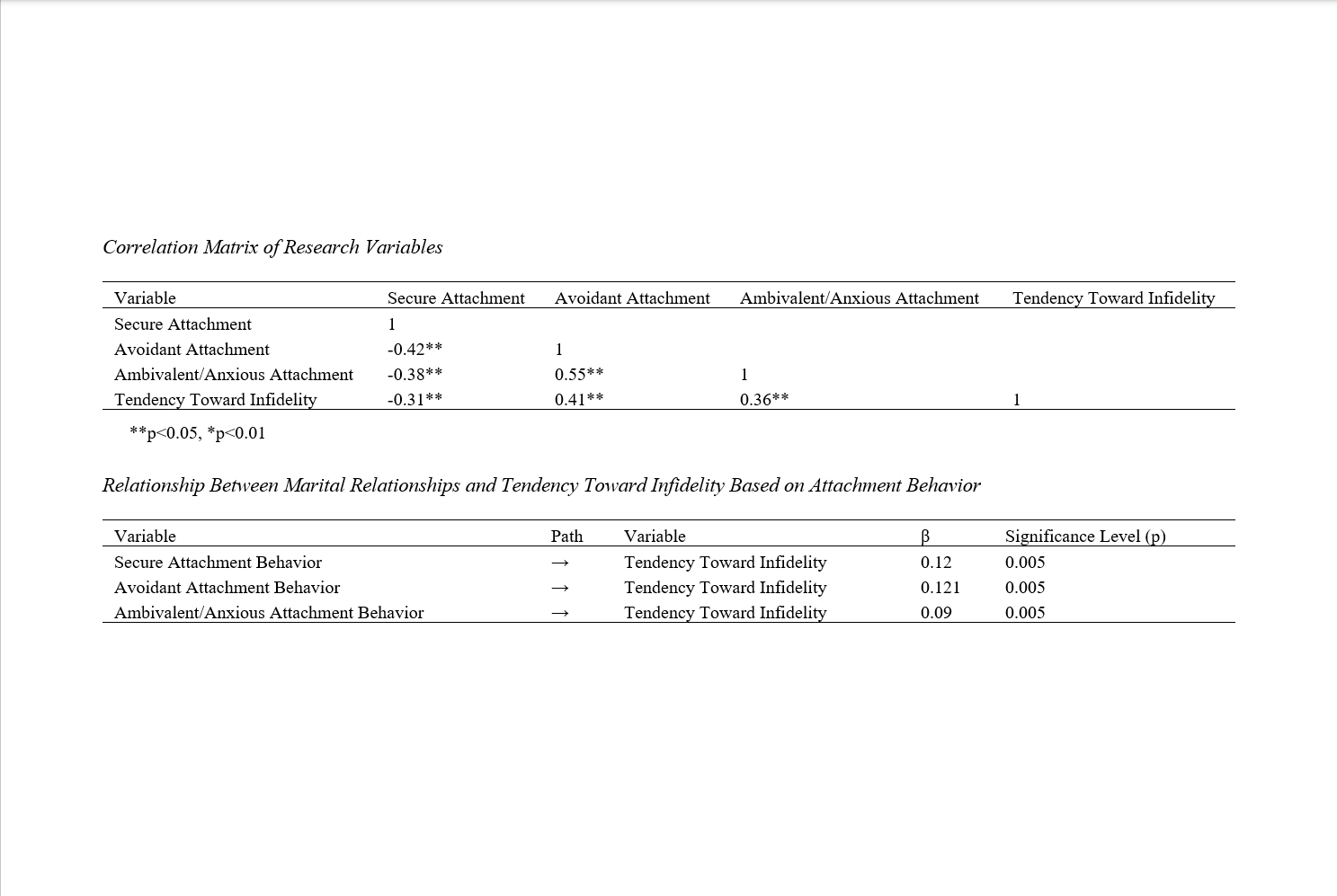
Findings: The results indicated that attachment behavior in marital relationships predicts the tendency toward infidelity in married women. Marital relationships have a direct effect on the tendency toward infidelity based on attachment behavior.
Conclusion: This study confirms that marital relationship stability influences attachment behaviors, which in turn affect the tendency toward infidelity. Secure attachment reduces infidelity risk, while avoidant and ambivalent/anxious attachment increase it, highlighting attachment’s critical role.
Downloads
References
Ahramian, A., Soudani, M., & Gholamzadeh Jofreh, M. (2021). The Effectiveness of Solution-Focused Therapy on Attitudes Toward Marital Infidelity and Marital Intimacy in Married Individuals. Psychological Sciences, 101, 799-811. https://psychologicalscience.ir/browse.php?a_id=1048&sid=1&slc_lang=en
Aminiha, A., Farahbakhsh, K., & Esmaeili, M. (2015). A Qualitative Inquiry into Spouses' Reactions to the Disclosure of Marital Infidelity. Journal of Family Counseling and Psychotherapy, 5(3), 72-92. https://fcp.uok.ac.ir/article_42710.html?lang=en
Azari, F., & Ali Nia, M. (2019). Prediction of Marital Infidelity Tendency Based on Sexual Intimacy and the Level of Social Media Usage. Iranian Journal of Psychology and Behavioral Sciences, 20(2), 37-46. https://www.psyj.ir/afile/phpiCjhei.pdf
Badanfiroz, A. (2025). Comparison of the Effectiveness of Dialectical Behavior Therapy and Emotion-Focused Therapy on Communication Patterns and Marital Intimacy in Marital Infidelity Among Women. Jarac, 7(1), 127-137. https://doi.org/10.61838/kman.jarac.7.1.15
Bayati Ashkeftaki, S., Chorami, M., Ghazanfari, A., & Ahmadi, R. (2022). The Effectiveness of Self-Differentiation Training on Attachment Quality and Alexithymia in Adolescents from Divorced Families with Externalizing Behavior Disorders. Psychological Methods and Models, 47, 55-66. https://jpmm.marvdasht.iau.ir/article_5277.html?lang=en
Estebsari, A., & Abolghasemi, S. (2024). The Causal Relationship Between Early Maladaptive Schemas and Attachment Styles With Attitudes Toward Marital Infidelity Among Married Men and Women. Jarac, 6(4), 75-82. https://doi.org/10.61838/kman.jarac.6.4.9
Guo, W., Chen, T., & Wei, Y. (2023). Intrinsic need satisfaction, emotional attachment, and value co-creation behaviors of seniors in using modified mobile government. Cities, 141, 104529. https://doi.org/10.1016/j.cities.2023.104529
Khezrlou, E., Aghayousefi, A., & Moghadam, H. E. (2024). Predicting Attitudes Toward Marital Infidelity in Couples Based on Attachment Styles and Personality Traits With the Mediation of Coping Strategies (Gender Comparison). Aftj, 5(3), 256-269. https://doi.org/10.61838/kman.aftj.5.3.27
Larki, T. (2025). Comparison of the Impact of Mentalization-Based Therapy and Unified Transdiagnostic Treatment on Intimacy and Marital Satisfaction of Women With Experience of Marital Infidelity. Injoeacs, 6(1), 137-147. https://doi.org/10.61838/kman.ijecs.6.1.14
Ma, G., Bu, X., Ulusoy, U., & Xie, G. (2023). Effect of particle shape on bubble-particle attachment behavior: Roles of surfaces, edges, and vertexes. Journal of Cleaner Production, 429, 139606. https://doi.org/10.1016/j.jclepro.2023.139606
Maghfira, T. N., Krisnadhi, A. A., Basaruddin, T., & Pudjiati, S. R. R. (2023). The Indonesian Young-Adult Attachment (IYAA): An audio-video dataset for behavioral young-adult attachment assessment. Data in Brief, 50, 109599. https://doi.org/10.1016/j.dib.2023.109599
Moshrefi, M., Niknam, M., & Khakpour, R. (2022). Evaluation of the Structural Model of Marital Infidelity Tendency Based on Marital Justice with the Mediating Role of Emotional Maturity. Royesh Psychology Journal, 76, 57-66. https://frooyesh.ir/browse.php?a_id=4085&slc_lang=en&sid=1&printcase=1&hbnr=1&hmb=1
Movahedrad, F., Seyed Ali Tabar, S. H., Mohammadi, A., & Hosseini Fard, V. (2024). The Effectiveness of Strength-Based Counseling on Marital Infidelity Tendency and Self-Compassion in Conflicted Couples. Quarterly Journal of Assessment and Research in Applied Counseling, 5(2). https://doi.org/10.61838/kman.jarac.5.2.2
Pourhamidi, M., Sarvghad, S., Rezaei, A., & Boghouli, H. (2019). Comparison of the Effectiveness of Cognitive Behavioral Therapy and Cognitive Behavioral Hypnotherapy in Reducing Anxiety Symptoms and Improving the Quality of Life of Middle School Students with Test Anxiety. Psychological Methods and Models, 10(35), 17-39. https://jpmm.marvdasht.iau.ir/article_3511.html?lang=en
Rafiei, S., Hatami, A., & Foroughi, A. A. (2011). The Relationship Between Early Maladaptive Schemas and Attachment Styles in Women Who Have Experienced Marital Infidelity. Women and Society (Women's Sociology), 2(1), 21-36. https://jzvj.marvdasht.iau.ir/article_1207.html?lang=en
Rokach, A., & Chan, S. H. (2023). Love and Infidelity: Causes and Consequences. International journal of environmental research and public health, 20(5), 3904. https://doi.org/10.3390/ijerph20053904
Salehzadeh, S., Ghanbari Hashem Abadi, B. A., & Nejat, H. (2024). Structural Equation Modeling of the Tendency Toward Marital Infidelity Based on Significant Five Personality Factors Mediated by Attachment Styles and Sexual Satisfaction. J Health Rep Technol, 10(1), e142998. https://doi.org/10.5812/jhrt-142998
Seyed Ali Tabar, S. H., Mohammadalipour, Z., Habibi, F., Sarvestani, A., & Javan Bakht, A. (2015). Reliability, Validity, and Factor Structure of the Marital Disillusionment Scale. Pajouhandeh Journal, 20(6), 342-349. https://pajoohande.sbmu.ac.ir/browse.php?a_id=2100&sid=1&slc_lang=en
Yousefpouri, M. (2024). Effectiveness of acceptance and commitment-based couples therapy on attitudes towards marital infidelity and emotional regulation in married women. Aftj, 5(2), 103-111. https://doi.org/10.61838/kman.aftj.5.2.12
Downloads
Additional Files
Publication Timeline
- Submitted
- Revised
- Accepted
Issue
Section
License
Copyright (c) 2025 Sara Mohtadi (Author); Hojatollah Moradi (Corresponding Author); Ahmad Baseri (Author)

This work is licensed under a Creative Commons Attribution-NonCommercial 4.0 International License.