A Sociological Study of the Phenomenon of Emotional Divorce in Tehran
DOI:
https://doi.org/10.61838/kman.aftj.5.5.15Keywords:
emotional divorce, sociological factors, qualitative research, Tehran, family relationships, social pressures, educational interventionAbstract
Objective: This study aims to explore the sociological factors, contextual conditions, structural factors, and social pressures contributing to emotional divorce in Tehran.
Method: The study employs a qualitative approach using a sequential exploratory design and grounded theory strategy. A purposive sample of 21 individuals, aged 25-40, with at least a bachelor's degree in psychology, sociology, or related fields, participated in semi-structured interviews. Data were analyzed using open coding and axial coding processes to identify key structures and indices related to emotional divorce. The participants included university lecturers, teachers, housewives, and private sector employees, ensuring a diverse representation of educated individuals with relevant expertise.
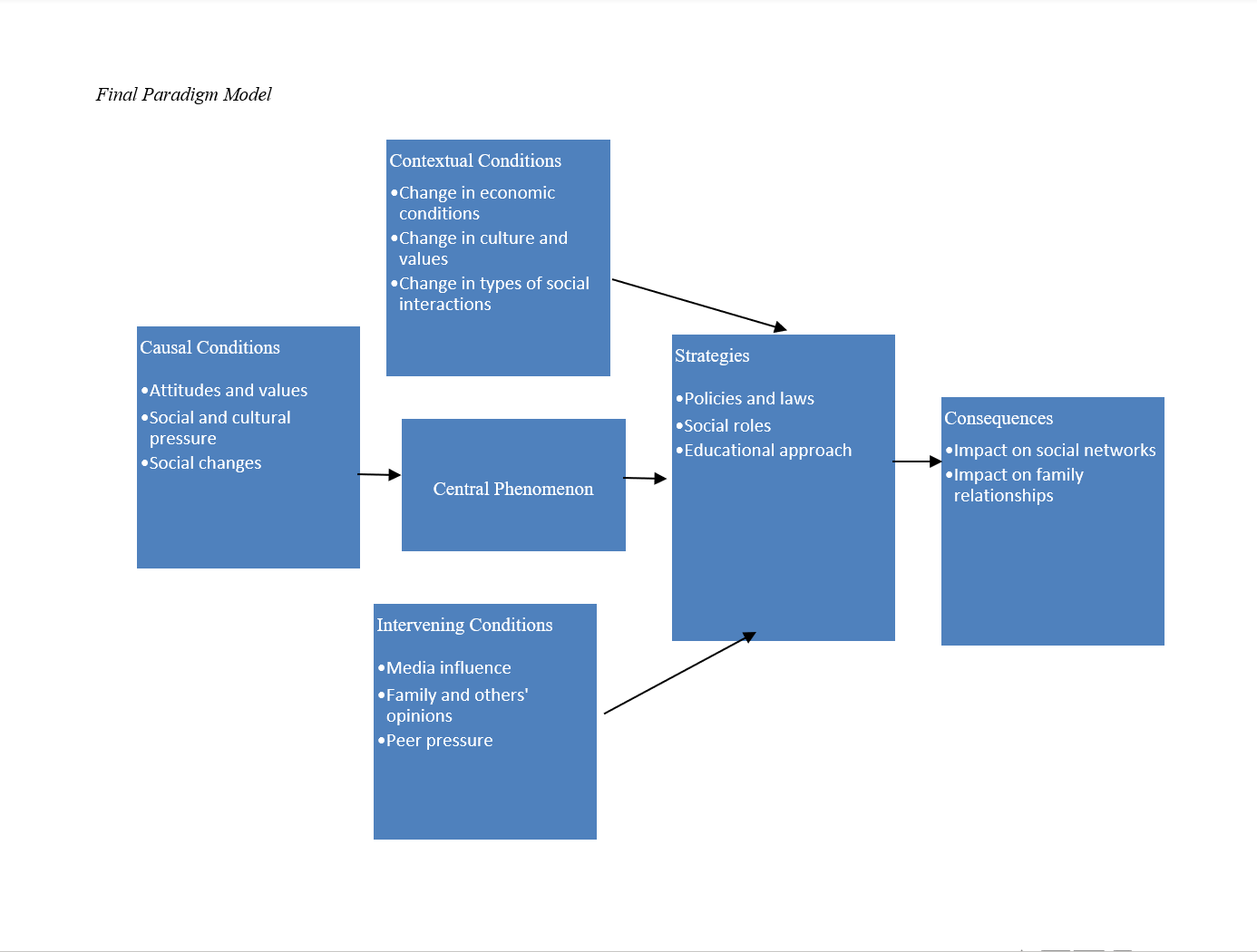
Findings: The results indicate that attitudes and values, social and cultural pressure, and social changes are significant causal factors in the occurrence of emotional divorce. Key phenomena identified include changes in emotional relationships, lack of emotional behavior towards the spouse, emotional void, and compulsory living. Contextual conditions such as changes in culture, values, economic conditions, and types of social interactions were influential. Structural factors identified include policies and laws, and social roles. Social pressures, including peer pressure, family opinions, and media influence, were crucial intervening factors. An educational approach was identified as an effective strategy for preventing and managing emotional divorce.
Conclusion: Emotional divorce, while not always visible, significantly impacts individuals and society. Understanding its sociological aspects and underlying causes is essential for developing effective prevention and management strategies. Educational programs aimed at improving emotional relationships, communication skills, and stress management can mitigate the negative impacts. Policymakers can use these insights to formulate supportive policies and laws. Further research is needed to generalize findings and explore the impact of emotional divorce on children and other regions.
Downloads
References
Assr, D., & Abd-elmaksoud, S. M. (2021). The relationship between emotional divorce and motivation for achievement among working women. Egyptian Journal of Social Work, 12(1), 17-38. https://ejsw.journals.ekb.eg/article_177162.html
Bagheri, P., Ghojogh, M. G., Armanmehr, V., Noghabi, N. D., Moshki, M., & Moradi, N. (2022). Development and Validation of a Questionnaire for Emotional Divorce Measurement: A Mixed Research on Family Mental Health Context. Journal of Advanced Biomedical Sciences. https://publish.kne-publishing.com/index.php/JABS/article/view/8630
Eyo, U. E. (2018). Divorce: Causes and effects on children. https://philpapers.org/rec/EEYDCA
Jarwan, A. S., & Al-frehat, B. M. (2020). Emotional Divorce and Its Relationship with Psychological Hardiness. International Journal of Education and Practice, 8(1), 72-85. https://eric.ed.gov/?id=EJ1249643
Khandandel, S., Mohammadzadeh, R., Abbasi Asfajir, A. A., & Sadeghi, J. (2023). Investigating the psychological status of children of divorce in adulthood using a qualitative method. Journal of Adolescent and Youth Psychological Studies (JAYPS), 4(5), 36-46. https://doi.org/10.61838/kman.jayps.4.5.4
Khatibi, A., & Alikhanypor, A. (2022). A Survey on the Effect of Social Factors and the Perception of Positive Consequences after Divorce on Consensual Divorce (from the Perspective of Divorce Applicants in Hamadan). Journal of Family Research, 18(1), 75-96. https://doi.org/10.52547/JFR.18.1.75
Mirzadeh Koohshahi, F., Rezaei, A., & Najafi, M. (2019). Construction and Validation of Emotional Divorce Scale in Iranian Population. PCP, 7(1), 53-62. https://doi.org/10.32598/jpcp.7.1.53
Navabinejad, S., Rostami, M., & Parsakia, K. (2024). Influences of Family Structure and Intimacy on Emotional Divorce: A Cross-Sectional Analysis. Journal of Psychosociological Research in Family and Culture, 2(1), 23-30. https://doi.org/10.61838/kman.jprfc.2.1.5
Rasheed, A., Amr, A., & Fahad, N. (2021). Investigating the Relationship between Emotional Divorce, Marital Expectations, and Self-Efficacy among Wives in Saudi Arabia. Journal of Divorce & Remarriage, 62(1), 19-40. https://doi.org/10.1080/10502556.2020.1833290
Shiri, M. A. (2016). Predict marital conflicts and emotional divorce based on the character strengths among spouses. International Journal of Fundamental Psychology and social Science, 6(2), 15-22. https://fundamentaljournals.org/index.php/ijfpss/article/view/174
van Berkel, S. R., Prevoo, M. J. L., Linting, M., Pannebakker, F., & Alink, L. R. A. (2024). What About the Children? Co-Occurrence of Child Maltreatment and Parental Separation. Child maltreatment, 29(1), 53-65. https://doi.org/10.1177/10775595221130074
van der Wal, R. C., Levelt, L., Kluwer, E., & Finkenauer, C. (2024). Exploring Associations Between Children's Forgiveness Following Parental Divorce and Psychological Well-Being. Family Transitions, 1-23. https://doi.org/10.1080/28375300.2024.2310432
Downloads
Additional Files
Publication Timeline
- Submitted
- Revised
- Accepted
Issue
Section
License
Copyright (c) 2024 Hamzeh Salemi (Author); Shahla Kazemi Pour Sabet (Corresponding Author); Parvin Savadian (Author)

This work is licensed under a Creative Commons Attribution-NonCommercial 4.0 International License.