The Relationship Between Sexist Parenting Style and Cognitive Emotion Regulation Styles in Men With Perpetration of Domestic Violence Against Women
Keywords:
Domestic violence, sexist parenting style, cognitive emotion regulation, structural equation modeling, men perpetratorsAbstract
Objective: This study aimed to investigate the relationship between sexist parenting style, cognitive emotion regulation strategies, and the perpetration of domestic violence against women by married men.
Methods and Materials: A correlational design was used involving 300 married men selected through convenience sampling from medical centers in Qazvin. Participants completed the Mohseni Tabrizi Domestic Violence Questionnaire and the Garnefski Cognitive Emotion Regulation Questionnaire. Descriptive statistics, Pearson correlations, and structural equation modeling using LISREL 8.80 were conducted to analyze the data. Model fit was assessed using indices including Chi-square, RMSEA, CFI, and TLI.
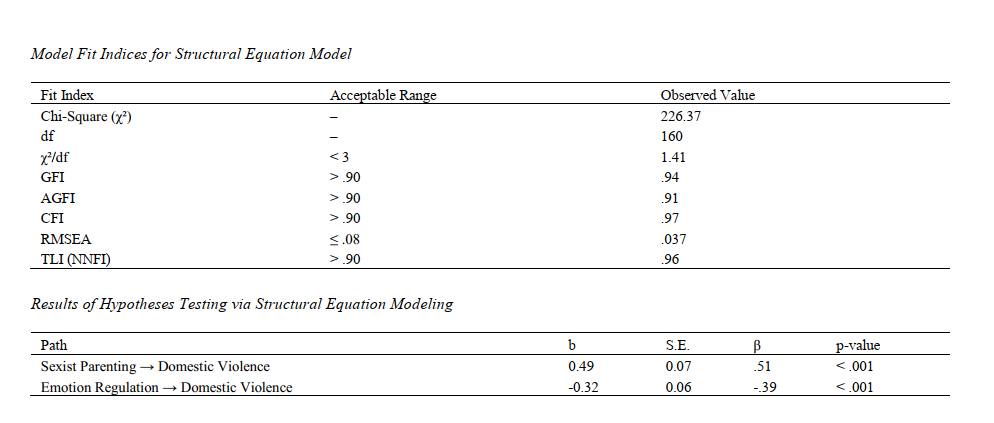
Findings: Results indicated that sexist parenting style was positively associated with domestic violence perpetration (β = .51, p < .001). Maladaptive cognitive emotion regulation strategies were also significantly associated with increased violent behavior (β = -.39, p < .001). Model fit indices demonstrated a good fit (χ²/df = 1.41, RMSEA = .037, CFI = .97, TLI = .96). Additionally, sexist parenting and emotion regulation interacted positively in predicting violence, suggesting that both factors jointly contribute to abusive behavior.
Conclusion: The findings underscore the critical role of sexist parenting and maladaptive cognitive emotion regulation strategies in perpetuating domestic violence against women. These results highlight the need for preventive interventions focusing on gender-sensitive parenting practices and training in adaptive cognitive emotion regulation strategies among men to reduce the prevalence of domestic violence.
Downloads
References
Benagiano, G., Carrara, S., & Filippi, V. (2010). Social and ethical determinants of human sexuality: 2. Gender-based violence. Journal of Sexual Medicine, 15(4), 220-231. https://doi.org/10.3109/13625187.2010.490888
Bermea, A. M., Slakoff, D. C., & Goldberg, A. E. (2021). Intimate Partner Violence in the LGBTQ+ Community: Experiences, Outcomes, and Implications for Primary Care. Primary Care: Clinics in Office Practice, 48(2), 329-337. https://doi.org/10.1016/j.pop.2021.02.006
Fakhraei, A., & Azita. (2018). Predicting eating disorders of nursing students based on emotional malaise, coping styles and cognitive emotion regulation. Journal of psychiatric nursing, 6(6). https://doi.org/10.21859/ijpn-06062
Ghalandarzadeh, Pournaghash, T., & Seyed, S. (2020). The Mediating Role of Psychological Distress, Emotion Regulation Reappraisal Strategy, and Emotion Regulation Suppression Strategy in the Relationship Between Domestic Violence and Cognitive Functions in Women Victims of Violence. Quarterly Journal of Applied Psychological Research, 11(2), 1-21. https://japr.ut.ac.ir/article_77290.html
Gihwa, K., & Yang, S. (2016). An Ethnographic Study of a Shelter for Victims of Domestic Violence in Korea. Indian Journal of Gender Studies, 23(3), 376-392. https://doi.org/10.1177/0971521516656076
Hashemi, F., Keshavarz, A. H., & Gholamali Lavasani, M. (2022). The Mediating Role of Cognitive Emotion Regulation Strategies in the Relationship Between Domestic Violence, Attachment Styles, and Psychological Well-Being of Women. https://doi.org/https://doi.org/10.18502/qjcr.v21i83.11088
K., S., & Tripathi, K. N. (2024). Study of Mental Health,Self Esteem and Domestic Violence in Relation to Type of Family and Tenure of Marriage. Mind and Society, 13(02), 1-9. https://doi.org/10.56011/mind-mri-132-20241
Keivanlu, S., & Mikaili, N. (2023). The combined effectiveness of emotion regulation therapy and compassion-focused therapy on the mental well-being of women with experiences of domestic violence. Journal of Women's Psychology, 4(1), 98-108. https://doi.org/10.61838/kman.pwj.4.1.8
Kobrlo, N. A. M. D. (2024). Domestic Violence in Iraqi Society Between Acceptance and Rejection in the Media. Route Educational and Social Science Journal. https://doi.org/10.17121/ressjournal.3551
Liu, H. (2024). Impact of Domestic Violence on Women’s Mental Health and Coping Strategies: A Survey Study in Mexico. Journal of Research in Social Science and Humanities, 3(2), 22-28. https://doi.org/10.56397/jrssh.2024.02.04
Mahmoudi, F. (2017). A Study of the Role of Spiritual Attitude in Predicting Emotional Cognitive Regulation Strategies in Students. Quarterly Journal of Religion and Health, 5(1). https://jrh.mazums.ac.ir/browse.php?a_id=404&sid=1&slc_lang=fa
Menaker, T. A., & Franklin, C. A. (2015). Gendered Violence and Victim Blame: Subject Perceptions of Blame and the Appropriateness of Services for Survivors of Domestic Sex Trafficking, Sexual Assault, and Intimate Partner Violence. Journal of Crime and Justice, 38(3), 395-413. https://doi.org/10.1080/0735648x.2014.996321
Moeini, F., Hosseini Arian, N., Karbasi, T., Tozandejani, H., Rahnejat, A., & Daniyavi, V. (2022). The Effectiveness of Emotion-Focused Therapy on Feelings of Rejection, Marital Compatibility, and Emotional Regulation in Women Victims of Domestic Violence. Nurse and Physician in War, 10(36), 15-16. http://npwjm.ajaums.ac.ir/article-1-899-fa.html
Mordas, E. S. (2024). Domestic Violence and Maternal Perversion. Психолог(4), 28-44. https://doi.org/10.25136/2409-8701.2024.4.69150
Musazadeh, H., Merghati Khoi, E., Sediqanifar, A., & Ara, F. (2010). The relationship between spousal abuse and the content of religiosity in men who commit spousal abuse, Urmia, 2008-2009. Quarterly Journal of Urmia School of Nursing and Midwifery, 8(3), 162-168. https://unmf.umsu.ac.ir/article-1-215-fa.html
Naji Sabri, S. (2022). A Literature Review on Domestic Violence Expressed From Gender Perspective. Qalaai Zanist Scientific Journal, 7(1). https://doi.org/10.25212/lfu.qzj.7.1.32
Oddone, C. (2020). Perpetrating Violence in Intimate Relationships as a Gendering Practice: An Ethnographic Study on Domestic Violence Perpetrators in France and Italy. Violence an International Journal, 1(2), 242-264. https://doi.org/10.1177/2633002420962274
Razzaqi, H., Toofani, H., Nemati, Z., & Kazemian, M. (2008). A six-month study in injured women due to spousal abuse referred to Shahid Kamyab Emergency Hospital in Mashhad. Scientific Journal of Forensic Medicine, 14(4), 235-239. https://sjfm.ir/browse.php?a_id=161&sid=1&slc_lang=fa&ftxt=0
Sadat Asadi, L. (2009). Controlling domestic violence from law to morality. Women's Book Quarterly(23). https://hawzah.net/fa/Article/View/86572/
Saeedzadeh. (2008). Domestic Violence in the Proposed Islamic Punishment Bill. Women's Square Magazine(23). https://ensani.ir/fa/article/423706/
Sarichilou, M. E., Gafeleh bashi, S. H., Kalantari, Z., Moradi, M., & Jahani hashemi, H. (2010). Domestic violence against women and Preventive intervention in the Minoodar & Kowsar regions of Qazvin (2005-2006). The Journal of Qazvin University of Medical Sciences, 13(4), 19-24. https://www.sid.ir/fa/journal/ViewPaper.aspx?id=109178
Solati, S. K., Rabiee, M., & Shariati, M. (2011). The Relationship between Religious Orientation and Mental Health. Qom University of Medical Sciences Journal, 5(3), 42-48. https://sid.ir/paper/456854/fa
Taheri Fard, M., & Mikaeili, N. (2019). The Effectiveness of Mindfulness-Based Cognitive Therapy on Social Anxiety, Resilience, and Emotion Regulation in Women Victims of Domestic Violence. Journal of Thought and Behavior, 60, 10-25. https://www.sid.ir/paper/172057/fa
Thamizhmathi, J., Vedapriya, D. R., & Bhuvaneswari, N. S. (2024). Prevalence of Domestic Violence and Perceived Stress Among Married Women in an Urban Area of Puducherry: A Cross Sectional Study. Nbejms, 2(7), 678-692. https://doi.org/10.61770/nbejms.2024.v02.i07.005
Yazdkhasti, B., & Shiri, H. (2008). Values of patriarchy and violence against women. Women's Studies, 6(3), 55-79. https://sid.ir/paper/66079/fa

Downloads
Additional Files
Published
Submitted
Revised
Accepted
Issue
Section
License
Copyright (c) 2025 Fatemeh Aliakbari (Author); Davood Taghvaei (Corresponding Author); Zabih Pirani (Author)

This work is licensed under a Creative Commons Attribution-NonCommercial 4.0 International License.
How to Cite