Comparison of the Effectiveness of Unified Transdiagnostic Treatment and Compassion-Based Approach on Suicidal Ideation and Spiritual Well-Being in Women Victims of Domestic Violence
DOI:
https://doi.org/10.61838/kman.aftj.6.3.1Keywords:
Compassion-Based Therapy, Unified Transdiagnostic Treatment, Suicidal Ideation, Spiritual Well-Being, Domestic ViolenceAbstract
Objective: The present study aimed to compare the effectiveness of Unified Transdiagnostic Treatment and the Compassion-Based Approach on suicidal ideation and spiritual well-being in women victims of domestic violence.
Methods: This study is applied in terms of its purpose and quasi-experimental in nature and method, utilizing a pre-test, post-test, and two-month follow-up design with a control group. The study population comprised all women victims of domestic violence who sought help from social emergency centers and family counseling clinics in Tehran during the second half of 2023. The sample consisted of 51 participants who were selected through purposive sampling and randomly assigned to experimental and control groups. The first experimental group received an eight-session (90-minute each) Compassion-Based Therapy intervention program, while the second experimental group received a ten-session (60-minute each) Unified Transdiagnostic Treatment program at these centers. The control group did not receive any intervention. Data collection tools included the Violence Against Women Questionnaire by Haj-Yahya (2001), the Beck and Steer Suicidal Ideation Scale (1991), and the Spiritual Well-Being Scale by Paloutzian and Ellison (1982). The obtained data were analyzed using repeated measures analysis of covariance (ANCOVA) and Bonferroni post hoc test with SPSS 27 software.
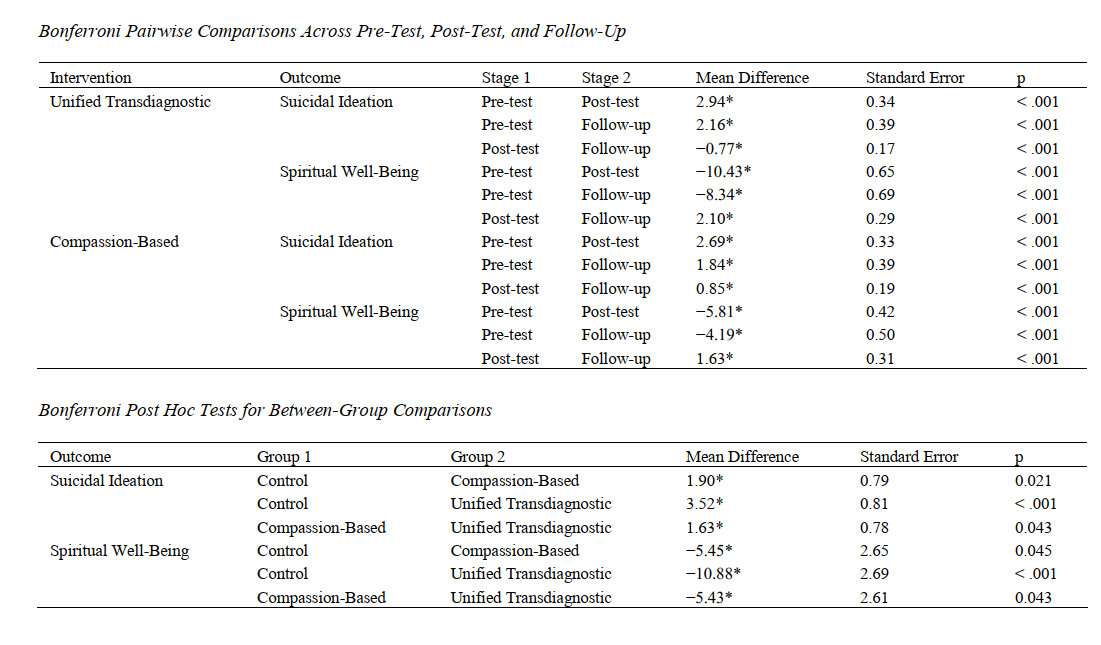
Findings: The study findings indicate that both Compassion-Based Therapy and Unified Transdiagnostic Treatment led to a reduction in suicidal ideation and an increase in spiritual well-being in the experimental groups. Additionally, considering the mean difference, Unified Transdiagnostic Treatment had a greater effect than the Compassion-Based Approach in reducing suicidal ideation and enhancing spiritual well-being (p < .05).
Conclusion: Based on the findings of this study, Compassion-Based Therapy and Unified Transdiagnostic Treatment are effective approaches for improving spirituality and reducing suicidal ideation in women victims of domestic violence. Psychologists and family specialists are encouraged to utilize these findings to enhance the quality of family life.
Downloads
References
Abdollahzadeh, H., Shadin, N., Salahi Nezhad, M., Kaya, B., Mahmoudi, M., & Faridon Sarijeh, P. (2020). The Effectiveness of Spiritual Self-Care Education on Self-Compassion and Moral Courage in Nurses The Effect of Spirituality Therapy on Lifestyle in Hemodialysis Patients. Journal of Behavioral Sciences Research, 18(3), 393-402. https://doi.org/10.1037/v00751-001 10.52547/rbs.18.3.393
Adams, J. M., & van Dahlen, B. (2021). Preventing suicide in the United States. Public Health Reports, 136(1), 3-5. https://doi.org/10.1177/0033354920974657
Afshari, A. (2018). Predicting medication adherence in diabetic patients based on self-compassion, emotional regulation, and spiritual well-being. Behavioral Sciences Research, 16(4), 466-475. https://doi.org/10.52547/rbs.16.4.466
Agarwal, K., Fortune, L., Heintzman, J. C., & Kelly, L. L. (2020). Spiritual Experiences of Long-Term Meditation Practitioners Diagnosed with Breast Cancer: An Interpretative Phenomenological Analysis Pilot Study. Journal of religion and health, 59(5), 2364-2380. https://doi.org/10.1007/s10943-020-00995-9
Ahmadi, R., Sajadian, E., & Jafari, F. (2019). The Effectiveness of Compassion-Based Therapy on Anxiety, Depression, and Suicidal Ideation in Women with Vitiligo. Journal of Dermatology and Beauty, 1(10), 1-29. https://jdc.tums.ac.ir/browse.php?a_id=5369&slc_lang=en&sid=1&printcase=1&hbnr=1&hmb=1
Ahmadi, V., & Valizadeh, H. (2021). The Effectiveness of Acceptance and Commitment-Based Therapy on the Quality of Life and Death Anxiety in the Elderly. Aging Psychology, 7(2), 166-153. https://doi.org/10.22126/jap.2021.6370.1528
Alharbi, J., Jackson, D., & Usher, K. (2019). Compassion fatigue in critical care nurses. An integrative review of the literature, 40(11), 1087-1097. https://doi.org/10.15537/smj.2019.11.24569
Anisi, J., Fathi Ashtiani, A., Soltani Nejad, A., & Amiri, M. (2022). Prevalence of Suicidal Thoughts and Related Factors among Soldiers. Military medicine, 8(2), 113-118. https://militarymedj.bmsu.ac.ir/article_1000243.html?lang=en
Asadi Hasanvand, A., Sadri Demirchi, E., Ghamari Kivi, H., & Sheikh-ol-Eslami, A. (2022). Comparison of the Effectiveness of Integrated Transdiagnostic and Solution-Focused Interventions on Suicidal Thoughts in Victims of Sexual Assault. Psychological studies, 4(18), 7-18. https://psychstudies.alzahra.ac.ir/article_6831.html?lang=en
Birnie, K., Speca, Michael, Carlson, Linda E. (2010). Exploring self-compassion and empathy in the context of mindfulness-based stress reduction (MBSR). Stress and Health, 26(5), 359-371. https://doi.org/10.1002/smi.1305
Bodok-Mulderij, I., Schaap‐Jonker, H., Klaassen-Dekker, A., Boselie, J. J., & Jacobs, N. (2023). The Relation Between Religion/Spirituality and Mental Health Is Mediated by Self-Compassion: Evidence From Two Longitudinal Studies in the Dutch-Speaking General Population. Psychology of Religion and Spirituality, 15(3), 407-417. https://doi.org/10.1037/rel0000501
Campisi, S. C., Carducci, B., Akseer, N., Zasowski, C., Szatmari, P., & Bhutta, Z. A. (2020). Suicidal Behaviours Among Adolescents from 90 Countries: A Pooled Analysis of the Global School-Based Student Health Survey. BMC public health, 20(1), 1102. https://doi.org/10.1186/s12889-020-09209-z
Chenari, M., & Kazemizadeh, Z. (2017). The Role of Spiritual Health in Islamic Lifestyle. Spiritual Research Journal. http://pmbo.ir/%D8%AC%D8%A7%DB%8C%DA%AF%D8%A7%D9%87-%D8%B3%D9%84%D8%A7%D9%85%D8%AA-%D9%85%D8%B9%D9%86%D9%88%DB%8C-%D8%AF%D8%B1-%D8%B3%D8%A8%DA%A9-%D8%B2%D9%86%D8%AF%DA%AF%DB%8C-%D8%A7%D8%B3%D9%84%D8%A7%D9%85%DB%8C__a-759.aspx
Devkota Sapkota, B., & Simkhada, P. (2024). Domestic Violence Against Women in Nepal: A Systematic Review of Risk Factors. Journal sage. https://doi.org/https://doi.org/10.1177/1524838023122223
Erez, E., Ibarra, P. R., & Lurie, N. (2024). Electronic monitoring and domestic violence: The role of technology in protecting victims. Crime Prevention and Community Safety, 6(1), 33-44.
Gilbert, P. (2009a). Introducing Compassion-Focused Therapy. Advances in psychiatric treatment, 15(3), 199-208. https://doi.org/10.1192/apt.bp.107.005264
Gilbert, P. (2009b). The Nature and Basis for Compassion Focused Therapy. Hellenic Journal of Psychology, 6, 273-291. https://psycnet.apa.org/record/2010-03679-003
Gilbert, P. (2010). Compassion Focused Therapy: Distinctive Features. Routledge/Taylor & Francis Group. https://doi.org/10.4324/9780203851197
Gilbert, P. (2014). The Origins and Nature of Compassion Focused Therapy. British Journal of Clinical Psychology, 53(1), 6-41. https://doi.org/10.1111/bjc.12043
Gilbert, P. (2015). An Evolutionary Approach to Emotion in Mental Health with a Focus on Affiliative Emotions. Emotion Review, 7, 230-237. https://doi.org/10.1177/1754073915576552
Gilbert, P. (2018). Compassion-Focused Therapy. Translated by Mehrnoush Esbati & Ali Feizi. https://doi.org/10.4324/9780203851197
Gilbert, P., Basran, J. K., Raven, J., Gilbert, H., Petrocchi, N., Cheli, S., Rayner, A., Hayes, A., Lucre, K., Minou, P., Giles, D., Byrne, F., Newton, E., & McEwan, K. (2022). Compassion Focused Group Therapy for People with a Diagnosis of Bipolar Affective Disorder: A Feasibility Study. Frontiers in psychology, 13, 841932. https://doi.org/10.3389/fpsyg.2022.841932
Golmohammad, R., Ghasemi Firoozabadi, M., Abdoli, Z., & Saghikha, H. (2021). Effectiveness of Emotion-Focused Therapy on Psychological Distress and Depression in Married Women Victims of Domestic Violence. Journal of Mashhad University of Medical Sciences, 64(6), 4338-4348. https://mjms.mums.ac.ir/article_20934.html
Haji Heidari, B., & Sajadian, E. (2023). The Role of Resilience, Emotion Regulation, and Spiritual Health in Predicting Suicidal Ideation in Women Victims of Violence During the COVID-19 Pandemic. Iranian-Islamic Family Studies, 3(3), 52-75. https://sanad.iau.ir/en/Journal/iifsj/Article/921430/FullText
Hertanto, I., Suparto, S., Rustamaji, M., & Saefudin, Y. (2024). Police and Law Enforcement of Domestic Violence Crimes Based on Human Rights in Indonesia. Khazanah Hukum, 6(2), 134-144. https://doi.org/10.15575/kh.v6i2.34357
Hosseini Akhgar, F. S., Davati, A., & Garshasbi, A. (2018). Relationship Between Spiritual Health and Depression in Pregnant Women Referring to Mostafa Khomeini Hospital. Daneshvar Medical Bimonthly, 139(114), 19-24. https://www.sid.ir/paper/30614/en
Jabbari, N., & Aghili, S. M. (2023). The Effectiveness of Compassion-Focused Therapy and Emotion-Focused Therapy on Self-Harming Behaviors and Interpersonal Needs in Adolescent Girls with Suicidal Ideation. Quarterly Journal of Modern Psychological Research, 69(1), 61-70. https://psychologyj.tabrizu.ac.ir/article_16242.html?lang=en
Kadhim, N. S. (2024). Effect of Domestic Violence on Children: A Review. International Journal of Education and Social Science Research, 07(02), 239-247. https://doi.org/10.37500/ijessr.2024.7216
Kobrlo, N. A. M. D. (2024). Domestic Violence in Iraqi Society Between Acceptance and Rejection in the Media. Route Educational and Social Science Journal. https://doi.org/10.17121/ressjournal.3551
Liu, X., Cao, J., & Xie, C. (2019). Finite-Time and Fixed-Time Bipartite Consensus of Multi-Agent Systems under a Unified Discontinuous Control Protocol. Journal of the Franklin Institute, 356(2), 734-751. https://doi.org/10.1016/j.jfranklin.2017.10.009
Magnano, P., Zammitti, A., Dibilio, R., & Faraci, P. (2019). Italian Validation of the Jarel Spiritual Well-Being Scale. Mental Health, Religion & Culture, 22, 626-644. https://doi.org/10.1080/13674676.2019.1594740
Mars, B., Heron, J., Klonsky, E. D., Moran, P., O'Connor, R. C., Tilling, K., Wilkinson, P., & Gunnell, D. (2018). What Distinguishes Adolescents with Suicidal Thoughts from Those Who Have Attempted Suicide? A Population-Based Birth Cohort Study. Journal of Child Psychology and Psychiatry, 60(1), 91-99. https://doi.org/10.1111/jcpp.12878
Michaelson, V., Brooks, F., Jirásek, I., Inchley, J., Whitehead, R., King, N., Walsh, S., Davison, C. M., Mazur, J., & Pickett, W. (2016). Developmental Patterns of Adolescent Spiritual Health in Six Countries. SSM-Population Health, 2, 294-303. https://doi.org/10.1016/j.ssmph.2016.03.006
Muchtarom, M. (2024). Analysis of Underage Marriage Impacting Broken Homes and Domestic Violence. Int. J. Law. Rev. State. Adm, 2(1), 28-35. https://doi.org/10.58818/ijlrsa.v2i1.108
Norton, P. J., & Paulus, D. J. (2016). Toward a Unified Treatment for Emotional Disorders: Update on the Science and Practice. Behavior therapy, 47(6), 854-868. https://doi.org/10.1016/j.beth.2015.07.002
Nur, N. (2023). Suicidal Thoughts and Attempts Among Married Women Who Experience Intimate Partner Violence in Türkiye. Eastern Mediterranean Health Journal, 29(9). https://doi.org/10.26719/emhj.23.097
Pirutinsky, S., Cherniak, A. D., & Rosmarin, D. H. (2020). COVID-19, Mental Health, and Religious Coping Among American Orthodox Jews. Journal of religion and health, 59, 2288-2301. https://doi.org/10.1007/s10943-020-01070-z
Plante, T. G. (2018). Healing with Spiritual Practices: Proven Techniques for Disorders from Addictions and Anxiety to Cancer and Chronic Pain. ABC-CLIO. https://doi.org/10.5040/9798400662225
Sanagouye Moharer, G., Shirazi, M., Kia, S., & Karami Mahajeri, Z. (2020). The Effect of Compassion-Based Training on Hope, Life Satisfaction, and Mood Disorders in Delinquent Adolescent Girls. Psychiatric Nursing, 8(3), 46-56. https://ijpn.ir/browse.php?a_id=1572&sid=1&slc_lang=en
Sheyvandi Chelicheh, K., Abdolmaleki, S., Ghalami, Z., & Nafar, Z. (2023). Explaining the Resilience Model Based on Life Purpose and Relationship Quality with the Mediating Role of Spiritual Health in Facing Psychological Pressure Due to COVID-19. Quarterly Journal of Counseling Culture and Psychotherapy, 14(54), 1-34. https://qccpc.atu.ac.ir/article_14612.html
Spencer, C. M., Stith, S. M., & Cafferky, B. (2019). Risk Markers for Physical Intimate Partner Violence Victimization: A Meta-Analysis. Aggression and Violent Behavior, 44, 8-17. https://doi.org/10.1016/j.avb.2018.10.009
Steele, S. J., Farchione, T. D., Cassiello-Robbins, C., Ametaj, A., Sbi, S., Sauer-Zavala, S., & Barlow, D. H. (2018). Efficacy of the Unified Protocol for Transdiagnostic Treatment of Comorbid Psychopathology Accompanying Emotional Disorders Compared to Treatments Targeting Single Disorders. Journal of psychiatric research, 104, 211-216. https://doi.org/10.1016/j.jpsychires.2018.08.005
Tamjidfar, A. (2022). The Effect of Compassion Therapy on Spiritual Well-being of 11th and 12th Grade Students in Neyshabur during the 2020-2021 Academic Year. Advances in Modern Psychology, Educational Sciences, and Teaching, 5(48), 110-120. https://ensani.ir/fa/article/498592/
Thamizhmathi, J., Vedapriya, D. R., & Bhuvaneswari, N. S. (2024). Prevalence of Domestic Violence and Perceived Stress Among Married Women in an Urban Area of Puducherry: A Cross Sectional Study. Nbejms, 2(7), 678-692. https://doi.org/10.61770/nbejms.2024.v02.i07.005
Downloads
Additional Files
Publication Timeline
- Submitted
- Revised
- Accepted
Issue
Section
License
Copyright (c) 2025 Mahboobe Hossein Alizadeh (Author); Mohammad Ghamari (Corresponding Author); Marzieh GholamiTooranposhti (Author)

This work is licensed under a Creative Commons Attribution-NonCommercial 4.0 International License.