Prioritizing Parenting Competencies in the Digital Era
DOI:
https://doi.org/10.61838/kman.aftj.5021Keywords:
Digital parenting, parenting competence, digital literacy, emotional regulationAbstract
Objective: This study aimed to identify, categorize, and prioritize the essential competencies required for effective and responsible parenting in the digital era.
Methods and Materials: This research employed a sequential mixed-method design consisting of a qualitative and a quantitative phase. The qualitative phase involved an integrative literature review of studies published between 2015 and 2025, focusing on digital parenting frameworks, emotional regulation, online safety, and educational mediation. Data were analyzed through thematic content analysis using NVivo 14, resulting in eight primary competency categories. The quantitative phase involved a ranking survey completed by 205 Italian parents, who evaluated the importance of the identified competencies using a five-point Likert scale. Descriptive and ranking analyses were conducted with SPSS version 26, generating mean scores and standard deviations to determine the relative priority of each category.
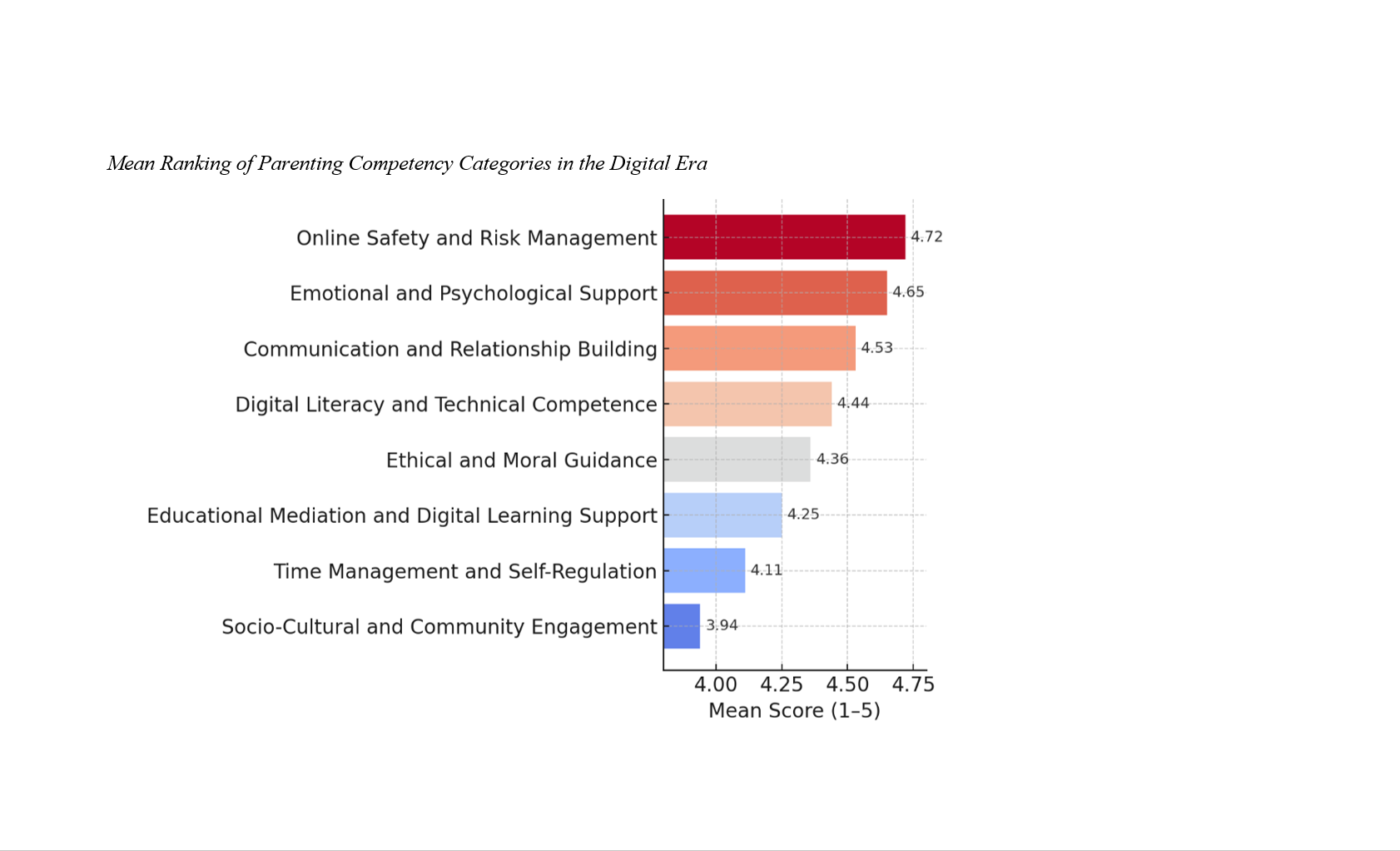
Findings: The results revealed that Online Safety and Risk Management (M = 4.72, SD = 0.38) was the most highly valued competency, followed by Emotional and Psychological Support (M = 4.65, SD = 0.42) and Communication and Relationship Building (M = 4.53, SD = 0.47). These findings emphasize parents’ primary concerns with protecting children from digital risks, supporting emotional resilience, and maintaining healthy communication. Digital Literacy and Technical Competence (M = 4.44) and Ethical and Moral Guidance (M = 4.36) occupied mid-level positions, reflecting their continued relevance. The lowest-ranked but still significant competencies were Educational Mediation (M = 4.25), Time Management (M = 4.11), and Socio-Cultural Engagement (M = 3.94), suggesting varying perceptions of their immediate necessity.
Conclusion: The study concludes that digital-era parenting is multidimensional, encompassing safety, emotional, technical, ethical, and cultural competencies. Strengthening these integrated skills is essential for fostering children’s balanced development and responsible media engagement in contemporary digital environments.
Downloads
References
Aprido, M. R., Muzaki, A., Utomo, W. B., & Abidin, Z. (2025). The Influence of Technology on the Psychology of Child Development in the Perspective of Islamic Education. Journal of Scientific Research Education and Technology (Jsret), 4(2), 1055-1064. https://doi.org/10.58526/jsret.v4i2.776
Arninda, A., Budiarti, L., Archie, A., Darusman, D., Madepo, M. A., & Firmansyah, F. (2024). Pengembangan SDM Berbasis Smart User Dalam Memanfaatkan Media Sosial Dan Penggunaan E-Wallet Di Era Digital. Jurnal Pengabdian Masyarakat Nusantara (Jpmn), 4(1), 41-49. https://doi.org/10.35870/jpmn.v4i1.2876
Asnawan, A., Farid, M., Umam, K., & Shalihah, I. a. (2024). Optimizing Parenting to Grow Early Childhood Character Through Islamic Education in the Digital Era. Jurnal Obsesi Jurnal Pendidikan Anak Usia Dini, 8(6), 2033-2038. https://doi.org/10.31004/obsesi.v8i6.6319
Choi, J. K., & Choi, J.-I. (2024). The Impact of Parents’ Digital Media Literacy and Digital Media Parenting on Young Children’s Overdependence on Smart Devices. Reg Entrep Edu Res Cent, 6(4), 135-157. https://doi.org/10.23108/decrc.2024.6.4.135
Dakhi, J. P., Febrianti, A., & Waruwu, R. (2025). Pemanfaatan Teknologi Digital Upaya Meningkatkan Literasi Digital Dan Motivasi Membaca Siswa Sekolah Dasar. Modem, 3(3), 88-96. https://doi.org/10.62951/modem.v3i3.584
Darwin, C., Widowati, A., & Haryanto, E. (2025). The Influence of Digital Parenting on Alpha Generation Pre-Teenagers Grade 6 in One of the Private Elementary Schools in Jambi City. Journal of Innovation and Research in Primary Education, 4(2), 224-231. https://doi.org/10.56916/jirpe.v4i2.1238
Febriyanti, A., Marsofiyati, M., & Utari, E. D. (2025). Parental Parenting as the Foundation of Children's Character Education in the Social Media Era. Asian Journal of Applied Education (Ajae), 4(3), 301-320. https://doi.org/10.55927/ajae.v4i3.14849
Gatcho, A. R. G., Mao, X. G., & Ting, F. (2024). Early Literacy in the Digital Age. 123-148. https://doi.org/10.4018/979-8-3693-1777-8.ch005
Gritsai, L. A. (2025). Role Media Education in the Formation of Family Educational Values. Sign Problematic Field in Mediaeducation, 55(1), 17-28. https://doi.org/10.47475/2070-0695-2025-55-1-17-28
Hakim, L. N., & Nusantara, H. (2023). Strengthening Digital Literacy in Helping to Learn During a Pandemic. Dedic. J. Community Services, 1(1), 55-68. https://doi.org/10.17509/dedicated.v1i1.59229
Halalae, P. N. (2025). How Do Different Parenting Styles Impact a Teenager's Mental Health in the Digital Age? https://doi.org/10.31234/osf.io/ugt6y_v1
Herak, R. (2025). Character Education in the Digital Age: Challenges and Opportunities Amidst Technological Developments. MSJ, 3(2), 245-252. https://doi.org/10.61942/msj.v3i2.367
Jamwal, R., & Ram, Y. (2025). Frameworks for Assessing Digital Parenting Competence: A Review of Global Standards and Their Applicability in Contemporary Technological Environments. Ijsate, 93-102. https://doi.org/10.63680/nm23vb09zx565n
Kusumalestari, R. R., Oesman, M. A., Ahmadi, D., Umar, M., & Yulianita, N. (2023). Parenting Styles and Digital Literacy: Uncovering Their Correlation Among Adolescents. Jurnal Kajian Komunikasi, 11(2), 144. https://doi.org/10.24198/jkk.v11i2.46658
Laxmi, & Kalpana, C. (2023). Impact of Children Using Technology &Amp; Social Media. Rest Journal on Banking Accounting and Business, 2(2). https://doi.org/10.46632/jbab/2/2/9
Li, Y. (2024). Nurturing Tomorrow's Minds: The Impact of Family Education on Holistic Child Development. Communications in Humanities Research, 32(1), 190-195. https://doi.org/10.54254/2753-7064/32/20240074
Listrianti, F., Paramita, A. S., Dewi, N. A. R., Taqiyah, A., Aisah, S., & Lailiyah, N. (2024). Pelatihan Dan Pendampingan Pemahaman Literasi Digital Bagi Siswa MI Darussalam Sumber Rejo Kecamatan Paiton. Al-Dyas, 3(3), 1124-1136. https://doi.org/10.58578/aldyas.v3i3.3844
Lu, J., & Han, F. (2023). Identifying Home Digital Literacy Practice in Chinese Young Children. 1(1), 33-33. https://doi.org/10.61365/forum.2023.018
Okela, A. H., Olatokun, W. M., Anumudu, C. E., Ziani, A., Nser, K. K., & Lagha, F. B. (2025). Parental Social Media Literacy Antecedents and Children’s Digital Media Addiction: Observations From Two African Countries. Competitiveness Review an International Business Journal Incorporating Journal of Global Competitiveness, 35(4), 685-700. https://doi.org/10.1108/cr-11-2023-0294
P., R. D., & Irwansyah, I. (2024). Empowering Children as Resilient Digital Citizens: Navigating the Challenges of the Digital Media Landscape. International Journal for Multidisciplinary Research, 6(3). https://doi.org/10.36948/ijfmr.2024.v06i03.22310
Sari, N., Nurhayati, N., Purwaningrum, P., Sari, R. Y., Safira, R. S., & Umah, K. (2025). Strategi Pengasuhan Anak Usia Dini Di Era Teknologi Dengan Berbasis Literasi Digital. Jurnal Pengabdian Masyarakat (Abdira), 5(4), 195-202. https://doi.org/10.31004/abdira.v5i4.963
Syukur, Y., Putra, A. H., Ardi, Z., Zahri, T. N., & Putri, J. E. (2024). Global Perspectives on Digital Parenting: Challenges and Opportunities in Improving Family Well-Being. E3s Web of Conferences, 568, 04014. https://doi.org/10.1051/e3sconf/202456804014
Widiastuti, R. Y., & Yuliati, N. (2025). Parental Readiness in Child Rearing in the Digital Era. Jurnal Pendidikan Anak Usia Dini Undiksha, 13(1), 100-111. https://doi.org/10.23887/paud.v13i1.84892
Windasari, I. W., & Dheasari, A. E. (2024). The Role of Parents and Educators in Early Childhood's Digital Literacy. Electronic Journal of Education Social Economics and Technology, 5(2), 112-117. https://doi.org/10.33122/ejeset.v5i2.331
Downloads
Additional Files
Publication Timeline
- Submitted
- Revised
- Accepted