Structural Relationships Between Physical Education Course Happiness, Peer Relationships, and School Satisfaction: A Mediation Model Analysis
DOI:
https://doi.org/10.61838/kman.intjssh.5907Keywords:
Physical education, School satisfaction, Peer relationships, Positive emotions, AdolescentsAbstract
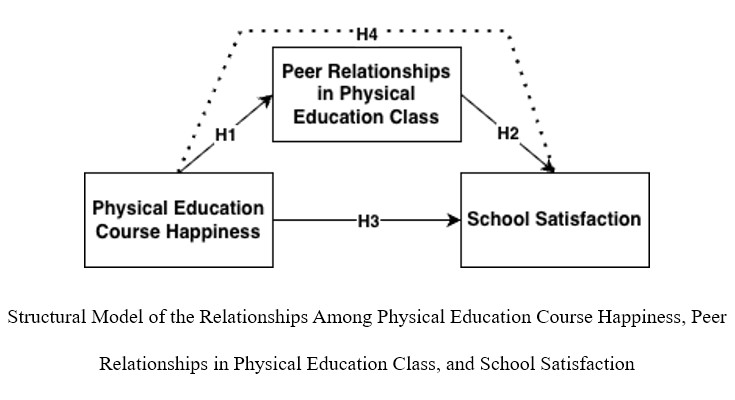
Objective: The emotional and social processes students experience in school life, beyond their academic performance, are fundamental components of their overall well-being. Physical education classes provide a unique learning environment with opportunities for positive emotions, social interaction, and peer relationships, contributing to students’ broader school experiences. However, the social processes underlying the association between happiness experienced in physical education classes and school satisfaction remain insufficiently understood. Therefore, this study examined the relationship between physical education course happiness and school satisfaction among middle school students and investigated whether peer relationships statistically mediated this association.
Methods and Materials: We used a correlational design with 614 volunteer students aged 10–15 years from four middle schools in Malatya, Türkiye. Physical education course happiness was specified as the predictor, school satisfaction as the outcome, and peer relationships as the mediator.
Findings: The findings revealed significant positive direct associations between physical education course happiness and peer relationships (β = .268, p < .001) and between physical education course happiness and school satisfaction (β = .124, p < .001), as well as a significant positive association between peer relationships and school satisfaction (β = .462, p < .001). Furthermore, the indirect association between physical education course happiness and school satisfaction through peer relationships was statistically significant (β = .124, p < .001), while the total association was also positive and significant (β = .248, p < .001). The proposed model explained 25.9% of the variance in school satisfaction.
Conclusion: These findings indicate that greater happiness in physical education is associated with higher school satisfaction both directly and indirectly through more positive peer relationships. Given the cross-sectional correlational design, these pathways should be interpreted as statistical associations rather than evidence of causal relationships.
Downloads
References
1. Adler A. Positive education: educating for academic success and a full life. Pap Psicólogo. 2017;38:50-7. doi: 10.23923/pap.psicol2017.2821.
2. Moral-Garcia JE, Jiménez A, Cabaco AS, Jiménez-Eguizabal A. The role of physical activity and school physical education in enhancing school satisfaction and life satisfaction. Int J Environ Res Public Health. 2021;18(4):1689. doi: 10.3390/ijerph18041689.
3. Bisquerra R, Hernández S. Positive psychology, emotional education and the happy classrooms program. Pap Psicólogo. 2017;38:58-65.
4. Poulou M, Norwich B. Psychological needs, mixed self-perceptions, well-being and emotional and behavioral difficulties: adolescent students' perceptions. Eur J Psychol Educ. 2020;35:775-93. doi: 10.1007/s10212-019-00457-1.
5. Ryff CD. Psychological well-being revisited: advances in the science and practice of eudaimonia. Psychother Psychosom. 2014;83:10-28. doi: 10.1159/000353263.
6. Seligman MEP. Flourish: A visionary new understanding of happiness and well-being. New York: Free Press; 2011.
7. Proctor C, Tsukayama E, Wood AM, Maltby J, Eades JF, Linley PA. Strengths gym: the impact of a character strengths-based intervention on the life satisfaction and well-being of adolescents. J Posit Psychol. 2011;6(5):377-88. doi: 10.1080/17439760.2011.594079.
8. Erol M, Köksal H. The effect of friendship education on primary school students' psychological well-being and peer relationships. Child Ind Res. 2025;18:1029-52. doi: 10.1007/s12187-025-10221-1.
9. Tikkanen L, Anttila H, Ulmanen S, Pyhältö K. Peer relationships and study wellbeing: upper secondary students' experiences. Soc Psychol Educ. 2024;39:3097-117. doi: 10.1007/s11218-024-09942-y.
10. Ulmanen S, Tikkanen L, Pyhältö K. Sense of relatedness and study engagement as mediators between students' peer support and life satisfaction. Eur J Psychol Educ. 2024;39:2603-17. doi: 10.1007/s10212-024-00858-x.
11. Unesco. Why the world needs happy schools: UNESCO; 2025.
12. Podiya JK, Navaneetham J, Bhola P. Influences of school climate on emotional health and academic achievement of school-going adolescents in India: a systematic review. BMC Public Health. 2025;25:54. doi: 10.1186/s12889-024-21268-0.
13. Yazdi H, Abdollahi A, Mohsenpour M. Academic engagement as a mediator between the sense of school belonging and academic achievement. J Genet Psychol. 2025:1-14. doi: 10.1080/00221325.2025.2544580.
14. Gomez-Baya D, Garcia-Moro FJ, Nicoletti JA, Lago-Urbano R. A cross-national analysis of the effects of bullying and school exclusion on subjective happiness in 10-year-old children. Children. 2022;9(2):287. doi: 10.3390/children9020287.
15. McDowell I. Measures of self-perceived well-being. J Psychosom Res. 2010;69:69-79. doi: 10.1016/j.jpsychores.2009.07.002.
16. Raufelder D, Kulakow S. The role of social belonging and exclusion at school and the teacher-student relationship for the development of learned helplessness in adolescents. Br J Educ Psychol. 2022;92(1):59-81. doi: 10.1111/bjep.12438.
17. Sorrenti L, Caparello C, Meduri CF, Filippello P. The mediating role of school refusal in the relationship between students' perceived school atmosphere and underachievement. Eur J Investig Health Psychol Educ. 2025;15(1):1. doi: 10.3390/ejihpe15010001.
18. Daily SM, Smith ML, Lilly CL, Davidov DM, Mann MJ, Kristjansson AL. Using school climate to improve attendance and grades: understanding the importance of school satisfaction among middle and high school students. J Sch Health. 2020;90(9):683-93. doi: 10.1111/josh.12929.
19. Leisterer S, Jekauc D. Students' emotional experience in physical education: a qualitative study for new theoretical insights. Sports (Basel). 2019;7(1):10. doi: 10.3390/sports7010010.
20. Aydın S, Güllü M. İlkokulda beden eğitimi derslerinin branş öğretmeni tarafından yürütülmesinin öğrencilerin psikomotor gelişimlerine ve okula bağlılıklarına etkisi. Sivas Cumhuriyet Üniv Spor Bilim Derg. 2025;6(2):83-92.
21. Baños R, Fuentesal J, Conte L, Ortiz-Camacho MDM, Zamarripa J. Satisfaction, enjoyment and boredom with physical education as mediator between autonomy support and academic performance in physical education. Int J Environ Res Public Health. 2020;17(23):8898. doi: 10.3390/ijerph17238898.
22. Norman G, Akarsu M, Onay G. The relationship between secondary school students' happiness levels in physical education classes and their school satisfaction. J Sports Sci Acad. 2025;1(1):31-7. doi: 10.5281/zenodo.14849930.
23. Fredrickson BL. The broaden-and-build theory of positive emotions. Philos Trans R Soc Lond B Biol Sci. 2004;359(1449):1367-77. doi: 10.1098/rstb.2004.1512.
24. Deci EL, Ryan RM. The "what" and "why" of goal pursuits: human needs and the self-determination of behavior. Psychol Inq. 2000;11(4):227-68. doi: 10.1207/S15327965PLI1104_01.
25. Baena-Extremera A, Granero-Gallegos A. Prediction model of satisfaction with physical education and school. Rev Psicodidact. 2015;20:177-92. doi: 10.1387/RevPsicodidact.11268.
26. Baños R, Baena-Extremera A, Ortiz-Camacho MDM. Prediction of the satisfaction with student life based on teaching competence and satisfaction with the school. Front Psychol. 2019;10:2506. doi: 10.3389/fpsyg.2019.02506.
27. Böke H, Aygun Y, Tufekci S, Yagin FH, Canpolat B, Norman G, et al. Effects of cooperative learning on students' learning outcomes in physical education: a meta-analysis. Front Psychol. 2025;16:1508808. doi: 10.3389/fpsyg.2025.1508808.
28. Yang J, A G, Wang M. Research on the impact of school physical education environment on adolescent peer relationships. Appl Educ Psychol. 2023;4(7):11-9. doi: 10.23977/appep.2023.040702.
29. Flick L, Dawes M, Brian A, Monsma E, De Meester A. Relationships among peer-relatedness, self-confidence, peer victimization, social anxiety and school satisfaction in American high school students. Phys Educ Sport Pedagog. 2024;29(6):573-87. doi: 10.1080/17408989.2022.2135692.
30. Chen W, Huang Z, Peng B, Hu H. Unpacking the relationship between adolescents' perceived school climate and negative emotions: the chain mediating roles of school belonging and social avoidance and distress. BMC Psychol. 2025;13:58. doi: 10.1186/s40359-025-02364-1.
31. Duran NS, Lleras CL. Neighborhood disadvantage, peer acceptance, and sense of belonging among middle school students. Child Ind Res. 2025;18:1905-26. doi: 10.1007/s12187-025-10264-4.
32. Murillo-Moraño J, Calmaestra J, Morente Á, Benítez-Sillero JD. Influence of school bullying on motivation in physical education classes. J Sch Violence. 2025;24(1):64-80. doi: 10.1080/15388220.2024.2393144.
33. Uğraş S, Sağın AE, Yücekaya MA, Temel C, Mergan B, Couto N, et al. Perceived bullying in physical education classes, school burnout, and satisfaction: a contribution to understanding children's school well-being. Healthcare. 2025;13(11):1285. doi: 10.3390/healthcare13111285.
34. Uğraş S, Serbes Ş. Beden eğitimi dersi mutluluk düzeyi ölçeği geçerlik ve güvenilirlik çalışması. J Glob Sport Educ Res. 2019;2(2):1-10.
35. Sağın AE, Yücekaya MA, Uğraş S. Beden eğitimi dersi akran ilişkileri ölçeği: geçerlik ve güvenilirlik çalışması. Adıyaman Üniv Sos Bilim Enst Derg. 2025(49):576-602. doi: 10.14520/adyusbd.1648824.
36. Randolph JJ, Kangas M, Ruokamo H. The preliminary development of the children's overall satisfaction with schooling scale (COSSS). Child Ind Res. 2009;2:79-93. doi: 10.1007/s12187-008-9027-1.
37. Telef B. Turkish adaptation study of overall school satisfaction scale for children. Eğitimde Kuram ve Uygulama. 2014;10(2):478-90.
38. Kim HY. Statistical notes for clinical researchers: assessing normal distribution (2) using skewness and kurtosis. Restor Dent Endod. 2013;38(1):52-4. doi: 10.5395/rde.2013.38.1.52.
39. Mishra P, Pandey CM, Singh U, Gupta A, Sahu C, Keshri A. Descriptive statistics and normality tests for statistical data. Ann Card Anaesth. 2019;22(1):67-72. doi: 10.4103/aca.ACA_157_18.
40. Tabachnick BG, Fidell LS. Using multivariate statistics. Boston: Allyn & Bacon; 2019.
41. Hair JF, Black WC, Babin BJ, Anderson RE. Multivariate data analysis. Upper Saddle River: Pearson Education; 2014.
42. Preacher KJ, Hayes AF. Asymptotic and resampling strategies for assessing and comparing indirect effects in multiple mediator models. Behav Res Methods. 2008;40(3):879-91. doi: 10.3758/BRM.40.3.879.
43. Gempp R, González-Carrasco M. Peer relatedness, school satisfaction, and life satisfaction in early adolescence: a non-recursive model. Front Psychol. 2021;12:641714. doi: 10.3389/fpsyg.2021.641714.
44. Jiang X, Huebner ES, Siddall J. A short-term longitudinal study of differential sources of school-related social support and adolescents' school satisfaction. Soc Indic Res. 2013;114(3):1073-86. doi: 10.1007/s11205-012-0190-x.
45. Allen KA, Kern ML. School belonging in adolescents: theory, research and practice. Singapore: Springer; 2017.
46. Deci EL, Ryan RM. Motivation, personality, and development within embedded social contexts: an overview of self-determination theory. New York: Oxford University Press; 2012. 85-107 p.
47. Wang L, Xiang W, Yang Z, Cheng M, Shi J, Wan Z. The effect of peer relationship on subjective well-being among Chinese middle school students: a chain mediation model. Front Psychol. 2025;16:1495506. doi: 10.3389/fpsyg.2025.1495506.
48. Guinto MLM, Campoamor-Olegario LA. From fitness to flourishing: culturally grounded implementation of the PERMAH model in Philippine physical education. Front Psychol. 2025;16:1648656. doi: 10.3389/fpsyg.2025.1648656.
49. World Health O. WHO Guidelines on Physical Activity and Sedentary Behaviour: World Health Organization; 2020.
Downloads
Publication Timeline
- Submitted
- Revised
- Accepted