Comparative Analysis of Female Swimmers and Female Para Swimmers: A Deep Dive into Physiological and Psychological Profiles
DOI:
https://doi.org/10.61838/kman.intjssh.5601Keywords:
para-swimming , peak expiratory flow, systolic blood pressure , will to win, mental toughnessAbstract
Objective: This study aimed to compare selected physiological and psychological characteristics of Indian female competitive swimmers in able-bodied and para-swimming categories.
Methods and Materials: Fifty-two female competitive swimmers participated in the study, including 26 able-bodied swimmers and 26 para-swimmers. Physiological measures included peak expiratory flow rate, breath-holding capacity, vital capacity, and systolic and diastolic blood pressure. Psychological measures included will to win, mental toughness, aggression, and competitive anxiety. A quantitative cross-sectional design was used. Data were analyzed using descriptive statistics, independent-samples t-tests, and effect-size estimates. Given the number of comparisons, the findings were interpreted as exploratory.
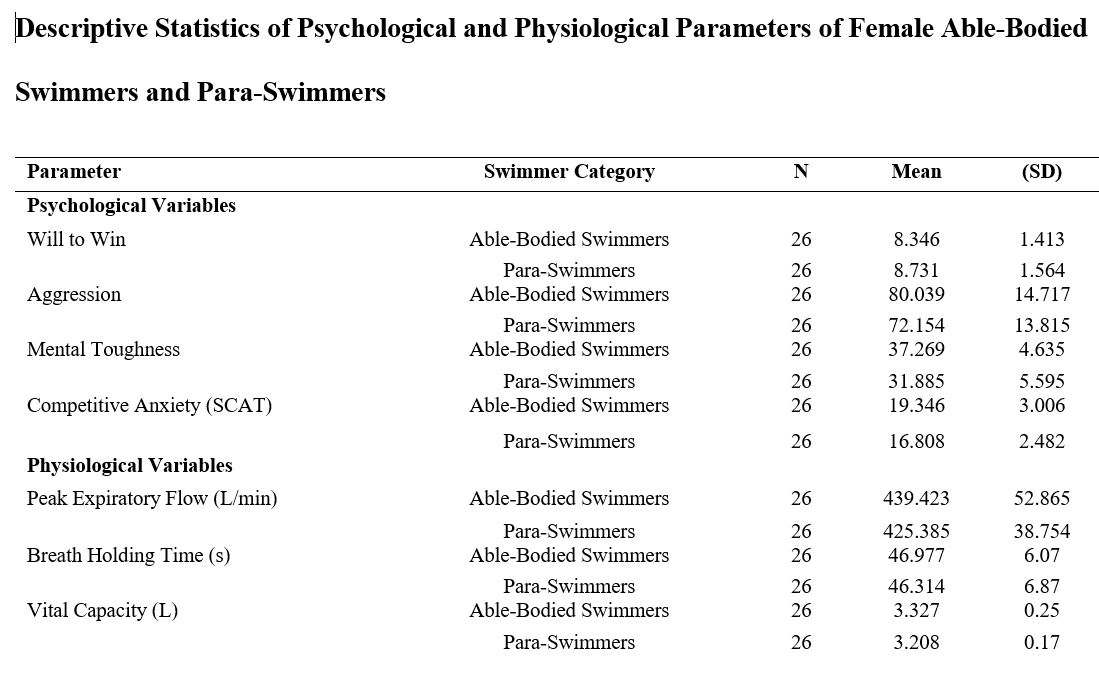
Findings: Para-swimmers demonstrated a slightly higher will-to-win score than able-bodied swimmers (8.731 ± 1.564 vs. 8.346 ± 1.413). In contrast, able-bodied swimmers reported higher aggression (80.039 ± 14.717 vs. 72.154 ± 13.815), mental toughness (37.269 ± 4.635 vs. 31.885 ± 5.595), and competitive anxiety (19.346 ± 3.006 vs. 16.808 ± 2.482). Differences in mental toughness and competitive anxiety were statistically significant (p < 0.01). Able-bodied swimmers also showed higher peak expiratory flow rate (439.423 ± 52.865 vs. 425.385 ± 38.754 L/min), breath-holding capacity (46.977 ± 6.070 vs. 46.314 ± 6.870 s), and vital capacity (3.327 ± 0.250 vs. 3.208 ± 0.170 L), as well as lower systolic blood pressure (125.039 ± 14.081 vs. 130.000 ± 12.202 mm Hg) and diastolic blood pressure (79.077 ± 11.085 vs. 82.846 ± 6.613 mm Hg). Most physiological differences were not statistically significant (p > 0.05), although the difference in vital capacity was borderline significant after adjustment for unequal variances (p = 0.050).
Conclusion: Physiological and respiratory characteristics were generally comparable between female able-bodied swimmers and para-swimmers. However, significant differences were observed in mental toughness and competitive anxiety. These findings indicate that impairment-related and competitive factors may influence specific psychological characteristics and support the development of tailored, impairment-informed coaching and psychological support programs for female para-swimmers.
Downloads
References
1. Payton, C. J., Burkett, B., Van de Vliet, P., Jarvis, H., Daly, D., Mehrkuehler, C., & Hogarth, L. (2018). Performance characteristics of para-swimmers: How effective is the swimming classification system? Physical Medicine and Rehabilitation Clinics of North America, 29(2), 333–346. https://doi.org/10.1016/j.pmr.2018.01.01 1
2. Hołub, M., Stanula, A., Baron, J., Głyk, W., Rosemann, T., & Knechtle, B. (2021). Predicting breaststroke and butterfly stroke results in swimming based on Olympic history. International Journal of Environmental Research and Public Health, 18(12), 6306. https://doi.org/10.3390/ijerph18126621
3. Lazar, J. M., Khanna, N., Chesler, R., & Salciccioli, L. (2013). Swimming and the heart. International Journal of Cardiology, 168(1), 19–26. https://doi.org/10.1016/j.ijcard.2013.03.063
4. Clemente-Suárez, V. J., Fuentes-García, J. P., Fernandes, R. J., & Vilas-Boas, J. P. (2021). Psychological and physiological features associated with swimming performance. International Journal of Environmental Research and Public Health, 18(9), 4561. https://doi.org/10.3390/ijerph18094561
5. Nicholls, A. R., Polman, R., & Levy, A. R. (2010). Coping self-efficacy, pre-competitive anxiety, and subjective performance among athletes. European journal of sport science, 10(2), 97-102. https://doi.org/10.1080/17461390903271592
6. Gonjo, T., & Olstad, B. H. (2020). Race analysis in competitive swimming: A narrative review. International Journal of Environmental Research and Public Health, 18(1), 69. https://doi.org/10.3390/ijerph18010069
7. Hogarth, L., Payton, C., Van de Vliet, P., Connick, M., & Burkett, B. (2018). A novel method to guide classification of para swimmers with limb deficiency. Scandinavian Journal of Medicine & Science in Sports, 28(11), 2397–2406. https://doi.org/10.1111/sms.13229
8. Kumar, A., & Shukla, P. S. (1988). Manual for Indian adaptation of will to win Questionnaire. Kumar Publication. Co, 4, 148.
9. Buss, A. H., & Perry, M. (1992). The aggression questionnaire. Journal of personality and social psychology, 63(3), 452.
10. Sheard, M., Golby, J., & van Wersch, A. (2009). Sports mental toughness questionnaire. European Journal of Psychological Assessment.
11. Martens, R., Vealey, R. S., & Burton, D. (1990). Competitive anxiety in sport. Human Kinetics.
12. Szájer, P., Tóth, L., Szemes, Á., Nagy, N., Zala, B., Köteles, F., & Szabo, A. (2019). A comparative analysis of national Olympic swimming team members' and para-swimming team members' psychological profiles. Cognition, Brain, Behavior, 23(4), 299-311.
13. Parakhonko, V., & Khimich, I. (2024). Factors affecting the psychological training of young swimmers. Науковий часопис Українського державного університету імені Михайла Драгоманова. Серія 15, 4(177), 200-203. https://doi.org/10.31392/UDU-nc.series15.2024.4(177).40
14. Rodríguez-Zamora, L., Iglesias, X., Barrero, A., Chaverri, D., Erola, P., & Rodríguez, F. A. (2012). Physiological responses in relation to performance during competition in elite synchronized swimmers. PLOS ONE, 7(11), e49098. https://doi.org/10.1371/journal.pone.0049098
15. Yadolahzadeh, A. (2020). The role of mental imagery and stress management training in the performance of female swimmers. Atena Journal of Sports Sciences, 3, 1-1.
16. Rezavandzayeri, F., Carral, J. M. C., Suárez, H. V., & Khortabi, A. (2024). The effects of para-swimming training volume and music on emotional intelligence and quality of life: Physical disabilities, adults, aquatic exercise, interventions. Journal of Sport and Health Research, 16(3), 427–438.
17. Iftikhar Ahmad Wani, Sneha Choudhary, Ab Majid Awan, Mehraj Ud Din Ganaie, Budru Nissa, Mohammad Muzamil Shah, Shaista Shafi, Jigmat Dachen (2025). Development and Validation of the Healthy Lifestyle Scale (HLS) for Regions with Icy Winters and Dry Summers. Universal Journal of Public Health, 13(3), 726 - 745. DOI: 10.13189/ujph.2025.130321.
18. Faridi, M., Hussein, M. N. A., & Wani, I. A. (2022). Relaxation and Psyching-Up in Sport: Anxiety Management Using Psychological Techniques. Journal of Positive School Psychology, 6(2), 2642-2647.
19. Faridi, M., Hussein, M. N. A., & Wani, I. A. (2022). Rehabilitation of self-confidence through meditation, relaxing exercises, and personal counseling. International journal of health sciences, (I), 962-968.
20. Bratta, C. (2022). Exploring sex differences in diving performance analysis (Doctoral dissertation, Università degli Studi di Cassino e del Lazio Meridionale). Università degli Studi di Cassino e del Lazio Meridionale. https://hdl.handle.net/20.500.14242/190721
21. Costa, M. J., Balasekaran, G., Vilas-Boas, J. P., & Barbosa, T. M. (2015). Physiological adaptations to training in competitive swimming: A systematic review. Journal of Human Kinetics, 49, 179–189. https://doi.org/10.1515/hukin-2015-0120
22. Hagan, J. E., Jr., Pollmann, D., & Schack, T. (2017). Elite athletes’ in-event competitive anxiety responses and psychological skills usage under differing conditions. Frontiers in Psychology, 8, 2280. https://doi.org/10.3389/fpsyg.2017.02280
23. Kizhakkevalappil, S. P., Alexander, R., & Nhattuvalappil, A. C. (2021). Comparison of body composition parameters between swimmers and non-swimmers: A cross-sectional study. Journal of Clinical & Diagnostic Research, 15(9). https://doi.org/10.7860/JCDR/2021/50793.15354
24. Wani IA, Dachen J, Singh S, Shukla TD, Sharma M, Pal A. Assessment of healthy lifestyle and physical movement levels among female university students: a cross-sectional study. Hum Mov. 2025;26(3):89–100; doi: https://doi.org/10.5114/ hm/203541.
Downloads
Publication Timeline
- Submitted
- Revised
- Accepted