Gentle Gymnastics and Perceived Psychophysical Well-Being in Adults and Older Adults: An Exploratory Observational Study
DOI:
https://doi.org/10.61838/kman.intjssh.5523Keywords:
Gentle gymnastics, Psychophysical well-being, Perceived benefits, Active aging, Adapted physical activityAbstract
Objective: This study aimed to explore the associations between age, duration, and frequency of participation in gentle gymnastics and the perceived psychophysical benefits in an adult and older population.
Methods and Materials: A cross-sectional observational study was conducted on a sample of adults and older adults aged 40 years and older engaged in gentle gymnastics. Data were collected using an ad hoc, non-validated self-report questionnaire assessing demographic characteristics, exercise practice patterns, and perceived physical and psychological benefits.
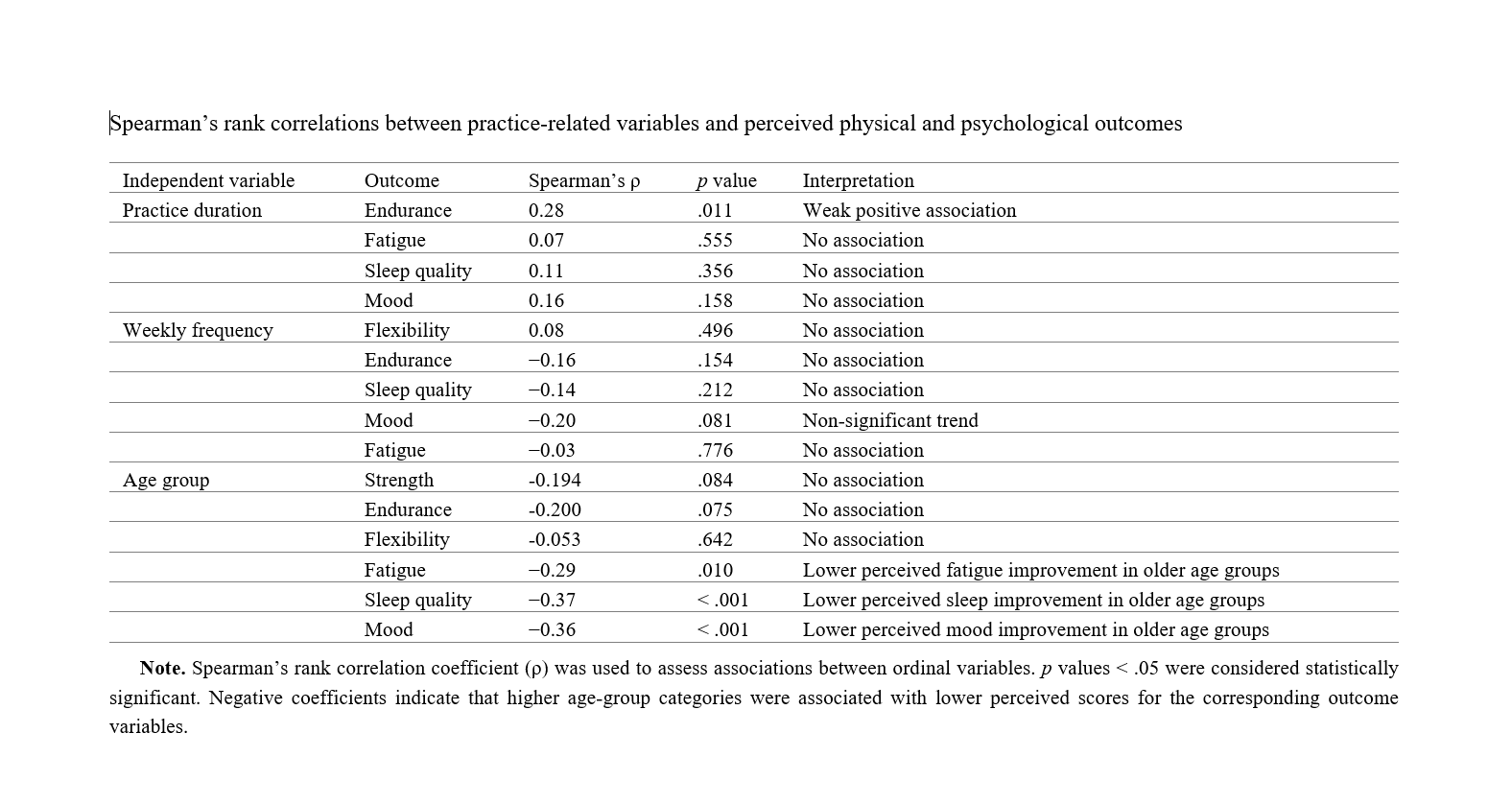
Findings: Eighty participants were included in the study. Overall, participants reported high levels of perceived psychological well-being, with 93.7% reporting improved mood after sessions and 92.5% reporting high overall satisfaction. Seventy-five percent of participants reported perceived improvements in sleep quality, while 90.1% reported a positive influence of physical activity on stress levels. Age was significantly and negatively associated with perceived improvements in sleep quality (ρ = −0.37; p < .001), mood (ρ = −0.36; p < .001), and fatigue reduction (ρ = −0.29; p = .010). No significant associations were found between age or weekly frequency of practice and most perceived physical capacities. However, practice duration showed a weak positive association with perceived physical endurance (ρ = 0.28; p = .011). A significant association was observed between initial motivation and the type of activity practiced (χ² (1) = 13.47; p < .001; φ = 0.41).
Conclusion: Gentle gymnastics was perceived by participants as mainly associated with psychological and general well-being benefits rather than marked improvements in perceived physical capacities. These findings highlight the importance of individualized and adapted physical activity programs in promoting psychophysical well-being and quality of life among adult and older populations.
Downloads
References
1. Cesari M LFVBBRME. Sarcopenia and physical frailty: two sides of the same coin. Front Aging Neurosci. 2014;6:192. [DOI]
2. Sherrington C FNKWWGTAMZANCBA. Evidence on physical activity and falls prevention for people aged 65+ years: systematic review to inform the WHO guidelines on physical activity and sedentary behaviour. Int J Behav Nutr Phys Act. 2020;17(1):144. [DOI]
3. Silveira Ea MCRDFMESGVPdSRLdOCNM. Sedentary behavior, physical inactivity, abdominal obesity and obesity in adults and older adults: A systematic review and meta-analysis. Clin Nutr ESPEN. 2022;50:63-73. [DOI]
4. Bull Fc A-ASSBSBKBMPCGCCCJPCSCRD. World Health Organization 2020 guidelines on physical activity and sedentary behaviour. Br J Sports Med. 2020;54(24):1451-62. [DOI]
5. Henson J DCMYT. Sedentary behaviour and disease risk. BMC Public Health. 2023;23(1):2048. [DOI]
6. Goodpaster Bh PSWHTBKSBNMSAVSEMTFAVM. The loss of skeletal muscle strength, mass, and quality in older adults: the health, aging and body composition study. J Gerontol A Biol Sci Med Sci. 2006;61(10):1059-64. [DOI]
7. Siparsky Pn KDTGWE, Jr. Muscle changes in aging: understanding sarcopenia. Sports Health. 2014;6(1):36-40. [DOI]
8. Siltanen S PEPKHMRTKLSMJRT. Effects of an Individualized Active Aging Counseling Intervention on Mobility and Physical Activity: Secondary Analyses of a Randomized Controlled Trial. J Aging Health. 2020;32(10):1316-24. [DOI]
9. Galle Sa DJBMMVDGMHGSEJAvDCMDML. The effects of a moderate physical activity intervention on physical fitness and cognition in healthy elderly with low levels of physical activity: a randomized controlled trial. Alzheimers Res Ther. 2023;15(1):12. [DOI]
10. Raiola G EGASDEFDIT. Physical Exercise and Psychophysical Learnings on Basic Strength Development. Methods Protoc. 2025;8(2):40. [DOI]
11. American College of Sports Medicine C-ZWJPDNFSMAMCTNCRSGJ. American College of Sports Medicine position stand. Exercise and physical activity for older adults. Med Sci Sports Exerc. 2009;41(7):1510-30. [DOI]
12. D'Aurizio G FFDPITDCG. Effects of Physical Activity on Cognitive Functioning: The Role of Cognitive Reserve and Active Aging. Brain Sci. 2023;13(11):1581. [DOI]
13. D'Elia F AGEGASRG. Perceptions and benefits of static and dynamic stretching in dancers: qualitative and quantitative aspects. J Phys Educ. 2022;33(1):e3339. [DOI]
14. McPhee Js FDPJDNJPNDH. Physical activity in older age: perspectives for healthy ageing and frailty. Biogerontology. 2016;17(3):567-80. [DOI]
15. Serra Mc DKRLDBAAO. Healthy Lifestyle and Cognition: Interaction between Diet and Physical Activity. Curr Nutr Rep. 2020;9(2):64-74. [DOI]
16. Esposito G CRIPLMVRG. Effects of stretching and resistance training on psychophysical awareness: a pilot study. Appl Sci. 2025;15(15):8259. [DOI]
17. Netz Y WMJBBJTG. Physical activity and psychological well-being in advanced age: a meta-analysis of intervention studies. Psychol Aging. 2005;20(2):272-84. [DOI]
18. Howe Te RLNFSDABC. Exercise for improving balance in older people. Cochrane Database Syst Rev. 2011;2011(11):CD004963. [DOI]
19. Sherrington C FNJWGKTAMZAHKCLHSLSE. Exercise for preventing falls in older people living in the community. Cochrane Database Syst Rev. 2019;1(1):CD012424. [DOI]
20. Szychowska A DW. Physical activity as a determinant of successful aging: a narrative review article. Aging Clin Exp Res. 2022;34(6):1209-14. [DOI]
21. American College of Sports M. ACSM's guidelines for exercise testing and prescription. Philadelphia: Wolters Kluwer; 2022.
22. Bauman A MDBFCBDMFSMA. Updating the evidence for physical activity: Summative reviews of the epidemiological evidence, prevalence, and interventions to promote 'active ageing'. Gerontologist. 2016;56(Suppl 2):S268-S80. [DOI]
23. Collado-Mateo D L-PAMPCDCJL-RML-CAGPF-D-OMA-AD. Key Factors Associated with Adherence to Physical Exercise in Patients with Chronic Diseases and Older Adults: An Umbrella Review. Int J Environ Res Public Health. 2021;18(4):2023. [DOI]
24. Nelson Me RWJBSNDPWJJOKACMCAC-SC. Physical activity and public health in older adults: recommendation from the American College of Sports Medicine and the American Heart Association. Med Sci Sports Exerc. 2007;39(8):1435-45. [DOI]
25. Altavilla G ASDEFRG. Assessment of motor performance and self-perceived psychophysical well-being in relation to body mass index in Italian adolescents. Children. 2024;11(9):1119. [DOI]
26. Beauchamp Mr RGRDWLEPAHSMWSALYSTPESA. Group-based physical activity for older adults (GOAL) randomized controlled trial: Exercise adherence outcomes. Health Psychol. 2018;37(5):451-61. [DOI]
27. Fox Kr SAMJDMG. Physical activity and mental well-being in older people participating in the Better Ageing Project. Eur J Appl Physiol. 2007;100(5):591-602. [DOI]
28. McAuley E MKSMRWHLKJFES. Long-term follow-up of physical activity behavior in older adults. Health Psychol. 2007;26(3):375-80. [DOI]
29. Garber Ce BBDMRFBALMJLIMNDCSDPACo. American College of Sports Medicine position stand. Quantity and quality of exercise for developing and maintaining cardiorespiratory, musculoskeletal, and neuromotor fitness in apparently healthy adults: guidance for prescribing exercise. Med Sci Sports Exerc. 2011;43(7):1334-59. [DOI]
30. Taylor D. Physical activity is medicine for older adults. Postgrad Med J. 2014;90(1059):26-32. [DOI]
31. Giardullo G CRPGAS. Exercise in the workplace: a qualitative-quantitative study of enjoyment. Sport Mont. 2024;22(3):93-8. [DOI]
32. Peluso Ma GdALH. Physical activity and mental health: the association between exercise and mood. Clinics (Sao Paulo). 2005;60(1):61-70. [DOI]
33. Bherer L EKIL-AT. A review of the effects of physical activity and exercise on cognitive and brain functions in older adults. J Aging Res. 2013;2013:657508. [DOI]
34. Reid Kj BKGLBNEWLZPC. Aerobic exercise improves self-reported sleep and quality of life in older adults with insomnia. Sleep Med. 2010;11(10):934-40. [DOI]
35. Garatachea N MOM-GRJ-JRG-GJMS. Feelings of well being in elderly people: relationship to physical activity and physical function. Arch Gerontol Geriatr. 2009;48(3):306-12. [DOI]
36. Lesinski M HTMTGAGU. Effects of Balance Training on Balance Performance in Healthy Older Adults: A Systematic Review and Meta-analysis. Sports Med. 2015;45(12):1721-38. [DOI]
37. Aliberti S CAEGAGRG. Three workouts compared: interval training, intermittent training and steady state training for the improvement of VO₂max and BMI. Sport i Nauka i Zdravlje. 2021;11(2):197-204. [DOI]
38. American College of Sports M. ACSM's guidelines for exercise testing and prescription. Philadelphia: Wolters Kluwer; 2019.
39. Fragala Ms CELDSIMKWJPMDRED. Resistance Training for Older Adults: Position Statement From the National Strength and Conditioning Association. J Strength Cond Res. 2019;33(8):2019-52. [DOI]
40. Bean Jf KDKLSGRFWRLSG. Are changes in leg power responsible for clinically meaningful improvements in mobility in older adults? J Am Geriatr Soc. 2010;58(12):2363-8. [DOI]
41. Bauman Ae RRSSJFWJCLRJFMBWLPASWG. Correlates of physical activity: why are some people physically active and others not? Lancet. 2012;380(9838):258-71. [DOI]
42. Paterson Dh WDE. Physical activity and functional limitations in older adults: a systematic review related to Canada's Physical Activity Guidelines. Int J Behav Nutr Phys Act. 2010;7:38. [DOI]
43. World Health O. World report on ageing and health: World Health Organization; 2015.
44. Raiola G DITDDFDEF. Effect of Teaching Methods on Motor Efficiency, Perceptions and Awareness in Children. Int J Environ Res Public Health. 2022;19(16):10287. [DOI]
Downloads
Publication Timeline
- Submitted
- Revised
- Accepted