Increasing Exercise Awareness in Individuals with Intellectual Disabilities Among Sports Science Students: An Educational Application
DOI:
https://doi.org/10.61838/kman.intjssh.4843Keywords:
Intellectual Disability, Exercise, UniversityAbstract
Objective: The primary aim of this research is to examine the awareness levels of students studying at the Faculty of Sports Sciences regarding the importance of exercise for individuals with intellectual disabilities and to contribute to developing this awareness. Considering the physical, psychological, and social benefits of exercise programmes for individuals with intellectual disabilities, increasing this awareness is crucial both for developing students' professional knowledge and skills and for contributing to the quality of life of individuals with intellectual disabilities.
Methods: The ‘Attitude Scale Towards Sports Activities of Individuals with Intellectual Disabilities’ developed by İlhan and Esentürk (2015) was administered to 68 participants studying at the Faculty of Sports Sciences in order to collect pre-test data. In the next stage, participants underwent a 120-minute training programme covering the definitions of mental disability, the characteristics of individuals with mental disabilities, and the benefits of exercise. Participants who completed the training were paired one-on-one with individuals with intellectual disabilities and underwent a 240-minute exercise programme, which was carried out over 2 days, 120 minutes per day. After the exercise programme was completed, the same attitude scale was re-administered to the participants to collect final test data. The data obtained were transferred to IBM SPSS 26 software for analysis. When evaluating the study data, the Shapiro-Wilk and Kolmogorov-Smirnov tests were used to check the normality of the numerical measurements, and the dependent samples t-test was used to examine changes over time.
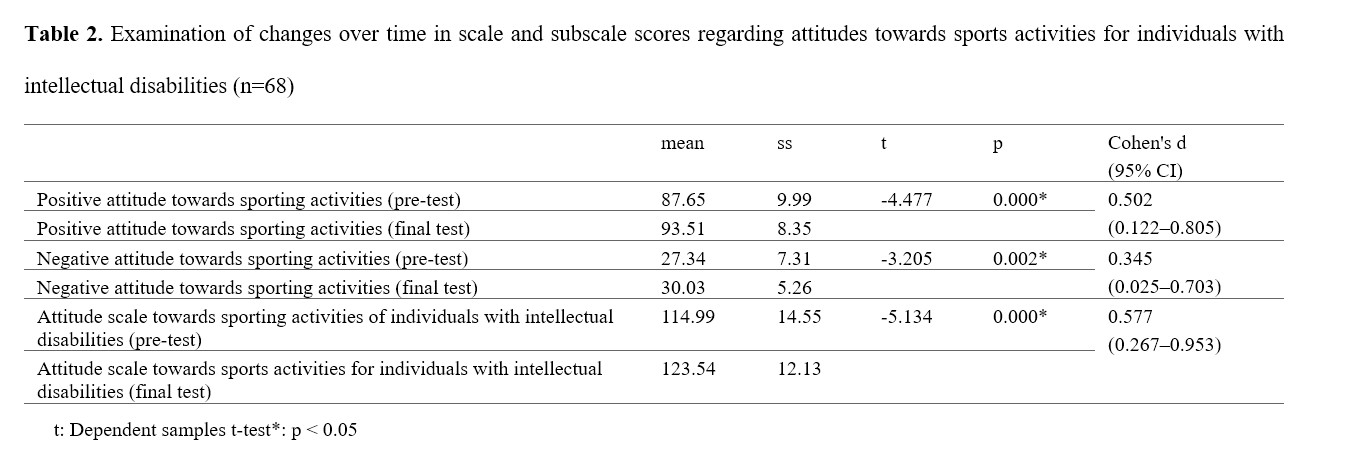
Findings: The results of the study revealed a statistically significant increase in the participants' pre-test and post-test mean scores on the attitude scale and sub-dimension scores regarding the sporting activities of individuals with intellectual disabilities over time.
Conclusion: The research is significant in terms of contributing to the development of positive attitudes towards individuals with intellectual disabilities by future sports educators and the training of more conscious and equipped sports scientists in this field.
Downloads
References
1. World Health O. World report on disability2011.
2. Şenlik MK, Atılgan E. The effect of a regular exercise programme on motor skills in adolescents with mild intellectual disabilities. Journal of Exercise Therapy and Rehabilitation. 2020;6(3):140-8.
3. Hekim M, Tokgöz M. Motor development deficiencies in children with intellectual disabilities: The importance of physical activity and sport in supporting motor development. Mehmet Akif Ersoy University Journal of Social Sciences Institute. 2016;8(17):489-501.
4. Bishop SR, Lau M, Shapiro S, Carlson L, Anderson ND, Carmody J, et al. Mindfulness: A proposed operational definition. Clinical Psychology: Science and Practice. 2004;11(3):230-41. [DOI]
5. Baykan Z, Naçar M, Şenol V, Çetinkaya F. Awareness of disability among academic staff at Erciyes University. Mersin University Journal of Health Sciences. 2018;11(1):1-11. [DOI]
6. İlhan L. The effect of physical education and sport on the socialisation levels of educable children with intellectual disabilities. Kastamonu Education Journal. 2008;16(1):315-24.
7. Sağlam M, Altındağ Ö. University students' awareness of disabled individuals. Beyond the Horizon Science Journal. 2017;17(1):15-29.
8. İlhan EL, Esentürk OK. Development of an awareness scale regarding the effects of sport on individuals with intellectual disabilities (ZEBSEYFÖ). CBÜ Journal of Physical Education and Sports Sciences. 2014;9(1):19-36.
9. İlhan EL, Esentürk OK. Attitude scale towards sporting activities of individuals with intellectual disabilities: Validity and reliability study. CBÜ Journal of Physical Education and Sports Sciences. 2015;10(1):1-15.
10. Howitt D, Cramer D. Introduction to SPSS statistics in psychology: For version 19 and earlier: London: Pearson Education Limited; 2011.
11. Lind DA, Marchal WG, Wathen SA. Basic statistics for business and economics: United States: McGraw-Hill Companies; 2006.
12. McKillup S. Statistics explained: An introductory guide for life scientists: United States: Cambridge University Press; 2012. [DOI]
13. Tabachnick BG, Fidell LS. Using multivariate statistics: United States: Pearson Education; 2013.
14. Wilcox RR. Modern statistics for the social and behavioral sciences: A practical introduction: United States: Chapman & Hall/CRC Press; 2012.
15. Nunnally JC. Psychometric Theory: New York: McGraw-Hill; 1978.
16. Allport GW. The nature of prejudice: Addison-Wesley; 1954.
17. Block ME, Obrusnikova I. Inclusion in physical education: A review of the literature from 1995-2005. Adapted Physical Activity Quarterly. 2007;24(2):103-24. [PMID: 17916912] [DOI]
18. Paluck EL, Green DP. Prejudice reduction: What works? A review and assessment of research and practice. Annual Review of Psychology. 2009;60(1):339-67. [PMID: 18851685] [DOI]