The Impact of Aerobic Exercise Intensity on the Expression of Pro-inflammatory Genes IL-1β, TNF-α, and IL-8 in the Intestinal Lymphocytes of Aged Mice
DOI:
https://doi.org/10.61838/kman.intjssh.4441Keywords:
Aerobic Exercise, Intestinal Inflammation, Aging, Pro-inflammatory Cytokines, Gut MicrobiomeAbstract
Objectives:: Aging is associated with chronic intestinal inflammation, which elevates the risk of diseases like colorectal cancer. Intestinal lymphocytes, which produce pro-inflammatory cytokines such as IL-1β, TNF-α, and IL-8, play a key role in this process. Despite the anti-inflammatory potential of aerobic exercise, the effects of different exercise intensities on gut immunity in aging are not well understood. This study investigated the effects of high-intensity (85–100% VO2max) and moderate-intensity (70–75% VO2max) aerobic exercise on the expression of pro-inflammatory genes IL-1β, TNF-α, and IL-8 in the intestinal lymphocytes of aged rats.
Methods & Materials: This was a randomized, controlled experimental study. Thirty-two male Wistar rats (18 months old) were divided into four groups: healthy control, untrained control (with DSS-induced intestinal inflammation), high-intensity exercise, and moderate-intensity exercise. Intestinal inflammation was induced using a 2–3% dextran sulfate sodium (DSS) solution. The exercise protocol was an 8-week program (5 sessions/week) of treadmill running. Gene expression was measured using Real-Time PCR, and protein levels were quantified via ELISA. Data were analyzed using ANOVA and independent t-tests, with a significance level of p≤0.05.
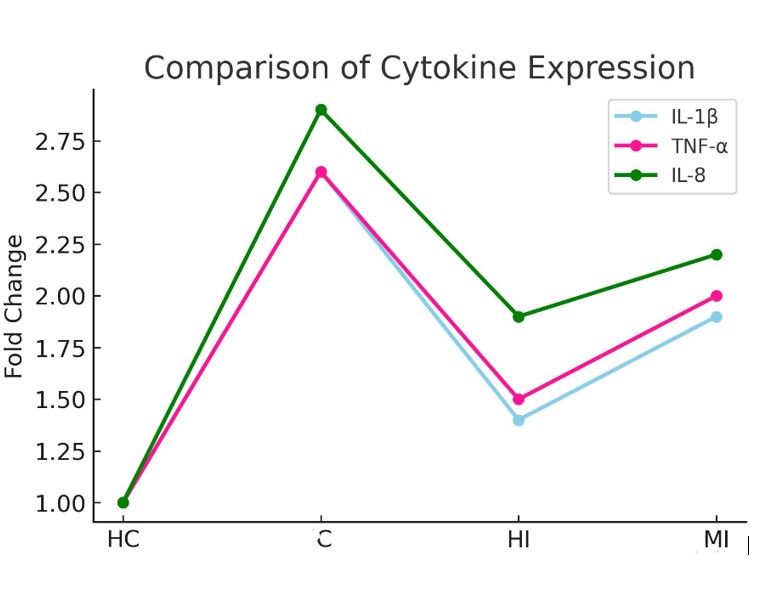
Results: Gene expression of IL-1β and TNF-α increased by 2.6 times and IL-8 by 2.9 times in the untrained control group (p<0.001). High-intensity exercise reduced the expression of IL-1β and TNF-α by 50% and IL-8 by 40%, whereas moderate intensity showed reductions of 35% and 30%, respectively (p<0.001). High intensity was more effective in reducing IL-1β and TNF-α (p=0.01).
Conclusion: Aerobic exercise, especially at high intensity, reduces intestinal inflammation in aged mice. It can serve as a non-pharmacological strategy for preventing age-related diseases.
Downloads
References
1. Duggal NA, Niemiro G, Harridge SD, Simpson RJ, Lord JM. Can physical activity ameliorate immunosenescence and thereby reduce age-related multi-morbidity? Nature Reviews Immunology. 2019;19(9):563-72. [PMID: 31175337] [DOI]
2. Florescu DN, Boldeanu MV, Șerban RE, Florescu LM, Serbanescu MS, Ionescu M, et al. Correlation of the pro-inflammatory cytokines IL-1β, IL-6, and TNF-α, inflammatory markers, and tumor markers with the diagnosis and prognosis of colorectal cancer. Life. 2023;13(12):2261. [PMID: 38137862] [PMCID: PMC10744550] [DOI]
3. Al Bander Z, Nitert MD, Mousa A, Naderpoor N. The gut microbiota and inflammation: An overview. International Journal of Environmental Research and Public Health. 2020;17(20):7618. [PMID: 33086688] [PMCID: PMC7589951] [DOI]
4. Roberts C, Sanders A, Thompson M. Impact of exercise on inflammatory markers and gut microbiota in elderly populations: A review. Ageing Research Reviews. 2023;75:101594. [DOI]
5. Mou Y, Du Y, Zhou L, Yue J, Hu X, Liu Y, et al. Gut microbiota interact with the brain through systemic chronic inflammation: Implications on neuroinflammation, neurodegeneration, and aging. Frontiers in Immunology. 2022;13:796288. [PMID: 35464431] [PMCID: PMC9021448] [DOI]
6. Rashe M, Ahmadi K. The effect of high-intensity interval training and probiotic consumption on the expression of interleukin-10 and interferon-gamma genes in the intestinal tissue of an animal model of fatty liver. Journal of Physiology and Sport. 2021;11(1):25-37. [DOI]
7. Khakro Abkenar A, Rahmaninia F, Lombardi J. The effect of different intensities of acute and chronic aerobic activity on the inflammasome signaling pathway NLRP3, TLR4, and inflammatory cytokine levels in young men. Applied Studies of Biological Sciences in Sport. 2020;8(16):116-30.
8. Lesniewski LA, Durrant JR, Connell ML, Henson GD, Black AD, Donato AJ, et al. Aerobic exercise reverses arterial inflammation with aging in mice. American Journal of Physiology - Heart and Circulatory Physiology. 2011;301(3):H1025-H32. [PMID: 21441310] [PMCID: PMC3119087] [DOI]
9. Hadiono M, Kushartanti BW. High intensity interval training (HIIT) and moderate intensity training (MIT) against TNF-α and IL-6 levels in rats. In 2nd International Conference on Sports Sciences and Health 2018. 2019:87-90. [DOI]
10. Shobeiri P, Seyedmirzaei H, Karimi N, Rashidi F, Teixeira AL, Brand S, et al. IL-6 and TNF-α responses to acute and regular exercise in adult individuals with multiple sclerosis (MS): A systematic review and meta-analysis. European Journal of Medical Research. 2022;27(1):185. [PMID: 36156182] [PMCID: PMC9511785] [DOI]
11. Woods JA, Wilund KR, Martin SA, Kistler BM. Exercise, inflammation and aging. Aging and Disease. 2012;3(1):130-40.
12. Strasser B, Wolters M, Weyh C, Krüger K, Ticinesi A. The effects of lifestyle and diet on gut microbiota composition, inflammation and muscle performance in our aging society. Nutrients. 2021;13(6):2045. [PMID: 34203776] [PMCID: PMC8232643] [DOI]
13. Aya V, Flórez A, Perez L, Ramírez JD. Association between physical activity and changes in intestinal microbiota composition: A systematic review. PLOS ONE. 2021;16(3):e0247039. [PMID: 33630874] [PMCID: PMC7906424] [DOI]
14. Scheiman J, Luber JM, Chavkin TA, MacDonald T, Tung A, Pham LD, et al. Meta-omics analysis of elite athletes identifies a performance-enhancing microbe that functions via lactate metabolism. Nature Medicine. 2019;25(7):1104-9. [PMID: 31235964] [PMCID: PMC7368972] [DOI]
15. Hohman LS, Osborne LC. A gut-centric view of aging: Do intestinal epithelial cells contribute to age-associated microbiota changes, inflammaging, and immunosenescence? Aging Cell. 2022;21(1):e13519. [PMID: 34825761] [PMCID: PMC8672793] [DOI]
16. Kern T, Blond MB, Hansen TH, Rosenkilde M, Quist JS, Gram AS. Structured exercise alters the gut microbiota in humans with overweight and obesity - A randomized controlled trial. International Journal of Obesity. 2020;44(1):125-35. [DOI]
17. Bressa C, Bailén-Andrino M, Pérez-Santiago JD, González-Soltero R, Pérez M, Larrosa M. Differences in gut microbiota profile between women with active lifestyle and sedentary women. PLOS ONE. 2017;12(2):e0171352. [PMID: 28187199] [PMCID: PMC5302835] [DOI]
18. Hampton-Marcell JT, Eshoo TW, Cook MD, Gilbert JA, Horswill CA, Poretsky RS. Comparative analysis of gut microbiota following changes in training volume among swimmers. International Journal of Sports Medicine. 2020;41(5):292-9. [PMID: 31975357] [DOI]
19. Muralidharan J, Moreno-Indias I, Bulló M, Lopez JV, Corella D, Castañer O, et al. Effect on gut microbiota of a 1-y lifestyle intervention with Mediterranean diet compared with energy-reduced Mediterranean diet and physical activity promotion: PREDIMED-Plus Study. The American Journal of Clinical Nutrition. 2021;114(2):524-35. [PMID: 34020445] [PMCID: PMC8408861] [DOI]
20. Wilmanski T, Diener C, Rappaport N, Patwardhan S, Wiedrick J, Lapidus J, et al. Gut microbiome pattern reflects healthy ageing and predicts survival in humans. Nature Metabolism. 2021;3(2):275-86. [PMID: 33619379] [PMCID: PMC8169080] [DOI]
Downloads
Publication Timeline
- Submitted
- Revised
- Accepted
Issue
Section
License
Copyright (c) 2025 Arezoo Kalantari (Author); Saeed Keshavarz (Corresponding Author); Allahyar Arabmomeni, Leila Sarrami (Author)

This work is licensed under a Creative Commons Attribution-NonCommercial 4.0 International License.