Moderate and Vigorous Physical Activity as a Protective Factor against Anxiety in University Students
DOI:
https://doi.org/10.61838/kman.intjssh.4422Keywords:
physical activity, generalized anxiety, Mexican students, moderation analysis, COVID-19Abstract
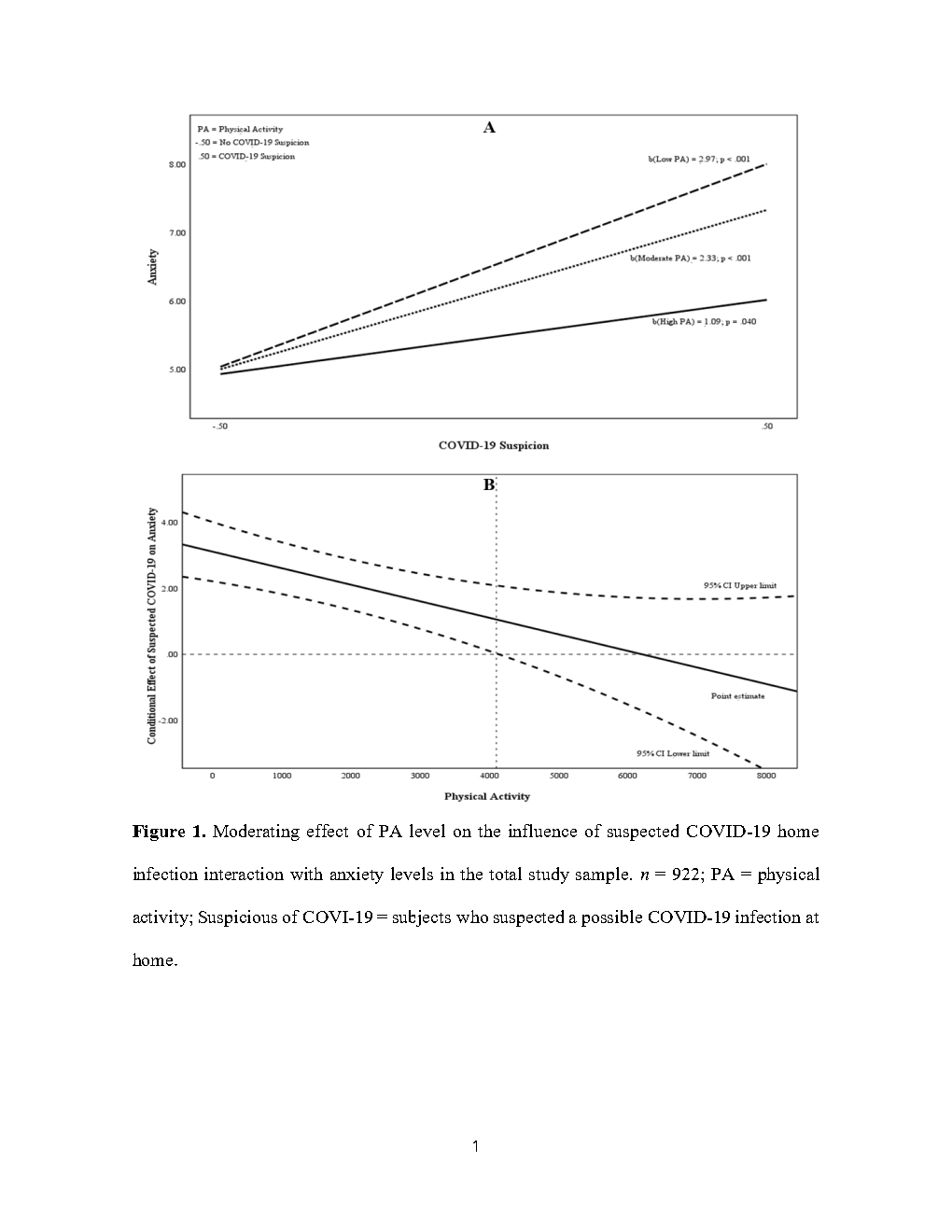
Objective: The COVID-19 pandemic has been one of the most significant adverse events contributing to increased anxiety worldwide. In response to the growing deterioration in mental health during and after the pandemic, health organizations and the scientific community have sought effective strategies to promote well-being, especially in preparation for future global crises. Moderate and vigorous physical activity (MVPA) has been identified as a potential protective factor that enhances resilience in the face of adversity. This study aimed to analyze the moderating effect of MVPA levels on the relationship between suspected COVID-19 infection and anxiety levels in university students.
Methods and Materials: A cross-sectional, correlational-explanatory study was conducted with a sample of 922 Mexican university students (36.66% men, 63.34% women; M age = 19.97, SD = 2.92). Anxiety was measured using the Generalized Anxiety Disorder Scale (GAD-7), and MVPA levels were assessed through the short form of the International Physical Activity Questionnaire (IPAQ-s). A dichotomous-response questionnaire was used to evaluate concern about COVID-19. ANOVA and simple moderation analyses were performed.
Findings: Results indicated a significant and negative moderating effect of MVPA on the relationship between suspected COVID-19 infection and anxiety levels. Additionally, significant sex differences were found in both MVPA levels and generalized anxiety.
Conclusion: In this sample, higher levels of MVPA were associated with lower anxiety, suggesting its potential as a protective factor in adverse contexts like a pandemic.
Downloads
References
1. Omarov B, Aliyev K, Tursynbayev A, Abdykerimova E, Sultan D, Kozhamkulova Z. Exploring the role of regular physical activity in the prevention of brain strokes. Retos. 2025;66:961-75.
2. Rassolnia A, Nobari H. The Impact of Socio-Economic Status and Physical Activity on Psychological Well-being and Sleep Quality Among College Students During the COVID-19 Pandemic. International Journal of Sport Studies for Health. 2024;7:1-12.
3. Ubago-Jiménez JL, Zurita-Ortega F, Chacón-Zagalaz J, Melguizo-Ibáñez E. Análisis del rendimiento académico según los niveles de actividad física y satisfacción vital. Una revisión sistemática. Sportis Scientific Journal of School Sport, Physical Education and Psychomotricity. 2023;9:610-36.
4. Fu HY, Wang J, Hu JX. Influence of physical education on anxiety, depression, and self-esteem among college students. World Journal of Psychiatry. 2023;13:1121-32.
5. Mahecha MS. Actividad física y ejercicio en salud y enfermedad: Editorial Mediterraneo; 2020.
6. Health USDo, Human S. Physical activity guidelines advisory committee scientific report2018.
7. Roth SM. Genetics primer for exercise science and health: Human Kinetics; 2010.
8. Nagata JM, Vittinghoff E, Pettee Gabriel K, Garber AK, Moran AE, Rana JS, et al. Moderate-to-vigorous intensity physical activity from young adulthood to middle age and metabolic disease: a 30-year population-based cohort study. British Journal of Sports Medicine. 2022;56:847-53.
9. Herring MP, Rasmussen CL, McDowell CP, Gordon BR, Kenny RA, Laird E. Physical activity dose for generalized anxiety disorder & worry: Results from the Irish longitudinal study on ageing. Psychiatry Research. 2024;332:115723.
10. Jayedi A, Zargar MS, Emadi A, Aune D. Walking speed and the risk of type 2 diabetes: a systematic review and meta-analysis. British Journal of Sports Medicine. 2024;58:334-42.
11. Liverpool S, Moinuddin M, Aithal S, Owen M, Bracegirdle K, Caravotta M, et al. Mental health and wellbeing of further and higher education students returning to face-to-face learning after Covid-19 restrictions. PLoS One. 2023;18:e0280689.
12. Who. World Health Organization. Reunión del Órgano de Negociación Intergumentamental para redactar y negociar un instrumento de la OMS sobre prevención, preparación y respuesta frente a pandemias2023.
13. Saraiva M, Mendes R, Cavaleiro A, Marouvo J, Brito A, Castro MA. Impact of COVID-19 lockdown on the Portuguese population's physical activity. Retos. 2025;66:520-9.
14. Sers S, Timm I, de Vries EA, Wäsche H, Woll A, Bender O, et al. Insights on physical behavior while working from home: An ecological momentary assessment study. Scandinavian Journal of Medicine & Science in Sports. 2023;33:2273-85.
15. Taheri M, Irandoust K, Reynoso-Sánchez LF, Muñoz-Helú H, Cruz-Morales KN, Torres-Ramírez R, et al. Effects of home confinement on physical activity, nutrition, and sleep quality during the COVID-19 outbreak in amateur and elite athletes. Frontiers in Nutrition. 2023;10.
16. Guelmami N, Ben Ezzeddine L, Hatem G, Trabelsi O, Ben Saad H, Glenn JM, et al. The Ethical Compass: Establishing ethical guidelines for research practices in sports medicine and exercise science. International Journal of Sport Studies for Health. 2024;7:31-46.
17. Jordan P, Shedden-Mora MC, Löwe B. Psychometric analysis of the Generalized Anxiety Disorder scale (GAD-7) in primary care using modern item response theory. PLoS One. 2017;12:e0182162.
18. Morales-Beltrán RA. Efecto moderador de actividad física ante niveles de ansiedad durante pandemia por COVID-19 en estudiantes universitarios. San Nicolás de los Garza: Universidad Autónoma de Nuevo León: [Doctoral thesis]; 2022.
19. Garber CE, Blissmer B, Deschenes MR, Franklin BA, Lamonte MJ, Lee IM, et al. Quantity and quality of exercise for developing and maintaining cardiorespiratory, musculoskeletal, and neuromotor fitness in apparently healthy adults. Medicine & Science in Sports & Exercise. 2011;43:1334-59.
20. Flora S, Marques A, Hipólito N, Morais N, Silva CG, Januário F, et al. Test-retest reliability, agreement and construct validity of the International Physical Activity Questionnaire short-form (IPAQ-sf) in people with COPD. Respiratory Medicine. 2023;206:107087.
21. Hayes AF, Rockwood NJ. Regression-based statistical mediation and moderation analysis in clinical research: Observations, recommendations, and implementation. Behaviour Research and Therapy. 2017;98:39-57.
22. Gerber M, Beck J, Brand S, Cody R, Donath L, Eckert A, et al. The impact of lifestyle Physical Activity Counselling in IN-PATients with major depressive disorders on physical activity, cardiorespiratory fitness, depression, and cardiovascular health risk markers: study protocol for a randomized controlled trial. Trials. 2019;20:367.
23. Giovenco D, Shook-Sa BE, Hutson B, Buchanan L, Fisher EB, Pettifor A. Social isolation and psychological distress among southern U.S. college students in the era of COVID-19. PLoS One. 2022;17:e0279485.
24. Du R, Zhang F, Chang M. The effect of physical exercise of different intensities on the mental health of college students. Revista de Psicología del Deporte. 2022;31:1-9.
25. Alizadeh Pahlavani H. Possible role of exercise therapy on depression: Effector neurotransmitters as key players. Behavioural Brain Research. 2024;459:114791.
26. Zhao Y, Ding Y, Chekired H, Wu Y. Student adaptation to college and coping in relation to adjustment during COVID-19: A machine learning approach. PLoS One. 2022;17:e0279711.
27. Qin T, Chen P, Wang J, Dong J, Zhang K. Impact of physical activity on anxiety among university students: a moderated mediation model. Frontiers in Psychology. 2024;15:1509201.
28. Wang S, Lu M, Dong X, Xu Y. Does physical activity-based intervention decrease repetitive negative thinking? A systematic review. PLoS One. 2025;20:e0319806.
29. Zhong L, Ma X, Li S, Yu L. The relationship between trait anxiety and sleep quality in college students: an exploratory analysis of physical activity as a moderator. Frontiers in Psychiatry. 2025;16:1563237.
30. Beisecker L, Harrison P, Josephson M, DeFreese JD. Depression, anxiety and stress among female student-athletes: A systematic review and meta-analysis. British Journal of Sports Medicine. 2024;58:278-85.
31. Fernández-Barradas EY, Marván-Garduño ML, Cibrián-Llanderal T, Reynoso-Sánchez F, Herrera-Meza S. Physical activity and engagement coping: A key for stress-recovery in Mexican university students. Journal of Clinical Sport Psychology. 2024;18:165-82.
32. Müller C, El-Ansari K, El Ansari W. Cross-sectional analysis of mental health among university students: Do sex and academic level matter? International Journal of Environmental Research and Public Health. 2022;19:12670.
Downloads
Additional Files
Publication Timeline
- Submitted
- Revised
- Accepted
Issue
Section
License
Copyright (c) 2025 Roxana Abril Morales-Beltrán, Germán Hernández-Cruz, Diana Korinna Zazueta-Beltrán, Roberto Andrés González-Fimbres (Author); Luis Felipe Reynoso-Sánchez (Corresponding Author)

This work is licensed under a Creative Commons Attribution-NonCommercial 4.0 International License.