Validation of the Arabic Version of the Brunel Mood Scale (BRUMS-AR) for Use with Football Players in Ramadan
DOI:
https://doi.org/10.61838/kman.intjssh.8.3.3Keywords:
BRUMS, BRUMS Arabic version, Ramadan-football players, Arabic validityAbstract
Objective: We aimed to test the psychometric properties of the Arabic Brunel Mood Scale (BRUMS-AR) among football players during Ramadan.
Methods and Materials: 528 participants (aged 18 to 45, with 505 men (96%) and 23 women (4%), categorized in 45% amateurs, 28% semi-professionals, and 27% professionals), completed the BRUMS-AR during Ramadan Month, through an online questionnaire (Google Forms), which included the Arabic version of the BRUMS scale (BRUMS-AR) and demographic questions on age, gender, and sporting experience.
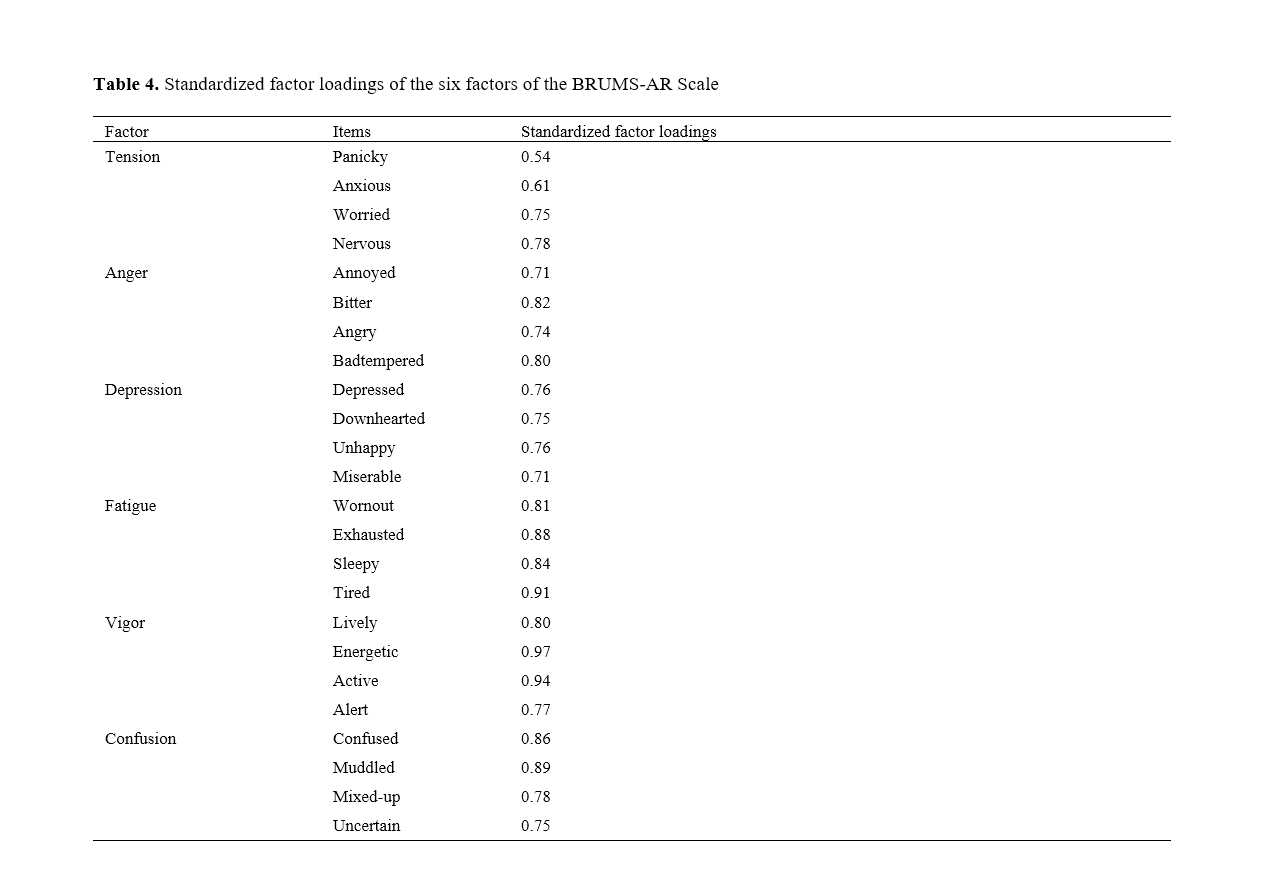
Findings: The internal consistency test of the six subscales showed good Cronbach’s alpha and McDonald’s Omega values, which exceeded adequacy levels for all factors of the BRUMS-AR respectively anger (0.882; 0.884), confusion (0.866; 0.872), depression (0.928; 0.859), fatigue (0.929; 0.893), tension (0.824; 0.825), and vigor (0.909; 0.911). The correlation test Hare positively intercorrelated, however, this factors were negatively correlated with the positive factor (Vigor). The measurement model of the BRUMS-AR was also tested using Confirmatory factor analysis (CFA). Our results showed congruence between the BRUMS-AR and the original model of the BRUMS with overall model fit indices CFI (0.93), TLI (0.92), RMSEA (0.07), and SRMR (0.04).
Conclusion: Our findings affirm the factorial validity and internal consistency of the BRUMS-AR, indicating that it is an appropriate instrument for application within Arabic football players.
Downloads
References
1. Albarracin D, Hart W. Positive mood + action = negative mood + inaction: effects of general action and inaction concepts on decisions and performance as a function of affect. Emotion. 2011;11(4):951-7.
2. Mitchell RL, Phillips LH. The psychological, neurochemical and functional neuroanatomical mediators of the effects of positive and negative mood on executive functions. Neuropsychologia. 2007;45(4):617-29.
3. Watson D, Vaidya J. Mood measurement: Current status and future directions. Handbook of Psychology: Research Methods in Psychology. 2003;2:351-75.
4. Hirschfeld RM, Williams JB, Spitzer RL, Calabrese JR, Flynn L, Keck Jr PE, et al. Development and validation of a screening instrument for bipolar spectrum disorder: The Mood Disorder Questionnaire. American Journal of Psychiatry. 2000;157(11):1873-5.
5. Heuchert JP, McNair DM. Profile of Mood States: Multi-Health Systems; 2012.
6. Terry PC, Lane AM, Lane HJ, Keohane L. Development and validation of a mood measure for adolescents. Journal of Sports Sciences. 1999;17(11):861-72.
7. Terry PC, Lane AM, Fogarty GJ. Construct validity of the Profile of Mood States -Adolescents for use with adults. Psychology of Sport and Exercise. 2003;4(2):125-39.
8. van Wijk CH, Martin JH, Hans-Arendse C. Clinical utility of the Brunel Mood Scale in screening for post-traumatic stress risk in a military population. Military Surgeon. 2013;178(4):372-6.
9. Beedie CJ, Terry PC, Lane AM. The Profile of Mood States and athletic performance: Two meta-analyses. Journal of Applied Sport Psychology. 2000;12(1):49-68.
10. Brandt R, Bevilacqua GG, Andrade A. Perceived sleep quality, mood states, and their relationship with performance among Brazilian elite athletes during a competitive period. Journal of Strength and Conditioning Research. 2016;31(4):1033-9.
11. Brandt R, da Silveira Viana M, Crocetta TB, Andrade A. Association between mood states and performance of Brazilian elite sailors: winners vs. non-winners. Cultura, Ciencia y Deporte. 2016;11(32):119-25.
12. Lane A, Thelwell R, Devonport T. Emotional intelligence and mood states associated with optimal performance. Journal of Applied Psychology. 2009;5(1):67-73.
13. Andrade A, Correia CK, Cruz WMd, Bevilacqua GG. Acute effect of exergames on children's mood states during physical education classes. Games for Health Journal. 2019;8(4):250-6.
14. Hernandez A, Busquets P, Jimenez R, Scanlan J. Mood states and academic performance in the objective structured clinical examination: The mediating effect of self-efficacy. Nurse Education Today. 2024;135:106116.
15. Bartlett L, Martin A, Neil AL, Memish K, Otahal P, Kilpatrick M, et al. A systematic review and meta-analysis of workplace mindfulness training randomized controlled trials. Journal of Occupational Health Psychology. 2019;24(1):108-26.
16. Rohlfs ICPDM, Rotta TM, Luft CDB, Andrade A, Krebs RJ, Carvalho TD. Brunel Mood Scale (BRUMS): an instrument for early detection of overtraining syndrome. Journal of Sport and Exercise Psychology. 2008;14(3):176-81.
17. Valenzuela PL, Amo C, Sánchez-Martínez G, Torrontegi E, Vázquez-Carrión J, Montalvo Z, et al. Enhancement of mood but not performance in elite athletes with transcranial direct-current stimulation. International Journal of Sports Physiology and Performance. 2019;14(3):310-6.
18. Pageaux B, Marcora SM, Rozand V, Lepers R. Mental fatigue induced by prolonged self-regulation does not exacerbate central fatigue during subsequent whole-body endurance exercise. Frontiers in Human Neuroscience. 2015;9:Article 108187.
19. Slimani M, Bragazzi NL. Data concerning the impact of mental fatigue on vigor as measured with the Brunel Mood Scale (BRUMS) in both physically active and trained subjects: A mini meta-analysis. Data in Brief. 2017;13:655-60.
20. Górriz Plumed AB, Prado-Gascó V, Villanueva Badenes L, Ordóñez López A, González Barrón R. The MOOD Questionnaire: Adaptation and validation of the Spanish version. Psicothema. 2013;25(2):252-7.
21. Hasan MM, Khan MHA. Corrigendum "Bangla version of the Brunel Mood Scale (BRUMS): validity, measurement invariance and normative data in non-clinical sample". Heliyon. 2022;8(11):e11749.
22. Lan MF, Lane AM, Roy J, Hanin NA. Validity of the Brunel Mood Scale for use with Malaysian athletes. Journal of Sports Science and Medicine. 2012;11(1):131-5.
23. Sahli H, Sahli F, Saidane M, Rebhi M, Guelmami N, Trabelsi K, et al. Testing the Psychometric Properties of an Arabic Version of the Brunel Mood Scale among Physical Education Students. European Journal of Investigation in Health, Psychology and Education. 2023;13:1539-52.
24. Soylu Y, Arslan E, Kilit B. Psychometric properties of the Brunel Mood Scale in Turkish adults and adolescents athletes. Spormetre Beden Eğitimi ve Spor Bilimleri Dergisi. 2022;20(2):56-67.
25. Vlachopoulos S, Lane AM, Terry PC. A Greek translation of the Brunel mood scale: initial validation among exercise participants and inactive adults. Sports. 2023;11:234.
26. Hernández A, Hidalgo MD, Hambleton RK, Gómez-Benito J. International Test Commission guidelines for test adaptation: A criterion checklist. Psicothema. 2020;32(3):390-8.
27. Kline RB. Principles and practice of structural equation modeling: Guilford Press; 2023.
28. Comrey AL, Lee HB. A first course in factor analysis: Psychology Press; 2013.
29. Lachheb M. The Paradoxes of Women's Football in Tunisia: The Case of the National Team: American University in Cairo Press; 2016. 127-36 p.
30. Wadkar SK, Singh K, Chakravarty R, Argade SD. Assessing the reliability of attitude scale by Cronbach’s alpha. Journal of Global Communication. 2016;9(2):113-7.
31. Tucker L, Lewis C. A reliability coefficient for maximum likelihood factor analysis. Psychometrika. 1973;38(1):1-10.
32. Bentler PM. Comparative fit indexes in structural models. Psychological Bulletin. 1990;107(2):238-46.
33. Hu LT, Bentler PM. Cutoff criteria for fit indexes in covariance structure analysis: Conventional criteria versus new alternatives. Structural Equation Modeling: A Multidisciplinary Journal. 1999;6(1):1-55.
34. Steiger JH. Structural Model Evaluation and Modification: An Interval Estimation Approach. Multivariate Behavioral Research. 1990;25(2):173-80.
35. Browne MW, Cudeck R. Alternative ways of assessing model fit. Sociological Methods & Research. 1992;21(2):230-58.
36. Byrne BM. Structural equation modeling with LISREL, PRELIS, and SIMPLIS: Basic concepts, applications, and programming: Psychology Press; 2013.
37. Diamantopoulos A. Modelling with LISREL: A guide for the uninitiated. Journal of Marketing Management. 1994;10:105-36.
38. Terry PC, Skurvydas A, Lisinskiene A, Majauskiene D, Valanciene D, Cooper S, et al. Validation of a Lithuanian-Language Version of the Brunel Mood Scale: The BRUMS-LTU. International Journal of Environmental Research and Public Health. 2022;19(8):4867.
39. Květon P, Jelínek M, Burešová I, Bartošová K. Czech adaptation of the Brunel Mood States for adolescent athletes. 14. 2020(1):47-57.
40. De Almeida FR, da Silva CB, Vendramini CMM, de Campos C, Brandão MRF. Psychometric properties of the Brazilian version of the BRUMS scale for basketball referees. Revista de Psicologia Del Deporte. 2018;27(4):37-44.
41. Zhang CQ, Si G, Chung PK, Du M, Terry PC. Psychometric properties of the Brunel Mood Scale in Chinese adolescents and adults. Journal of Sports Sciences. 2014;32(15):1465-76.
42. Bagherpour T, Hashim HA, Saha S. Factorial Validity and Internal Consistency of Iranian Adapted Brunel Mood Scale among Iranian Young Female Taekwondo Athletes 2013.
43. Terry PC, Malekshahi M, Delva HA. Development and initial validation of the Farsi Mood Scale. International Journal of Sport and Exercise Psychology. 2012;10(2):112-22.
44. Tueller S, Johnson KL, Grimm KJ, Desmarais SL, Sellers BG, Van Dorn RA. Effects of sample size and distributional assumptions on competing models of the factor structure of the PANSS and BPRS. International Journal of Methods in Psychiatric Research. 2017;26(4):Article e1549.
45. Rouquette A, Falissard B, Falissard B. Sample size requirements for the internal validation of psychiatric scales. International Journal of Methods in Psychiatric Research. 2011;20(4):235-49.
46. Anthoine E, Moret L, Regnault A, Sébille V, Hardouin JB. Sample size used to validate a scale: a review of publications on newly-developed patient reported outcomes measures. Health and Quality of Life Outcomes. 2014;12(1):176.
47. Lakens D. Sample size justification. Collabra: Psychology. 2022;8(1):Article 33267.
48. Cruchinho P, López-Franco MD, Capelas ML, Almeida S, Bennett PM, da Silva MM, et al. Translation, Cross-Cultural Adaptation, and Validation of Measurement Instruments: A Practical Guideline for Novice Researchers. Journal of Multidisciplinary. 2024;17:2701-28.
Downloads
Additional Files
Publication Timeline
Issue
Section
License
Copyright (c) 2025 Aymen Yacoubi, Chedlia Fitouri, samah Kamal Mohamed Mahmoud, Haitham Jahrmai , Imed laatiri , Karim Chamari (Author)

This work is licensed under a Creative Commons Attribution-NonCommercial 4.0 International License.