Psychological Readiness after Injury and Its Impact on Fear of Return and Re-injury in Young Football Players
DOI:
https://doi.org/10.61838/kman.intjssh.8.3.7Keywords:
Psychological readiness, Fear of returning to sports, Fear of re-injury, FootballAbstract
Objective: Research on sports injuries has traditionally focused on physical factors; however, injuries can also have significant psychological impacts on athletes. It is commonly assumed that physical and psychological recoveries occur simultaneously. Given the importance of psychological factors following injury, this study aimed to examine the impact of psychological readiness on the fear of returning to training and competition, as well as the fear of re-injury, among young football players.
Methods and Materials: A total of 265 young football players aged 17 to 25 from Mashhad, Iran, participated in this cross-sectional, descriptive-correlational study. Data were collected using measures of psychological readiness after a serious injury, fear of returning to sport post-injury, and fear of re-injury.
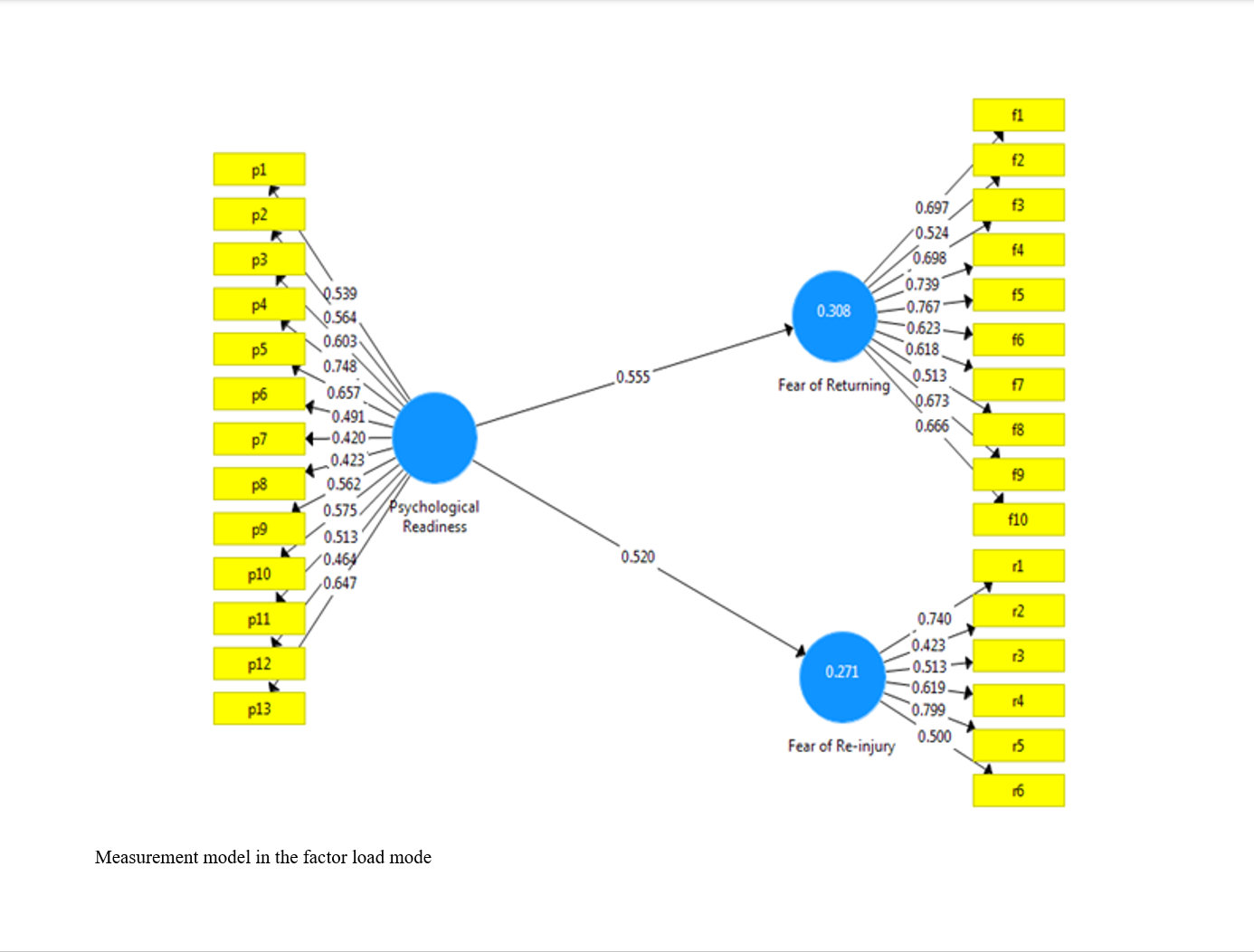
Findings: The findings indicated that psychological readiness significantly predicts fear of returning to sport and fear of re-injury, with effect sizes of 0.55 and 0.52, respectively. The t-statistics for these pathways were 9.21 (p = 0.002) and 9.20 (p = 0.001), demonstrating strong statistical significance.
Conclusion: Our findings suggest that sports coaches should collaborate with sports psychologists and maintain effective communication with the families of injured athletes. Such support can enhance athletes' psychological readiness, thereby reducing their fears related to returning to sport and re-injury.
Downloads
References
1. Mok KM. Reliability and methodological concerns of vertical drop jumping and sidestep cutting tasks: implications for ACL injury risk screening 2015.
2. Heijne A, Axelsson K, Werner S, Biguet G. Rehabilitation and recovery after anterior cruciate ligament reconstruction: patients' experiences. Scandinavian Journal of Medicine and Science in Sports. 2008;18(3):325EP - 35. [DOI]
3. Johnston LHAUCD. The context of emotional responses to athletic injury: a qualitative analysis. Journal of Sport Rehabilitation. 1998;7(3):206-20. [DOI]
4. Palmi J. Psicologia y lesión deportiva: Una breve introducción [Sports injuries and psychology: A brief introduction]. Revista de Psicología del Deporte. 2014;23(2):389-93.
5. Emery CA, Pasanen K. Current trends in sport injury prevention. Best Practice & Research Clinical Rheumatology. 2019;33:3-15. [DOI]
6. O'Brien J, Finch CF, Pruna R, McCall A. A new model for injury prevention in team sports: The Team-sport injury prevention (TIP) cycle. Science and Medicine in Football. 2019;3(12):1-4. [DOI]
7. Kvist J, Silbernagel KG. Fear of movement and reinjury in sports medicine: Relevance for rehabilitation and return to sport. Physical Therapy. 2022;102(2). [DOI]
8. Baez SE, Hoch MC, Hoch JM. Psychological factors are associated with return to pre-injury levels of sport and physical activity after ACL reconstruction. Knee Surgery Sports Traumatology Arthroscopy. 2020;28(2):495-501. [DOI]
9. Goddard K, Roberts CM, Byron-Daniel J, Woodford L. Psychological factors involved in adherence to sport injury rehabilitation: A systematic review. International Review of Sport and Exercise Psychology. 2020;14(2):1-23. [DOI]
10. Hsu CJ, Meierbachtol A, George SZ, Chmielewski TL. Fear of reinjury in athletes: implications for rehabilitation. Sports Health. 2017;9(2):162-7DO - 10.1177/1941738116666813.
11. Kunnen M, Dionigi RA, Litchfield C, Moreland A. My desire to play was stronger than my fear of re-injury': athlete perspectives of psychological readiness to return to soccer following anterior cruciate ligament reconstruction surgery. Annals of Leisure Research. 2020;23(1):1-15. [DOI]
12. Ardern CL, Webster KE, Taylor NF, Feller JA. Return to sport following anterior cruciate ligament reconstruction surgery: a systematic review and meta-analysis of the state of play. British Journal of Sports Medicine. 2011;45(7):596-606. [DOI]
13. Green B, Lin M, McClelland JA, Semciw AI, Schache AG, Rotstein AH, et al. Return to Play and Recurrence After Calf Muscle Strain Injuries in Elite Australian Football Players. American Journal of Sports Medicine. 2020;48(13):3306-15. [DOI]
14. Conti C, di Fronso S, Pivetti M, Robazza C, Podlog L, Bertollo M. Well-Come Back! Professional Basketball Players Perceptions of Psychosocial and Behavioral Factors Influencing a Return to Pre-injury Levels. Frontiers in Psychology. 2019;10SP - 222. [DOI]
15. Heil J. The injured athlete. Emotion in sport. Champaign, IL: Human Kinetics; 2000. p. 245-65[DOI]
16. Mozafarizadeh M, Heidari F, Khabiri M. The Effect of a Mind fullness-Based Training Program on Sport Injury Anxiety and Performance of Soccer Players. Journal of Rehabilitation Medicine. 2019;8(1):95EP - 108.
17. Trigsted SM, Cook DB, Pickett KA, Cadmus-Bertram L, Dunn WR, Bell DR. Greater fear of reinjury is related to stiffened jump-landing biomechanics and muscle activation in women after ACL reconstruction. Knee Surgery, Sports Traumatology, Arthroscopy. 2018;26(12):3682-9. [DOI]
18. Afsharnezhad T, Rezaie S, Yousefzadeh S. The Relationship between Fear of Movement and Pain Intensity with Physical Disability in Chronic Lew-Back Pain PatientsJO - Archives of Rehabilitation. 2010;11(2):21-8.
19. Khatibi A, Dehghani M, Alizadeh K. The role of fear of movement in chronicity of pain among musculoskeletal pain patients Behavioral Science Research. 2008;6(2):69-78. [DOI]
20. Lethem J, Slade P, Troup J, Bentley G. Outline of a fear-avoidance model of exaggerated pain perception-I. Behaviour Research and Therapy. 1983;21(4):401-8. [DOI]
21. Vlaeyen JW, Linton SJ. Fear-avoidance and its consequences in chronic musculoskeletal pain: a state of the art. Pain. 2000;85(3):317-32. [DOI]
22. Kori S. Kinisophobia: a new view of chronic pain behavior. Pain Management. 1990;3:35-43.
23. Vlaeyen JW, Kole-Snijders AM, Boeren RG, Van Eek H. Fear of movement/(re) injury in chronic low back pain and its relation to behavioral performance. Pain. 1995;62(3):363-72. [DOI]
24. Casey CY, Greenberg MA, Nicassio PM, Harpin RE, Hubbard D. Transition from acute to chronic pain and disability: a model including cognitive, affective, and trauma factors. Pain. 2008;134(1-2):69-79. [DOI]
25. Brewer BW. Review and critique of models of psychological adjustment to athletic injury. Journal of applied sport psychology. 1994;6(1SP - 87):100. [DOI]
26. Albinson CB, Petrie TA. Cognitive appraisals, stress, and coping: Preinjury and postinjury factors influencing psychological adjustment to sport injury. Journal of Sport Rehabilitation. 2003;12(4):306-22. [DOI]
27. Kvist J, Ek A, Sporrstedt K, Good L. Fear of re-injury: a hindrance for returning to sports after anterior cruciate ligament reconstruction. Knee surgery, sports traumatology, arthroscopy. 2005;13(5):393-7. [DOI]
28. Apkarian AV, Bushnell MC, Treede RD, Zubieta JK. Human brain mechanisms of pain perception and regulation in health and disease. European journal of pain. 2005;9(4):463-84. [PMID: 15979027] [DOI]
29. Cervero F. Understanding pain: exploring the perception of pain: MIT Press; 2012. [DOI]
30. Khatibi A, Dehghani M, Sharpe L, Asmundson GJ, Pouretemad H. Selective attention towards painful faces among chronic pain patients: evidence from a modified version of the dot-probe. Pain. 2009;142(1-2):42-7. [DOI]
31. Bardel MH, Woodman T, Perreaut-Pierre E, Barizien N. The role of athletes' pain-related anxiety in pain-related attentional processesJO - Anxiety, Stress & Coping. 2013;26(5):573-83. [DOI]
32. Razi M, Sadeghi H, Ebrahimi Takamejani E, Shariatzade M. Effect of Lower Limb Muscle Fatigue on Knee Joint Control Strategies during Landing in Young Men. Journal of Rehabilitation Medicine. 2018;7(2):1-10. [DOI]
33. Gómez-Piqueras P, Ardern C, Prieto-Ayuso A, Robles-Palazón FJ, Cejudo A, Sanz de Baranda P, et al. Psychometric analysis and effectiveness of the Psychological Readiness of Injured Athlete to Return to Sport (PRIA-RS) questionnaire on injured soccer players. International Journal of Environmental Research and Public Health. 2020;17(5):1536. [DOI]
34. Webster KE, Feller JA, Lambros C. Development and preliminary validation of a scale to measure the psychological impact of returning to sport following anterior cruciate ligament reconstruction surgery. Physical Therapy in Sport. 2008;9(1):9-15. [DOI]
35. Risberg MA, Holm I, Myklebust GAUEL. Neuromuscular training versus strength training during first 6 months after anterior cruciate ligament reconstruction: A randomized clinical trial. Physical Therapy. 2007;87:737-50. [DOI]
36. Ardern CL, Österberg A, Tagesson S, Gauffin H, Webster KE, Kvist J. The impact of psychological readiness to return to sport and recreational activities after anterior cruciate ligament reconstruction. British Journal of Sports Medicine. 2014;48(22):1613-9. [DOI]
37. Nwachukwu BU, Adjei J, Rauck RC, Chahla JAUOKR, Verma NN, Allen AA, et al. How much do psychological factors affect lack of return to play after anterior cruciate ligament reconstruction? A systematic review. Orthopaedic Journal of Sports Medicine. 2019;7(5):2325967119845313. [DOI]
38. Ross MD. The relationship between functional levels and fearavoidance beliefs following anterior cruciate ligament reconstruction. Journal of Orthopaedics and Traumatology. 2010;11(4):237-43. [DOI]
39. Lentz TA, Zeppieri G, Jr., George SZ, Tillman SM, Moser MW, Farmer KW, et al. Comparison of physical impairment, functional, and psychosocial measures based on fear of reinjury/lack of confidence and return-to-sport status after ACL reconstruction. The American Journal of Sports Medicine. 2015;43(2):345-53. [DOI]
40. Gennarelli SM, Brown SM, Mulcahey MK. The Physician and sportsmedicine. 2020;48(1):370-7. [DOI]
41. Lentz TA, Paterno MV, Riboh JC. So you think you can return to sport? British Journal of Sports Medicine. 2018;52(23):1482-3. [DOI]
42. Paterno MV, Rauh MJ, Schmitt LC, Ford KR, Hewett TE. Incidence of contralateral and ipsilateral anterior cruciate ligament (ACL) injury after primary ACL reconstruction and return to sportJO - Clinical Journal of Sport Medicine. 2012;22(2):116-21. [DOI]
43. Webster KE, Feller JA, Leigh WB, Richmond AK. Younger patients are at increased risk for graft rupture and contralateral injury after anterior cruciate ligament reconstructi. The American Journal of Sports medicine. 2014;42(3):641-7. [DOI]
44. Wiggins AJ, Ravi KG, Daniel KS, Denver S, Kate EW, Gregory DM. Risk of Secondary Injury in Younger Athletes after Anterior Cruciate Ligament Reconstruction: A Systematic Review and Meta-analysis. The American Journal of Sports Medicine. 2016;44(7):1861-76. [DOI]
45. Zhang M, Liu J, Jia Y, Zhang G, Zhou J, Wu D, et al. Risk factors for recurrence after bankart repair: A systematic review and meta-analysis. Journal of Orthopaedic Surgery and Research. 2022;17(1):113. [DOI]
46. McPherson AL, Feller JA, Hewett TE, Webster KE. Psychological Readiness to Return to Sport Is Associated With Second Anterior Cruciate Ligament Injuries. The American Journal of Sports Medicine. 2019;47(4):857-62. [DOI]
47. Turk RS, S., Chilton M, Thomas TL, Anene C, Mousad A, Le Breton S, et al. Return to Sport After Anterior Cruciate Ligament Reconstruction Requires Evaluation of >2 Functional Tests, Psychological Readiness, Quadriceps/Hamstring Strength, and Time After Surgery of 8 Months. Arthroscopy. 2023;39(3):790-801.e6. [DOI]
48. Sheean AJ, Lubowitz JH, Brand JC, Rossi MJ. Psychological Readiness to Return to Sport: Fear of Reinjury Is the Leading Reason for Failure to Return to Competitive Sport and Is Modifiable. Arthroscopy. 2023;39(8SP - 1775):1778. [DOI]
49. Gómez-Piqueras P, Ortega JM, Sainz de Baranda P. A propósito del "Return to play" en futbolistas lesionados. Apunts De Med De L'Esport. 2013;48:121-2. [DOI]
50. O'Brien M, Howell DR, Pepin MJ, Meehan WP. Sport-related concussions symptom recurrence after return to exercise. Orthopaedic Journal of Sports Medicine. 2017;5. [DOI]
51. Tjong VK, Baker HP, Cogan CJ, Montoya M, Lindley TR, Terry MA. Concussions in NCAA varsity football athletes: A qualitative investigation of player perception and return to sport. Journal of the American Academy of Orthopaedic Surgeons Global Research and Reviews. 2017;1:e070. [DOI]
52. Feller J, Webster KE. Return to sport following anterior cruciate ligament reconstruction. International Orthopaedics. 2013;37(2):285-90. [DOI]
53. Ivarsson A, Johnson U, Podlog L. Psychological predictors of injury occurrence: a prospective investigation of professional Swedish soccer players. Journal of Sport Rehabilitation. 2013;22(1):19-26. [DOI]
54. Takeshita S, Tanaka Y, Kita K, Amano H, Sato N, Horibe S. Influence of the psychological factor on return to sports after ACL reconstruction in the competitive level athletes. Knee Surgery Sports Traumatology Arthroscopy. 2016;28:2203-12. [DOI]
55. Forsdyke D, Gledhill A, Ardern C. Psychological readiness to return to sport: Three key elements to help the practitioner decide whether the athlete is really ready? British Journal of Sports Medicine. 2017;51:555-6. [DOI]
56. Webster KE, Feller JA. Development and validation of a short version of the anterior cruciate ligament return to sport after injury (ACL-RSI) scale. Orthopaedic Journal of Sports Medicine. 2018;6(4). [DOI]
57. Webster KE, Feller JA, Whitehead TS, Myer GD, Merory PB. Return to sport in the younger patient with anterior cruciate ligament reconstruction. Orthopaedic Journal of Sports Medicine. 2017;5(4). [DOI]
58. Lai CCH, Ardern CL, Feller JA, Webster KE. Eighty-three percent of elite athletes return to preinjury sport after anterior cruciate ligament reconstruction: A systematic review with meta-analysis of return to sport rates, graft rupture rates and performance outcomes. British Journal of Sports Medicine. 2018;52:128-38. [DOI]
59. Welling W, Benjaminse A, Seil R, Lemmink K, Zafagnini S, Gokeler A. Low rates of patients meeting return to sport criteria 9 months after anterior cruciate ligament reconstruction: A prospective longitudinal study. Knee Surgery Sports Traumatology Arthroscopy. 2018;26:3636-44. [DOI]
60. Werner JL, Burland JP, Mattacola CG, Toonstra J, English RA, Howard JS. Decision to return to sport participation after anterior cruciate ligament reconstruction, part II: Self-reported and functional performance outcomes. Journal of Athletic Training. 2018;53(5):464-74. [DOI]
61. Kaplan Y, Witvrouw E. When is it safe to return to sport after ACL reconstruction? Rev Criteria Sports Health. 2019;11:301-5. [DOI]
62. Gómez-Piqueras P, Sainz de Baranda P, Ortega E, Contreras O, Olmedilla A. Design and validation of a questionnaire on the perception of the athlete regarding his return to training after injury. Revista de Psicologia del Deporte. 2014;23(2):479-87.
63. Glazer DD. Development and preliminary validation of the Injury-Psychological Readiness to Return to Sport (I-PRRS) scale. Journal of Athletic Training. 2009;44(2):185-9. [DOI]
64. Hair JF, Black W, Babin BJ, Anderson RE. Multivariate data analysis: A global perspective. Upper Saddle River, New Jersey: Pearson; 2010.
65. Podlog L, Eklund RC. Return to sport after serious injury: a retrospective examination of motivation and psychological outcomes. Journal of Sport Rehabilitation. 2005;14(1):20-34. [DOI]
66. Miller RP, Kori SH, Todd DD. The Tampa Scale a Measure of Kinisophobia. The Clinical Journal of Pain. 1991;7(1):51. [DOI]
67. Hair JF, Hult GTM, Ringle CM, Sarstedt M, Danks NP, Ray S. Partial least squares structural equation modeling (PLS-SEM) using R: A workbook: Springer Nature; 2021. 197 p[DOI]
68. Gomez-Espejo V, Ortega E, Gonzalez-Reyes A, Olmedilla A. Return to Play (RTP) and psychological aspects associated: A systematic review. Journal of Sport Psychology. 2018;27:143-1154. [DOI]
69. Burland JP, Toonstra J, Werner JL, Mattacola CG, Howell DM, Howard JS. Decision to Return to Sport After Anterior Cruciate Ligament Reconstruction, Part I: A Qualitative Investigation of Psychosocial Factors. Journal of Athletic Training. 2018;53(5):452-63. [DOI]
70. Grant T. The Effect of Psychological Response on Recovery of Sport Injury: A Review of the Literature. The College at Brockport, State University of New York2018.
71. Monahan AC. Psychological Readiness of Athletes to Return to Play Following Injury 2018.
72. Podlog L, Heil J, Schulte S. Psychosocial factors in sports injury rehabilitation and return to play. 252014. p. 915-30[DOI]
73. Ardern CL, Taylor NF, Feller JA, Webster KE. A systematic review of the psychological factors associated with returning to sport following injury. British Journal of Sports Medicine. 2012;47(17):1120-6. [DOI]
74. Fältström A, Kvist J, Bittencourt NFN, Mendonça LD, Hägglund M. Clinical Risk Profile for a Second Anterior Cruciate Ligament Injury in Female Soccer Players After Anterior Cruciate Ligament Reconstruction. The American Journal of Sports Medicine. 2021;49(6):1421-30. [DOI]
75. Rodriguez RM, Marroquin A, Cosby N. Reducing Fear of Reinjury and Pain Perception in Athletes With First-Time Anterior Cruciate Ligament Reconstructions by Implementing Imagery Training. Journal of Sport Rehabilitation. 2019;28(4):385-9. [DOI]
76. Christino MA, Fleming BC, Machan JT, Shalvoy RM. Psychological factors associated with anterior cruciate ligament reconstruction recovery. Orthopaedic Journal of Sports Medicine. 2016;4(3). [DOI]
77. Beglar K, Alizadeh MH, Khabiri M, Tahmasebi F, Ghelichpoor Dashliboroon B. The relationship between psychological skills and injuries severity of Tehran teams soccer players participating in premier league of Iran. Research in Sports Management and Motor Behavior. 2013;3(6):15-27.
Downloads
Additional Files
Publication Timeline
Issue
Section
License
Copyright (c) 2025 Mojtaba Amiri, Martin Hofmeister, Reza Aminzadeh, Hamid Nejat (Author); Bahador Azizi (Corresponding Author); Elham Dehghani, Mohammad Khazaei, Katarzyna Dzioban (Author)

This work is licensed under a Creative Commons Attribution-NonCommercial 4.0 International License.