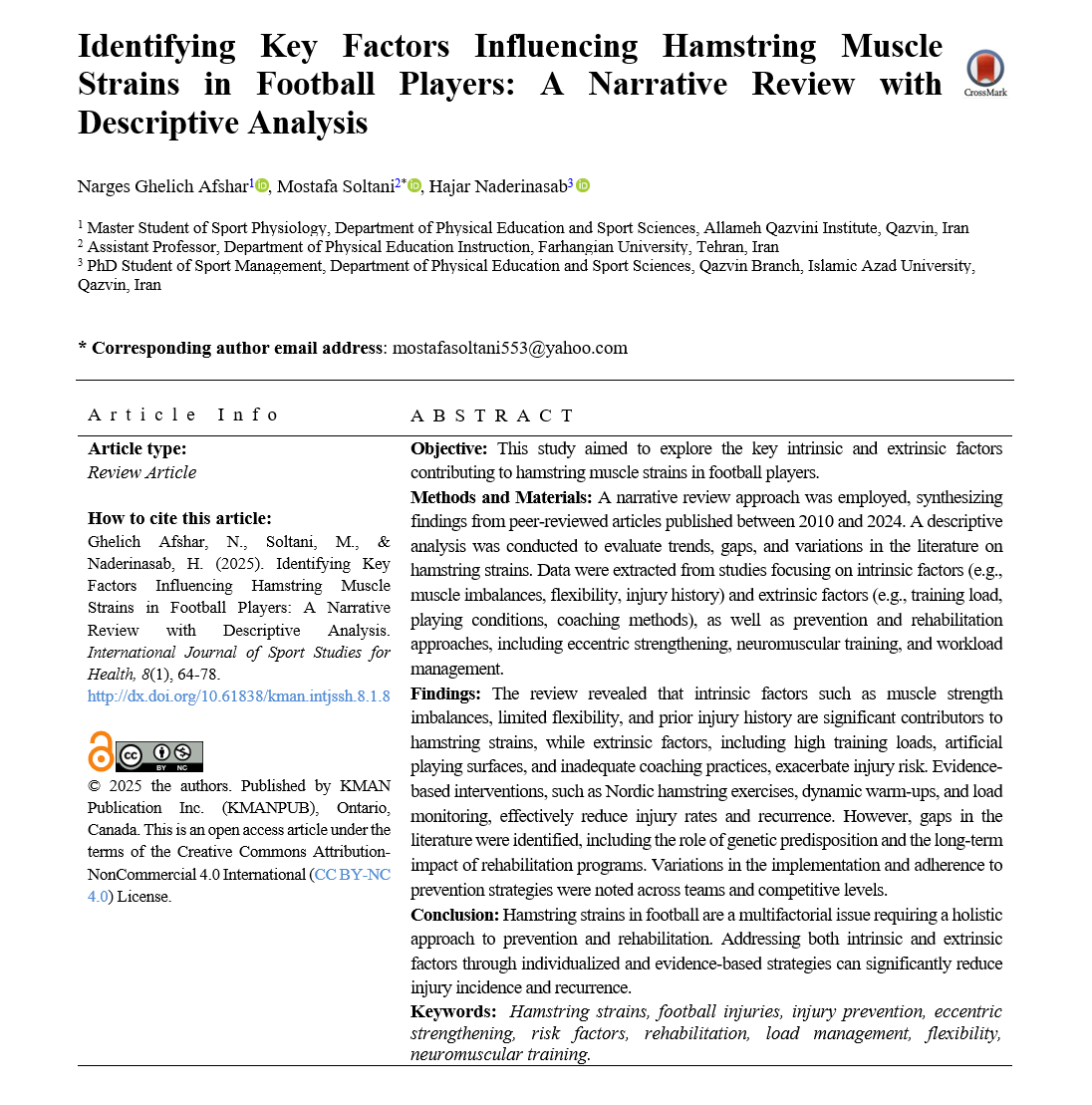
Identifying Key Factors Influencing Hamstring Muscle Strains in Football Players: A Narrative Review with Descriptive Analysis
DOI:
https://doi.org/10.61838/kman.intjssh.8.1.8Keywords:
Hamstring strains, football injuries, injury prevention, eccentric strengthening, risk factors, rehabilitation, load management, flexibility, neuromuscular trainingAbstract
Objective: This study aimed to explore the key intrinsic and extrinsic factors contributing to hamstring muscle strains in football players.
Methods and Materials: A narrative review approach was employed, synthesizing findings from peer-reviewed articles published between 2010 and 2024. A descriptive analysis was conducted to evaluate trends, gaps, and variations in the literature on hamstring strains. Data were extracted from studies focusing on intrinsic factors (e.g., muscle imbalances, flexibility, injury history) and extrinsic factors (e.g., training load, playing conditions, coaching methods), as well as prevention and rehabilitation approaches, including eccentric strengthening, neuromuscular training, and workload management.
Findings: The review revealed that intrinsic factors such as muscle strength imbalances, limited flexibility, and prior injury history are significant contributors to hamstring strains, while extrinsic factors, including high training loads, artificial playing surfaces, and inadequate coaching practices, exacerbate injury risk. Evidence-based interventions, such as Nordic hamstring exercises, dynamic warm-ups, and load monitoring, effectively reduce injury rates and recurrence. However, gaps in the literature were identified, including the role of genetic predisposition and the long-term impact of rehabilitation programs. Variations in the implementation and adherence to prevention strategies were noted across teams and competitive levels.
Conclusion: Hamstring strains in football are a multifactorial issue requiring a holistic approach to prevention and rehabilitation. Addressing both intrinsic and extrinsic factors through individualized and evidence-based strategies can significantly reduce injury incidence and recurrence.
Downloads
References
1. Ekstrand J, Hallén A, Marin V, Gauffin H. Most
Modifiable Risk Factors for Hamstring Muscle Injury in
Women’s Elite Football Are Extrinsic and Associated With the
Club, the Team, and the Coaching Staff and Not the Players
Themselves: The UEFA Women’s Elite Club Injury Study.
Knee Surgery Sports Traumatology Arthroscopy.
2023;31(7):2550-5. [PMID: 37121935] [PMCID:
PMC10275795] [DOI]
2. Ekstrand J, Healy JC, Waldén M, Lee JC, English B,
Hägglund M. Hamstring Muscle Injuries in Professional
Football: The Correlation of MRI Findings With Return to Play.
British Journal of Sports Medicine. 2011;46(2):112-7. [PMID:
22144005] [DOI]
3. Ekstrand J, Waldén M, Hägglund M. Hamstring
Injuries Have Increased by 4% Annually in Men's Professional
Football, Since 2001: A 13-Year Longitudinal Analysis of the
UEFA Elite Club Injury Study. British Journal of Sports
Medicine. 2016;50(12):731-7. [PMID: 26746908] [DOI]
4. Bahr R, Thorborg K, Ekstrand J. Evidence-Based
Hamstring Injury Prevention Is Not Adopted by the Majority of
Champions League or Norwegian Premier League Football
Teams: The Nordic Hamstring Survey. British Journal of Sports
Medicine. 2015;49(22):1466-71. [PMID: 25995308] [DOI]
5. Correia PF, Santos P, Mil‐Homens P, Gomes M, Dias
A, Valamatos MJ. Rapid Hamstrings to Quadriceps Ratio at
Long Muscle Lengths in Professional Football Players With
Previous Hamstring Strain Injury. European Journal of Sport
Science. 2020;20(10):1405-13. [PMID: 31917646] [DOI]
6. Grazioli R, López P, Andersen LL, Machado CLF,
Pinto MD, Cadore EL, et al. Hamstring Rate of Torque
Development Is More Affected Than Maximal Voluntary
Contraction After a Professional Soccer Match. European
Journal of Sport Science. 2019;19(10):1336-41. [PMID:
31099729] [DOI]
7. Kamandulis S. The Effects of High-Velocity
Hamstring Muscle Training on Injury Prevention in Football
Players. Frontiers in Physiology. 2023;14. [PMID: 37670769]
[PMCID: PMC10475598] [DOI]
8. Gee T. The Relationship Between Acute: Chronic
Workload Ratio of High-Speed Running and Hamstring Injuries
in Professional Footballers. International Journal of Strength
and Conditioning. 2022;2(1). [DOI]
9. Duhig S, Shield A, Opar DA, Gabbett TJ, Ferguson C,
Williams M. Effect of High-Speed Running on Hamstring
Strain Injury Risk. British Journal of Sports Medicine.
2016;50(24):1536-40. [PMID: 27288515] [DOI]
10. Lovell R, Knox MF, Weston M, Siegler J, Brennan
SL, Marshall PW. Hamstring Injury Prevention in Soccer:
Before or After Training? Scandinavian Journal of Medicine
and Science in Sports. 2017;28(2):658-66. [PMID: 28544170]
[DOI]
11. Mizutani Y, Taketomi S, Kawaguchi K, Takei S,
Yamagami R, Kono K, et al. Risk Factors for Hamstring Strain
Injury in Male College American Football Players -a
Prospective Cohort Study. 2023. [DOI]
12. Moreno-Pérez V, Coso JD, Campo RL, Resta R,
Romero-Sangüesa J, Courel-Ibáñez J, et al. Reduced Match
Exposure in the Previous 2 Matches Accounts for Hamstring
Muscle Injury Incidence in Professional Football Players.
Sports Health a Multidisciplinary Approach. 2023;16(1):109-
14. [PMID: 36896682] [PMCID: PMC10732102] [DOI]
13. Moreno-Pérez V, Madruga-Parera M, RomeroRodríguez D, Sánchez-Sánchez J, Felipe JL, Marcè-Hernández
L, et al. Eccentric Hamstring Muscle Strength During Home
Confinement Due to the COVID-19 Pandemic, and Football
Competition Resumption in Professional Football Referees: A
Prospective Observational Study. International Journal of
Environmental Research and Public Health. 2021;18(18):9737.
[PMID: 34574662] [PMCID: PMC8471918] [DOI]
14. Moreno-Pérez V, Rodas G, Peñaranda-Moraga M,
López-Samanés Á, Romero-Rodríguez D, Aagaard P, et al.
Effects of Football Training and Match-Play on Hamstring
Muscle Strength and Passive Hip and Ankle Range of Motion
During the Competitive Season. International Journal of
Environmental Research and Public Health. 2022;19(5):2897.
[PMID: 35270589] [PMCID: PMC8909953] [DOI]
15. Shah S, Collins K, Macgregor LJ. The Influence of
Weekly Sprint Volume and Maximal Velocity Exposures on
Eccentric Hamstring Strength in Professional Football Players.
Sports. 2022;10(8):125. [PMID: 36006091] [PMCID:
PMC9414047] [DOI]
16. Roe M, Delahunt E, McHugh MP, Gissane C, Malone
S, Collins K, et al. Association Between Eccentric Knee Flexor
Strength and Hamstring Injury Risk in 185 Elite Gaelic Football
Players. Scandinavian Journal of Medicine and Science in
Sports. 2020;30(3):515-22. [PMID: 31663638] [DOI]
17. Roe M, Murphy J, Gissane C, Blake C. Hamstring
Injuries in Elite Gaelic Football: An 8-Year Investigation to
Identify Injury Rates, Time-Loss Patterns and Players at
Increased Risk. British Journal of Sports Medicine.
2016;52(15):982-8. [PMID: 27797729] [DOI]
18. Aditya A. Effectiveness of Active Releasing
Technique vs Mulligan Bent Leg Raise for Footballers With
Hamstring Tightness. Interantional Journal of Scientific
Research in Engineering and Management. 2023;07(09). [DOI]
19. Dulera JK, Bhura P. Immediate Effect of Neural
Mobilization on Hamstring Flexibility and Functional
Performance Among Football Players in Vadodara. Pijr.
2021:37-40. [DOI]
20. Espinosa GdA, Pöyhönen T, Aramendi JF, Samaniego
JC, Knorr J, Kyröläinen H. Effects of an Eccentric Training
Programme on Hamstring Strain Injuries in Women Football
Players. Biomedical Human Kinetics. 2015;7(1). [DOI]
Downloads
Additional Files
Publication Timeline
Issue
Section
License
Copyright (c) 2024 Naeges Ghilich Afshar , Mostafa Soltani , Hajar Naderinasab (Author)

This work is licensed under a Creative Commons Attribution-NonCommercial 4.0 International License.